

It is called a coffee table because it provides a convenient surface for coffee and other refreshments beside a seating area. Today’s coffee tables serve many additional purposes, from holding books to concealing everyday clutter, but the familiar name still describes the table’s relationship to relaxed sitting and serving. It identifies a type of living-room furniture rather than requiring a particular drink, shape, or material.
The history needs a little care. Older tables used for serving drinks are part of the background, but they are not all the same as the low table now placed in front of a sofa. Separating the name, the furniture form, and the social habit gives a clearer answer than assigning the entire invention to one person.
Table of Contents
What the name tells you about its purpose
In ordinary use, a coffee table is a shared occasional surface within a seating group. It is usually lower than a dining table and positioned where seated people can reach it. The word coffee points to serving and hospitality, while table identifies the practical surface that supports those activities.
The name does not mean the table was designed only for coffee. Tea, water, snacks, a magazine, and a remote control all fit the same general role: keeping small items close during informal time in the living room. A household that never drinks coffee can still have a perfectly ordinary coffee table.
This relationship to seating is more useful than a rigid measurement. Tables vary in height and size because sofas and rooms vary too. A low, broad table in front of a sofa and a small table beside a chair may both hold a mug, but their placement and shared use lead people to describe them differently.
How drink-serving furniture fits into the history
The Victoria and Albert Museum describes tea drinking in early eighteenth-century Britain as a domestic social ritual supported by specialized equipment. Its discussion includes tea tables and elaborate serving wares. That background shows how beverages helped shape furniture and household arrangements before the modern coffee table became familiar.
It does not prove that a tea table was simply renamed a coffee table. Furniture forms can share a serving function while differing in height, construction, placement, and period. A table brought into a room for a tea service should not automatically be treated as identical to a permanent low table in a contemporary seating group.
The safest historical distinction is therefore between antecedents and the recognizable modern form. Drink-serving tables provide context. The low living-room table has its own development, connected with the way homes arranged informal seating and shared surfaces.
When did the modern coffee table become established?
The Milwaukee Art Museum’s exhibition Tea Table Coffee Table places the emergence of the American coffee table in the 1920s. It distinguishes the form by its lower, informal proportions and generous surface, and describes its importance in the mid-century American living room.
That account supports a useful timeline without settling every worldwide origin claim. It is evidence about the American development of the familiar form, not proof of the first low table anywhere or the first written use of the phrase. Claims naming a single universal inventor need stronger, more specific documentation.
The practical change is easy to understand: a table positioned within an informal seating group serves people who remain seated. It can hold refreshments while conversation continues and provide a common surface between several seats. That role helps explain why the object stayed useful as interiors and leisure habits changed.
Coffee table, tea table, cocktail table: what is the difference?
Term | Usual meaning | What to check when shopping |
Coffee table | A low shared table in a living-room seating area | Height, reach, shape, and circulation |
Tea table | A term with historical serving associations, also used descriptively today | Actual dimensions and intended placement |
Cocktail table | Often used commercially for a similar living-room table | Whether the listing describes a low table or another serving format |
Side table | A smaller surface beside a seat | Reach from that seat and room for a lamp or drink |
Retail terminology is not a universal technical standard. A seller might use coffee table and cocktail table for similar products, while another might use a term to signal a particular style. Read the dimensions and functions rather than assuming the label guarantees a shape or period.
Likewise, a round table is not automatically a tea table, and a rectangular one is not automatically a cocktail table. Form and naming overlap. What matters in a present-day room is whether the table serves the people and seating arrangement around it.
Why the name survives as functions change
A coffee table can now contain drawers, lift to a higher position, or become a temporary work surface. These additions do not erase its ordinary closed position in the living room. The name remains useful because people recognize the furniture’s main location and everyday role.
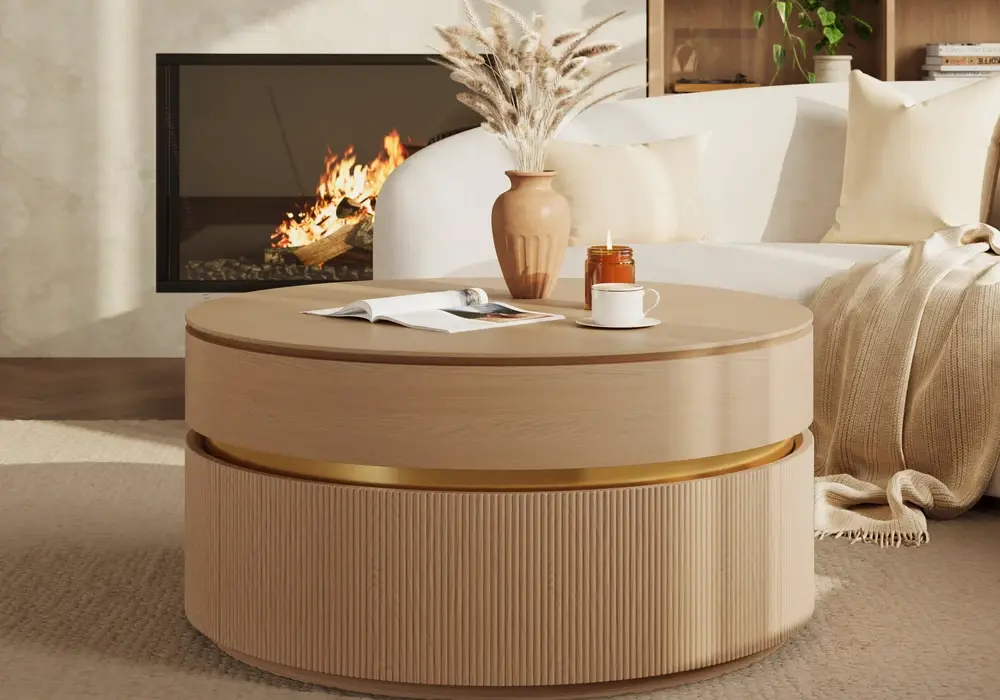
Consider Homary’s 32" (813 mm) Round Fluted Lift-Top Hidden Storage Coffee Table. The listing describes a circular lift-top design with hidden storage and a surface that can support occasional work. It illustrates how a coffee table can change position for another activity while remaining part of the seating area.
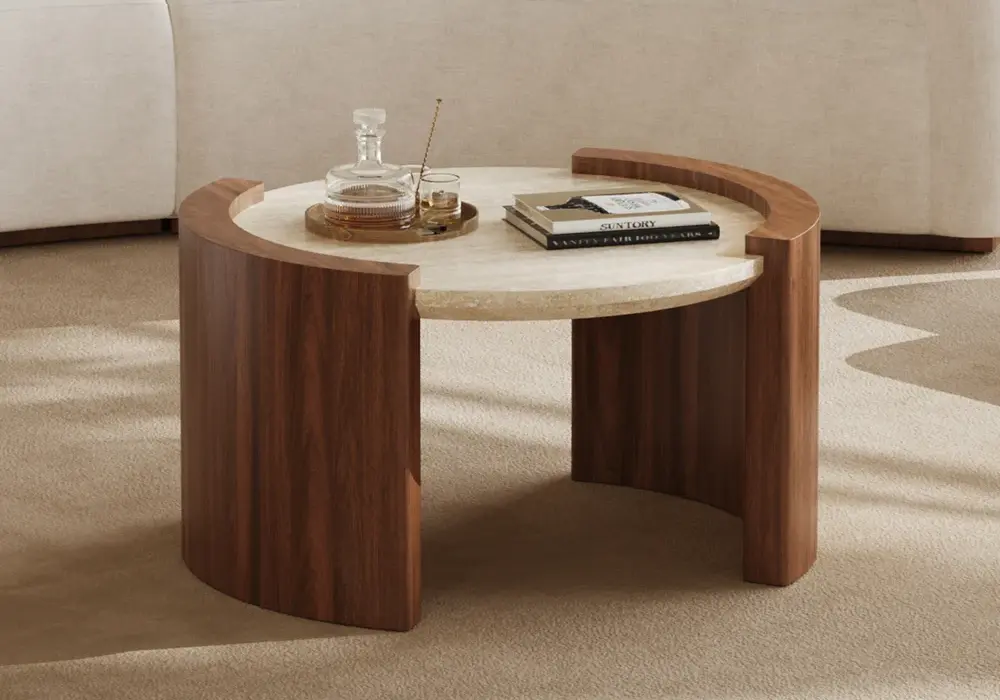
Homary’s 28" (711 mm) Round Travertine Top Coffee Table takes a simpler material-led approach, combining a natural stone top with a walnut wood base. It offers a different expression of the same basic idea: an accessible surface within the living-room arrangement.
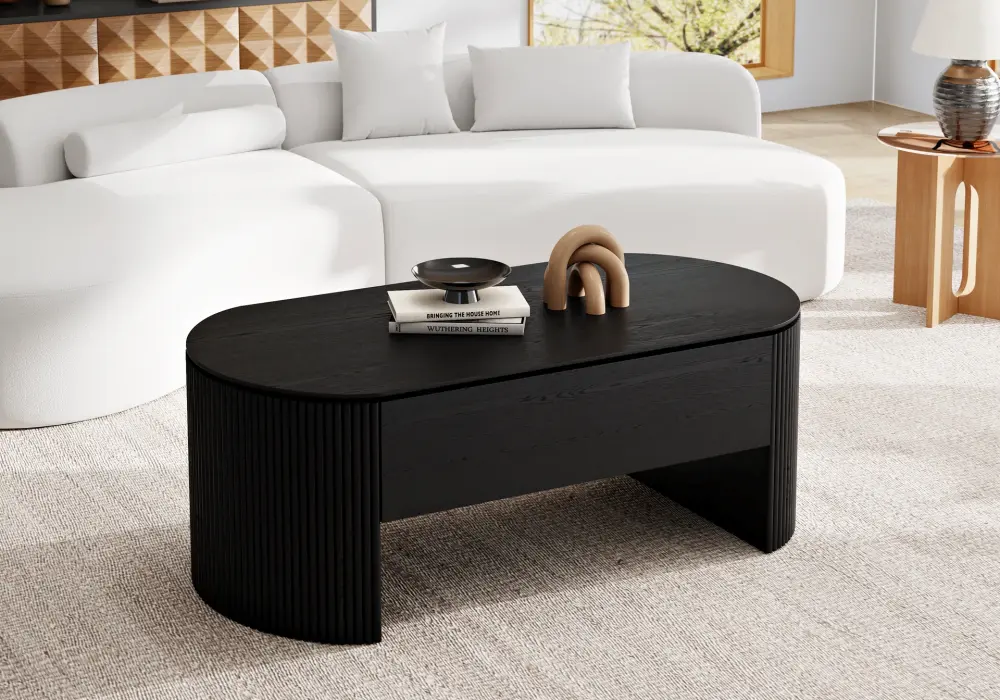
The 47" (1194 mm) Oval Lift-Top Hidden Storage Coffee Table adds a lift-top surface and concealed storage in an elongated shape. Homary describes engineered wood construction. Its extra functions are reasons to examine the opening movement and usable space, rather than judging only the closed silhouette.
These examples are contemporary interpretations, not evidence for the historical origin of the term. Their relevance is practical: the category now includes both simple surfaces and furniture that supports several activities.
Choose a table by use rather than by its name
Start with the seating arrangement. A long sofa may benefit from an elongated shared surface, while a tighter group might be easier to navigate around a round table. Trace the walking routes and check whether people can sit down and stand up without squeezing around the furniture.
Next, assess reach and height with the actual sofa. Use a temporary box or another safe stand-in to test the proposed proportions. A table that looks elegant in a photograph can feel inconvenient if it requires a deep forward bend whenever you set down a drink.
For a lift-top model, test the open position as a separate arrangement. Check knee space, the direction of travel, and the clearance needed for movement. Keep the mechanism’s load limits and instructions in mind. A raised surface should not be assumed to provide the same working setup as a dedicated desk for long sessions.
Finally, match care requirements to daily habits. Use suitable coasters and follow the finish-specific instructions. Natural stone, coated wood, and other surfaces can need different treatment. Storage is helpful when it holds the things you actually use; otherwise a simpler table may keep the room easier to manage.
If you are choosing a table now, identify its main job first: shared refreshments, a display surface, occasional work, or concealed storage. Then compare dimensions and functions. The name explains its familiar place in the room; your routine determines which version belongs there.
Frequently Asked Questions
Is a coffee table only for coffee?
No. The term describes a furniture category rather than a restriction on use. It can hold other drinks, books, games, or everyday accessories. Choose a surface and care routine appropriate to the items you plan to place on it.
Who invented the coffee table?
The evidence used here does not establish one worldwide inventor. The Milwaukee Art Museum dates the American form’s emergence to the 1920s. Earlier drink-serving furniture provides historical context, but it does not by itself establish a single origin story.
Why are coffee tables usually low?
Their position within a relaxed seating group favors a lower surface than a dining table. The right height still depends on the sofa and intended use. Test reach and circulation instead of treating one measurement as compulsory.
Is a cocktail table the same as a coffee table?
The terms often overlap in furniture retail, but usage varies. Compare the actual shape, dimensions, and intended setting. A product’s description is more reliable than assuming that one label always means a particular design.
Is a coffee table necessary in every living room?
No. Side tables or another arrangement may provide adequate surfaces in a compact room. Choose a coffee table when a shared central surface helps the seating group without making movement or access awkward.