

A coffee table pulls a living room together, or it doesn't. Leave it bare and the room reads unfinished. Pile it with knickknacks and it turns into clutter you have to work around every time you want to set down a drink. Below is a formula you can repeat in any room, along with guidance on choosing books, plants, and colors, arranging pieces by table shape and size, and keeping the surface practical and safe to live with. At the end, you'll find low-cost ways to refresh a coffee table without buying a new collection of decor.
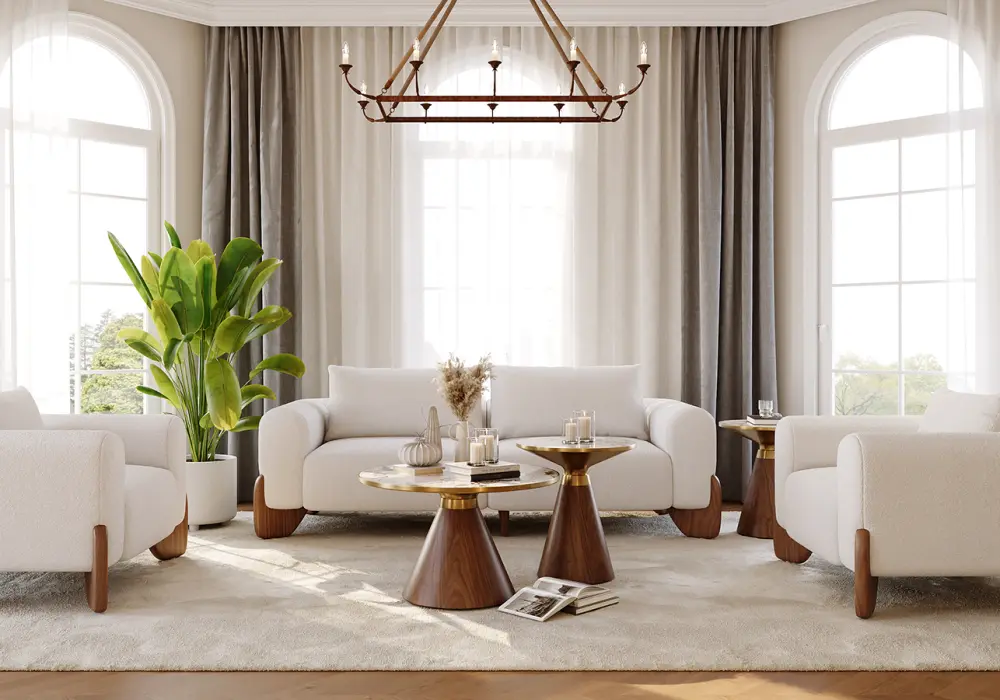
Sculra 711 mm Round Walnut Coffee Table
Table of Contents
The Simple Coffee Table Styling Formula: Height + Texture + Function
Working in layers beats scattering unrelated objects around the surface. Picture the table as a small composition built from a few distinct levels and materials: a tray or shallow bowl as a low visual anchor, one taller piece, one low functional piece, and a handful of personal accents. This works across different interior styles and room sizes because it's built on balance, not a specific trend.
Start With a Simple Anchor
A tray or shallow bowl gives the arrangement a defined base — rectangular, round, wooden, woven, ceramic, whatever suits the room.
It also solves a practical problem: smaller items stay grouped instead of scattered, and you can clear the whole tabletop in seconds by lifting one tray rather than moving five separate objects.
A useful starting formula:
1 anchor + 1 tall piece + 1 low functional piece + 1–3 personal accents + open space.
Add Height and Visual Movement
Height keeps an arrangement from looking flat. A vase, small plant, candle holder, or sculptural object can serve as the tallest point.
No single object should dominate the table. Aim for a gentle progression from low to medium to high, so the eye moves across the arrangement instead of landing on one spot.
A low stack of books under a small decorative bowl, paired with a vase or plant for height, is a straightforward way to build that progression. The differences in height should be noticeable, not exaggerated.
Mix Textures Instead of Adding More Objects
Texture does a lot of the work in a simple arrangement. Smooth ceramic against natural wood. Woven material softening glass or metal. Linen, stone, and matte finishes add variation without introducing more color.
This matters especially in neutral rooms, where texture carries much of the visual interest that color would otherwise provide.
Use Odd-Number Groupings and Leave Breathing Room
Three related objects tend to feel more relaxed than a row of matching accessories lined up evenly. Group a book, a bowl, and a small plant together rather than spacing items out across the whole table.
Leave room around them. A styled coffee table shouldn't have every inch assigned a job.
Watch for the Most Common Styling Mistakes
A few problems show up again and again: objects at nearly the same height that flatten the display, too many small decorative pieces that create noise, colors that don't relate to the rest of the room, or decor placed exactly where you'd normally set a drink.
When a table feels crowded, remove about a third of what's on it. Keep the pieces you actually use or the ones carrying the most visual weight. If the table feels calmer immediately, it had more on it than it needed.
Choose the Right Pieces — Books, Plants, and Color
With the structure settled, the next step is picking objects that support it. Coffee table books, plants, flowers, bowls, and small accessories all work, but the strongest combinations pull from your room's existing colors, materials, and daily habits rather than arriving as a matched set.
Choose Coffee Table Books by Interest, Size, and Color
Books should feel like they belong to you, not like set dressing. Start with subjects you're actually drawn to — design, photography, architecture, travel, cooking, art.
Proportions matter next. A single large book can anchor the stack on its own; two or three books in graduated sizes build a layered look instead. Cover color plays a role too — bold covers reinforce a colorful room, while neutral or muted covers suit a quieter one.
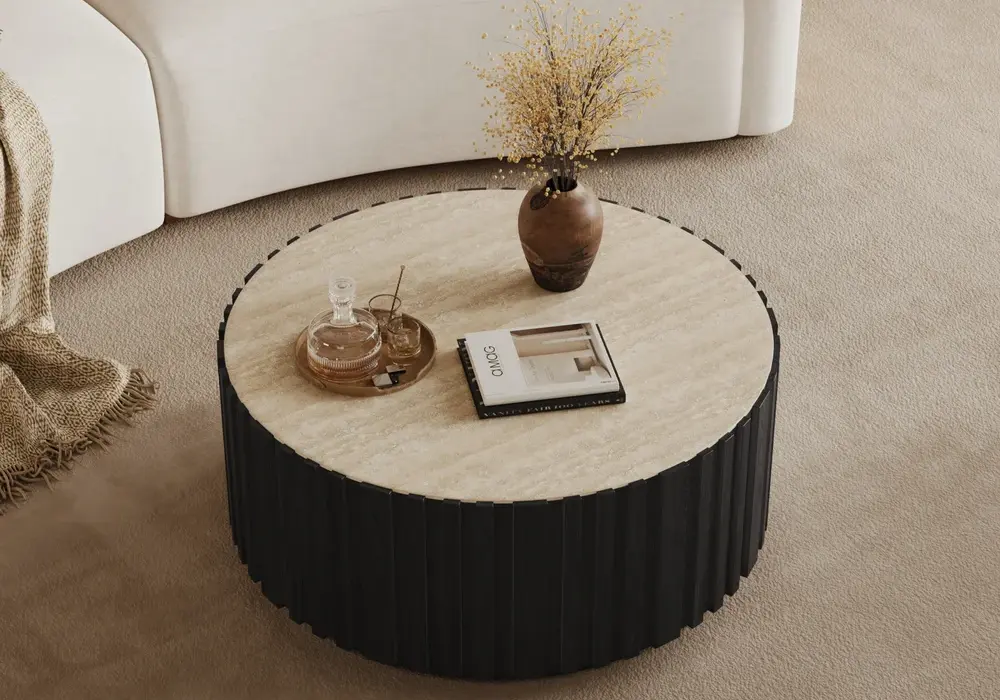
Aura 889 mm Round Black Slatted Sintered Stone Coffee Table
Select Plants and Flowers for the Right Amount of Height
Greenery adds softness, and the right choice comes down to how much vertical space you want to give it.
Option | Best for | Styling approach |
Small houseplant | Everyday greenery | Compact pot, kept within the anchor tray |
Low bouquet | Softness without blocking views | Stems kept low, slightly off-center |
Dried flowers | Long-lasting texture | Simple vase, restrained colors |
Branches | Sculptural height | A few stems rather than a dense bundle |
Faux flowers | Minimal maintenance | Realistic foliage, simple arrangement |
A small houseplant suits everyday, lived-in styling. A low bouquet adds softness without cutting off sightlines across the room. Dried flowers and branches bring texture and shape with almost no upkeep, and realistic faux flowers make sense in spaces where fresh arrangements aren't practical.
Build a Coordinated Color Palette
Rather than picking coffee table decor colors at random, borrow from what's already in the room — the sofa, the rug, cushions, curtains, wall art. Two or three repeated tones are usually enough.
A neutral room might repeat cream, warm brown, and muted green. A darker room might echo charcoal, off-white, and natural wood.
Repeating colors that already exist ties the table to the rest of the room without forcing every piece to match.
Add Material Contrast for More Depth
A restrained color palette gets more interesting once the materials vary. Wood against ceramic, metal against linen, stone against glass, woven fiber against a smooth finish.
One or two clear material contrasts are usually enough to make even a small arrangement feel considered.
Layout Ideas by Coffee Table Shape and Size
Once you've picked the pieces, placement is what's left. A rectangle, a circle, a square, and a small table each call for a different composition — the goal isn't more decor, it's distributing what you have so the table stays balanced and still works day to day.
Rectangular Coffee Table: Think in Three Zones
A rectangular table works well split into three loose zones: the main tray toward one end, a stack of books in the middle, a smaller accent toward the other side.
Skip perfect symmetry — a little variation reads as more relaxed.
Keep the area closest to the sofa open for drinks, snacks, or a notebook.
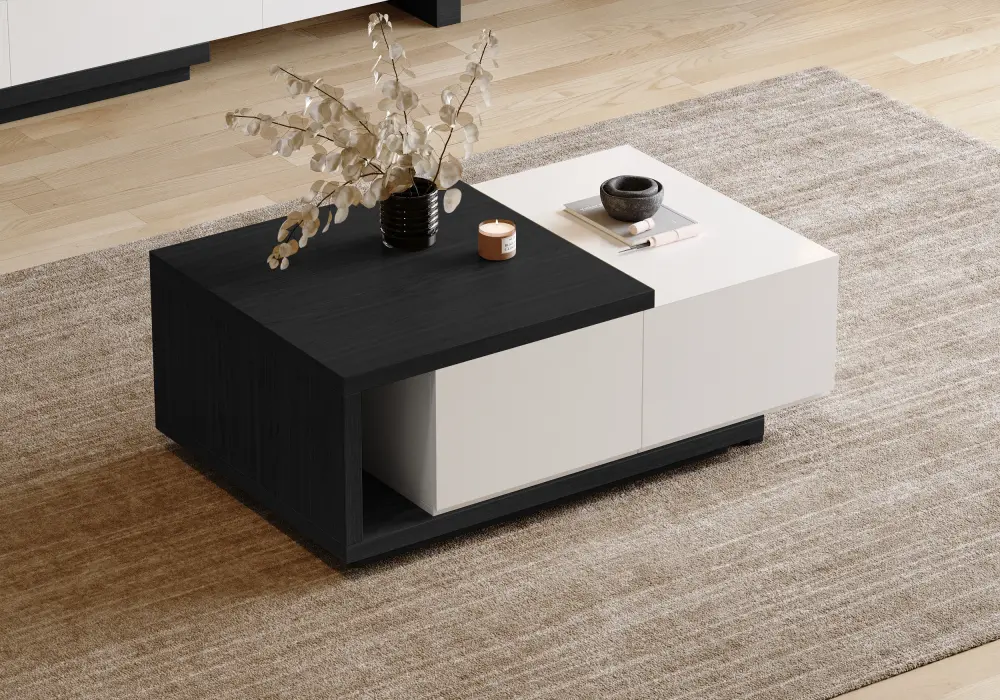
Quoint 1194 mm-1753 mm Extendable Coffee Table
Round Coffee Table: Build From the Center
Round tables pull the eye toward the middle. Start with a tray or bowl near the center and build a compact grouping around it.
Keep the arrangement tight rather than spreading objects toward the edges, and preserve a clear ring of open tabletop around the outside.
Square Coffee Table: Use Diagonal Balance
A square surface works well with diagonal placement — the main grouping toward one corner, a smaller, lower object balancing it from the opposite corner.
This keeps the center from feeling overcrowded while still reading as intentionally styled.
Large Coffee Table: Create Visual Islands
A large table often looks better with two or three separate groupings than one oversized centerpiece.
Treat each grouping as its own small island — books and a bowl in one, a plant or vase in another — with clear space between them so the table doesn't read as one continuous mass.
Small Coffee Table: Keep One Compact Grouping
Small tables call for restraint: a compact tray or shallow bowl with one book and one small plant or vase is often all a small table can hold without feeling crowded.
Keep the grouping low and tight, and leave most of the surface open for actual use — a detail that matters most in compact apartments and multifunctional living spaces.
Table shape or size | Easy layout | Main open area |
Rectangular | Three loose zones | Reach area in front of the sofa |
Round | Center grouping with outer ring | Outer edge |
Square | Diagonal balance | Center |
Large | Two or three visual islands | Space between groups |
Small | One compact low grouping | Most of the tabletop |
Keep Practical Spacing in Mind
Leave roughly 51–102 mm of visible tabletop around the main grouping instead of pushing objects to the edge — the exact amount will shift depending on the table's size and the scale of what you're placing on it.
Stack books largest at the bottom, smallest on top. Let a vase or plant mark the tallest point, but keep it low enough that it doesn't block sightlines or conversation across the room.
Let actual use shape the layout. On movie nights, leave a landing spot for drinks and snacks. When people are over, keep room for extra glasses. If the table doubles as a workspace sometimes, leave an unobstructed patch for a laptop or notebook.
Keep It Functional, Safe, and Easy to Maintain
A well-styled coffee table still has to work as furniture. Once the arrangement is done, take a final pass for reachability, surface care, stability, and household safety.
Keep the Most Useful Area Clear
The spot closest to the sofa is usually the easiest to reach, so reserve it for what actually gets used — drinks, snacks, remotes, reading glasses, a laptop.
Skip filling that area with decor. Concentrating the styling slightly to the sides or center keeps the table both good-looking and usable.
Match Cleaning and Protection to the Table Surface
Different materials need different care. Glass generally does well with a soft, non-abrasive cloth and a glass cleaner suited to it. Wood needs protection from standing moisture and gentle cleaning. Stone needs products matched to its specific type and finish. Painted and lacquered surfaces usually do best with a soft cloth and mild cleaning methods.
Follow the manufacturer's care instructions when they're available.
Protect the Surface With Simple Accessories
Coasters help on surfaces prone to staining or water marks. A lightweight tray keeps accessories corralled, and a non-slip base cuts down on sliding.
Small felt pads under heavier objects help protect finished surfaces from scratches — a small detail, but one that matters on tables that get used constantly.
Choose Safer Decor for Homes With Children or Pets
Households with young kids or pets need a different approach. Skip fragile glass, sharp-edged sculptures, small objects a child could swallow, unstable heavy pieces, and open-flame candles.
Choose plants carefully, too — some common varieties are harmful if ingested. Keep breakable or hazardous pieces out of easy reach, and lean toward rounded, sturdy, low-profile accessories.
Choose Pieces That Are Easy to Reset
The best setup is one that takes no real effort to maintain. Pieces that are easy to dust, wipe down, move, and regroup stay organized on their own.
A lidded box or small container can hide everyday clutter while keeping small items within reach. When the whole arrangement can be put back together in a minute, styling stops being a chore and becomes part of the routine.
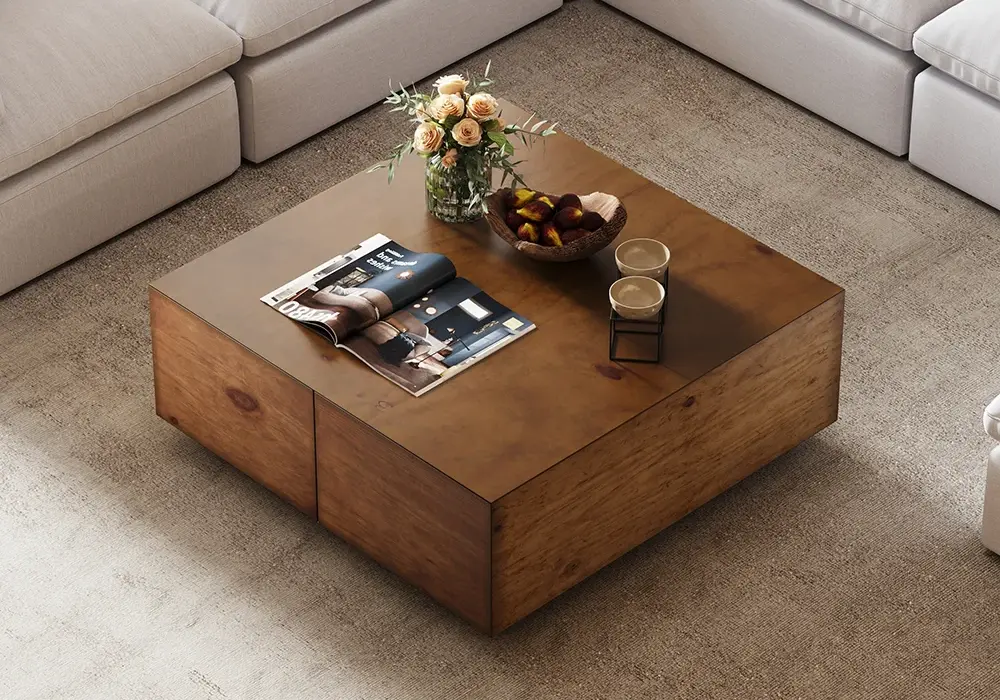
35" Distressed Pine Wood Square Coffee Table
Refresh Your Coffee Table on a Budget
A refresh doesn't require a new collection of decor. Small changes shift the look while keeping the same formula intact — before buying anything, look around the rest of the house for pieces you can rotate in.
Rotate What You Already Own
Move a vase from a side table, swap one bowl for another, bring in a different stack of books. Changing even one or two objects can shift the whole balance of the table.
Repositioning an existing grouping works too. Moving a centerpiece slightly off-center, or separating two objects that used to sit together, creates a new rhythm without spending a dollar.
Make Small Seasonal-Feeling Changes Without Overhauling the Room
Fresh flowers, a few branches, dried stems, or another natural element introduce a sense of change without a full redesign.
A different bowl or textile accent does the same job. Changing one layer at a time tends to look better than replacing the whole arrangement at once.
Use a Simple Fix for Common Styling Problems
If the table feels too busy, cut back the number of colors and pull a few small objects. If it looks flat, increase the height difference between pieces. If it feels cold or plain, bring in wood, woven texture, linen, or another tactile material.
For the simplest possible setup: one book, one bowl, one branch or small plant. That combination alone can finish a coffee table with almost no effort.
Start Styling Your Coffee Table Today
Clear the entire tabletop and start over. Measure the usable surface, decide which area needs to stay open for everyday use, then gather three to five pieces from around the house.
Build around one tray or shallow bowl. Add one taller piece, one functional item, one small personal accent. Step back, pull anything that feels unnecessary, and leave enough open space for how the room actually gets used.
Save this formula for future refreshes, and keep any shopping list short — a tray, coasters, a low-profile vase, or a lidded storage box add function without adding clutter.
For home decor retailers and interior design businesses, this framework also lends itself to a curated shopping list, a style quiz, room-specific product recommendations, or a personalized styling consultation.
FAQ: What to Put on a Coffee Table
What are the essential items to put on a coffee table?
A tray or shallow bowl, one taller piece, one low functional item, and one or two personal accents cover most rooms. Leave open space so the table stays usable.
What is the easiest formula for styling a coffee table?
1 anchor + 1 tall piece + 1 low functional piece + 1–3 accents + open space. Vary the heights, mix textures, and don't fill the entire surface.
What books and objects work best on a coffee table?
Pick books based on your own interests, their size, and the room's existing colors. Pair them with pieces that add contrasting height or texture — ceramic bowls, wooden accessories, small plants, woven pieces, simple sculptural decor.
How do I arrange a tray on a coffee table?
Use the tray to contain smaller objects while keeping the main usable area open. On a rectangular table, place it within one zone. On a round table, center it or shift it slightly while keeping open space around the grouping.
What should I put on a small coffee table in an apartment?
Keep it compact and low — a small tray or bowl with one book and a petite plant or low vase is usually enough. Avoid spreading multiple groupings across limited surface area.
What coffee table decor is safe for kids and pets?
Stick to stable, rounded pieces and skip fragile glass, sharp objects, small swallowable items, open flames, and plants that are toxic to kids or pets. Keep heavy or breakable accessories out of easy reach.
How can I refresh coffee table decor on a budget?
Rotate decor in from other rooms, swap one bowl or vase, add fresh flowers or branches, or rearrange what's already there. Simplifying the color palette, adding height variation, or bringing in natural texture works without replacing the whole setup.