

Place a few purposeful items on a coffee table: a tray to group small objects, one or two books, a low plant or flowers, and a single sculptural accent such as a bowl. Keep enough open surface for drinks, snacks, and remotes, and choose pieces that fit the table's shape and the room's daily use. The right display should make the room feel considered without turning the table into a shelf.
In this guide
Begin with the table's job
Match the table to how you use it
Before choosing decor, decide what the table needs to do. In a family room, it may hold drinks, a game, and the television remote. In a formal sitting area, it may be mostly decorative. A household with young children or pets may need fewer breakable, sharp, or easily tipped objects. If the tabletop is small, one compact arrangement is usually more useful than several miniature vignettes competing for space.
When the table doubles as a desk
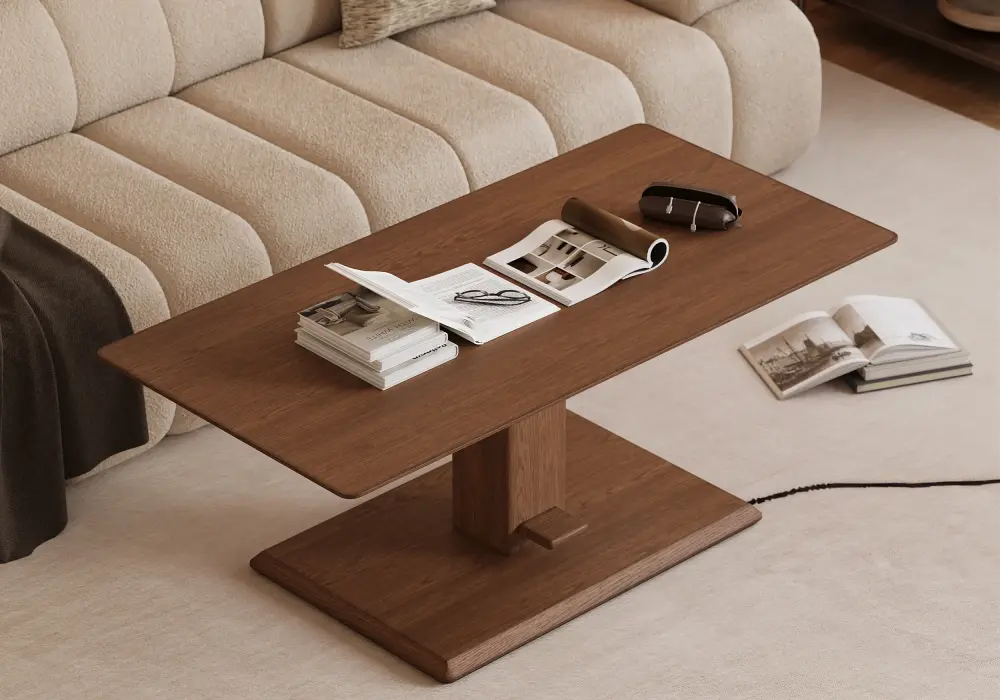
If the table also has to work as a laptop surface, a lift-top is worth considering. The 1194 mm walnut lift-top coffee table raises its top so it can double as a home office desk, then lowers back to coffee-table height for drinks and snacks. Its dark walnut tone also gives a pale sofa or rug something to contrast with. The trade-off is styling: clear the top before you raise it, so keep the display to a single tray you can lift away in one move. If you rarely work from the sofa, a fixed-height table is simpler.
Divide the surface into zones
Think of the surface in three parts: a landing area for everyday objects, a grouped decorative arrangement, and a little breathing room. A tray can define the arrangement and make it easy to move aside. Leave the center of the table accessible if guests commonly set down cups or plates, and keep tall objects out of the main sightline between seats. In a high-traffic room, make sure no item projects beyond the table edge where someone could catch it while walking past.
A simple mix that works in many rooms
Five building blocks
Use the following as a starting point, then edit for your lifestyle rather than filling every spot.
Element | What it adds | How to use it |
Tray | Order and an easy way to gather small items | Choose a size that leaves useful open tabletop around it. |
Book or two | Color, texture, and a conversation starter | Stack flat; keep the pile low and stable. |
Greenery or flowers | A natural focal point | Choose a short arrangement that does not block conversation. |
Bowl or sculptural object | Shape and personal character | Use one accent with a stable base instead of several small pieces. |
Candle | Warm visual texture | Place safely and never leave a flame unattended. |
You don't need every element
A tray, one book, and a small plant may be enough. On a long table, repeat a restrained visual theme in two or three low groupings, leaving gaps between them. On a round table, one central tray or a loose cluster often looks balanced. Avoid putting an object on a narrow edge or stacking decor where a bump could send it onto the floor.
Match the arrangement to the table's shape and scale
Round tables
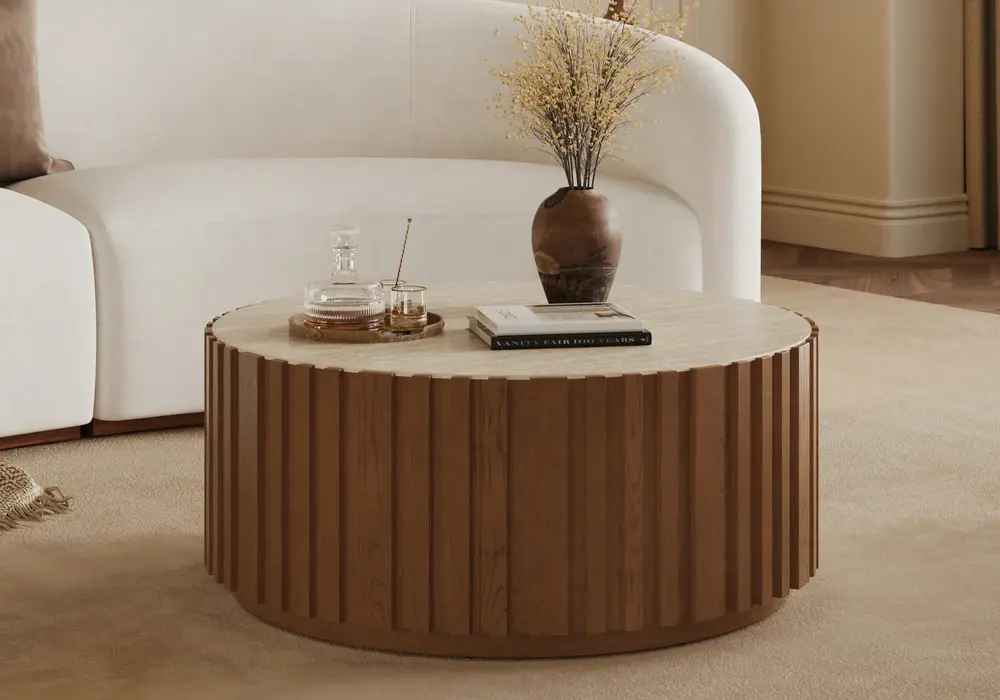
Round tables look best when objects form a compact cluster that echoes the circular outline. A round tray can reinforce the shape, while a single offset object creates a more relaxed look. The Aura 889 mm round coffee table is a good example: solid ash-wood slats, a travertine-style sintered stone top, and a rounded outline that suits one central tray and a single accent.
Rectangular and extendable tables
Rectangular tables can support a longer, lower arrangement, but leave room at the ends and avoid making a wall of decor that divides conversation. On an extendable table, plan the styling for the everyday size and remove or reposition items before opening the extension.
Scale and height
Use scale with care. A tiny bowl may disappear on a broad tabletop; a large vase can dominate a petite table and block the room. Group objects of different heights, but keep the tallest item low enough that people can see one another across the seating area. Books create a stable platform for a small object, but avoid tall, wobbly stacks. Place heavy accents directly on the tabletop rather than on a slippery pile.
Height and function also matter when the coffee table sits in a compact seating group. Low seating may make a very tall vase feel oversized, while a large sectional can visually overwhelm tiny accents. Try the arrangement in the actual room and notice whether anyone must lean around an object to reach a coaster. If they do, move the piece to a side table or shelf rather than forcing it onto the central surface.
Color and material
Color and material can connect the table to nearby furniture. Repeat one or two tones from a rug, sofa, or lamp. A stone top may look polished with a matte ceramic object or natural greenery; a wood surface can pair well with glass, woven texture, or a book jacket. Treat these as styling choices, not rules. If the table already has a strong grain, slatted base, or patterned surface, a simpler display can let its form remain visible.
The room's palette can guide the choice without turning the table into a color-matching exercise. Pick one accent already present elsewhere, such as a muted green from a cushion or a warm metal from a lamp, and repeat it once. Let the remaining objects add contrast through texture or shape. If several items compete for attention, remove one and look again from the doorway and from the sofa. This small edit often makes the arrangement feel calmer while keeping the display personal.
Keep daily items tidy but within reach
Everyday items, close at hand
Use a small lidded box or tray for remotes, coasters, and charging accessories. Put frequently used items on the side nearest the primary seat. Store less-used objects in a drawer or on a lower shelf when the table includes one. A clear tabletop is especially helpful when the table doubles as a place to work, play board games, or serve food.
When storage does the work
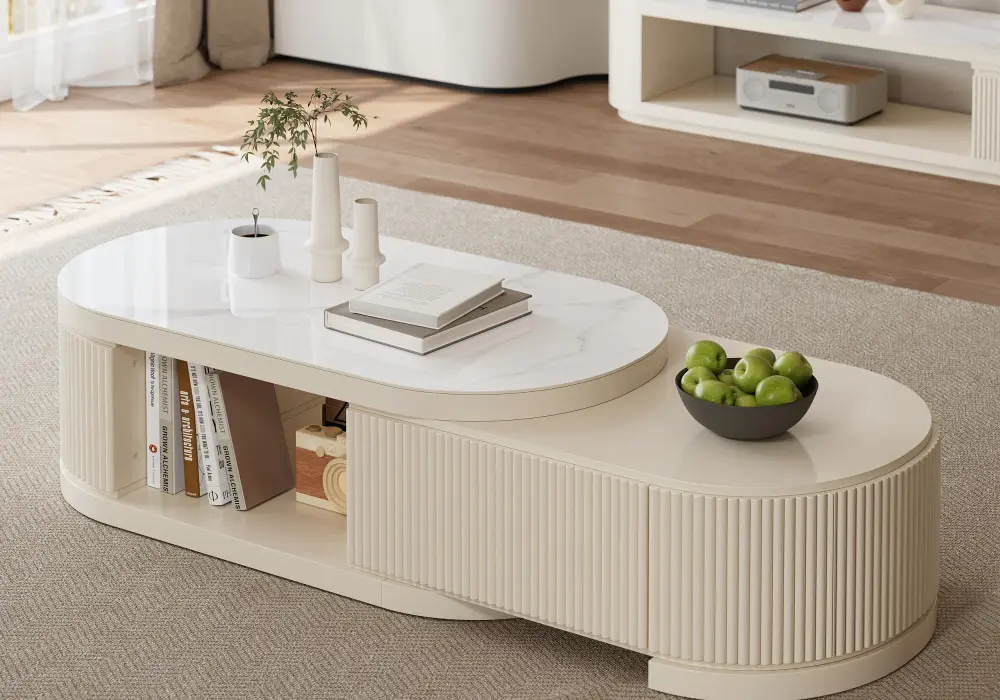
If you would rather keep almost nothing on show, choose a table with drawers. The Velar extendable coffee table combines a fluted, sintered stone top with four drawers for remotes, coasters, and games, and it extends from 1194 mm to 1702 mm when guests arrive. It suits households that entertain often; measure first, because the full 1702 mm needs extra floor space and clear walkways, and in a small room the closed 1194 mm size may be all you need.
Protect the surface
Protect the surface by using coasters and placemats as appropriate for its material. Follow the maker's care instructions and avoid assuming that a surface is impervious to heat, scratches, or spills. Wipe up moisture promptly and do not put a hot pan or open flame on a surface unless the product's instructions explicitly allow it. Use a stable vase and a waterproof base if it contains water; decorative plants should not leak onto the finish.
Edit the display through the year
Small swaps, big refresh
Changing a few small objects can refresh a room without buying a full set of seasonal decor. Swap book covers, flowers, or a bowl, then keep the tray and functional items in place. Choose pieces you enjoy seeing and use. One meaningful object is often more personal than a crowded collection of generic accents.
Test it from your seat
Try the arrangement from the seats where people actually sit. If a vase blocks a face or television, lower it. If the tray occupies too much of the surface, remove one item. If you need to move everything whenever you set down a mug, reduce the display. A coffee table should serve the room first and photograph well second.
Frequently Asked Questions
How many items should I put on a coffee table?
There is no fixed number. Start with three to five pieces across a few functions, then remove anything that crowds the surface, blocks sightlines, or gets in the way of daily use.
Should a coffee table have a tray?
A tray is useful when it helps group small items or makes them easier to move. It is optional; on a small table, the tray itself may take up more room than it saves.
What size decor works on a small coffee table?
Choose a compact group with low profiles, such as a small tray, one book, and a short plant. Keep the edge clear and leave enough tabletop for drinks or other everyday use.
Can I put a candle on a coffee table?
You can use a candle as decor, but follow its safety instructions, place it on a stable heat-resistant holder, keep it away from flammable objects, and never leave it burning unattended. Battery-powered candles are a lower-maintenance alternative.
What should I put on a coffee table with storage?
Keep the main surface lightly styled and use drawers or lower shelves for remotes, coasters, games, and other items you want close at hand. Separate functional storage from display so the table remains easy to use.