

An L-shaped sectional wraps around your coffee table on two sides, so the wrong shape can block the chaise, crowd the corner or leave half the seats out of reach. The right choice depends on four things: the length of each side, the chaise direction, the width of your room and who uses the space.
This guide gives you a clear shape recommendation first, then shows how to size the table, where to place it, and which shapes work in small, large and flexible layouts. Three example tables show how each shape fits in practice.
Table of Contents
Best Coffee Table Shapes for an L-Shaped Sectional: The Quick Answer
For most L-shaped sectionals, the safest choices are a round, oval or rounded-corner rectangular coffee table. The right one depends on four things: how long each side of the sectional is, which side the chaise is on, how wide the room is, and whether kids or pets use the space. An L-shaped sofa wraps around the table on two sides, so the table must be reachable from every seat and must not block the way in or out of the corner.
Shape | Best for | Watch out for |
Round | Compact rooms, busy walkways, homes with kids | Can look small next to a very long sofa |
Oval | Long chaise, narrow living rooms | Needs enough length to feel balanced |
Rectangular | Long sectionals, wide rooms | Corners can catch hips and shins in tight layouts |
Square | Sides of similar length, roomy layouts | Fills the inside corner and can crowd the chaise |
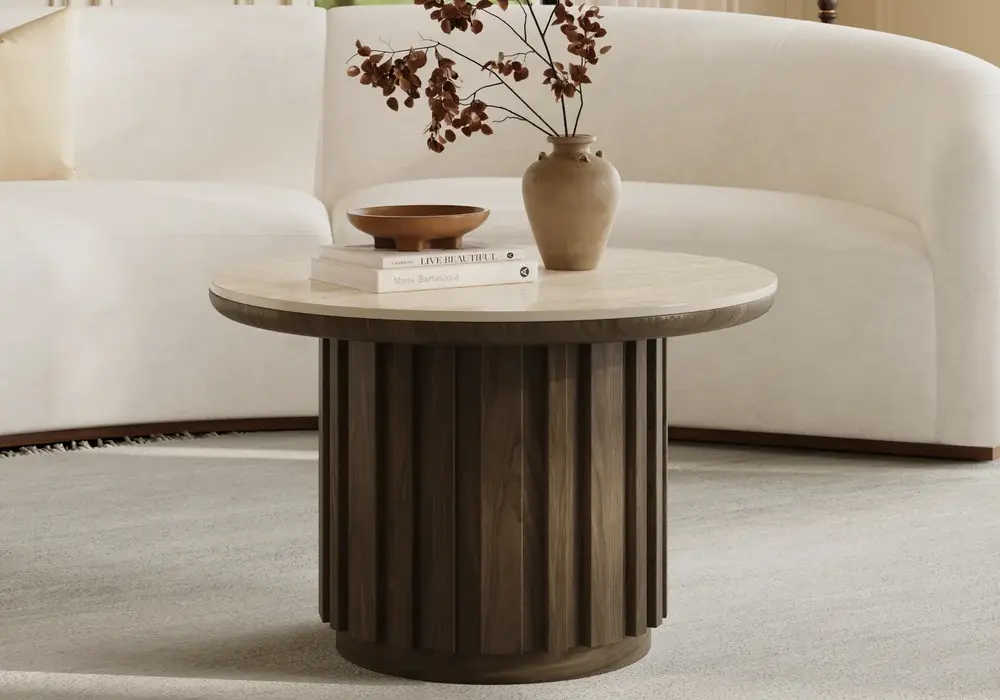
Round tables are the easiest fit. With no corners, they let you move around the sofa without snagging, and they sit comfortably in the inside corner of the "L" where several people reach for the same surface. The Aura Ash Wood Slatted Round Coffee Table with Sintered Stone Top is a good example. At 28 inches (about 710 mm) in diameter, it gives every seat a short reach and leaves the walkway open. Its slatted base keeps the silhouette light, so it does not overwhelm a small corner.
The other three shapes each solve a different problem:
- Oval: suits long chaises and narrow rooms, because it adds length without adding width.
- Rectangular: suits longer sectionals, where the table needs to match the length of the seating run.
- Square: works only when both sides are close in length and the room is generous.
How to Match Table Size to Your Sectional
Once you have chosen a shape, the size decides whether it looks right. A reliable guide is the two-thirds rule: the table should be roughly two-thirds the length of the seating run it faces. For a sectional, measure the long side. Treat the rule as a range, since round tables look larger than their width suggests and can sit at the lower end.
Height matters as much as footprint. Aim for a surface level with the seat cushions or slightly lower, around 400 to 450 mm (16 to 18 in), so drinks and books stay within easy reach.
Long side of sectional | Round (diameter) | Oval (L × W) | Rectangular (L × W) | Square |
2100 mm (84 in) | 700–800 mm | 1000–1100 × 550–600 mm | 1000–1200 × 500–600 mm | 700–800 mm |
2400 mm (96 in) | 800–900 mm | 1100–1300 × 600–700 mm | 1200–1400 × 600–700 mm | 800–900 mm |
2750 mm (108 in) | 900–1000 mm | 1200–1400 × 700–800 mm | 1350–1500 × 650–800 mm | 900–1000 mm |
Do not judge by total sofa length alone. Check that the table can serve the main seats, the chaise and the end seat from where it sits inside the corner.
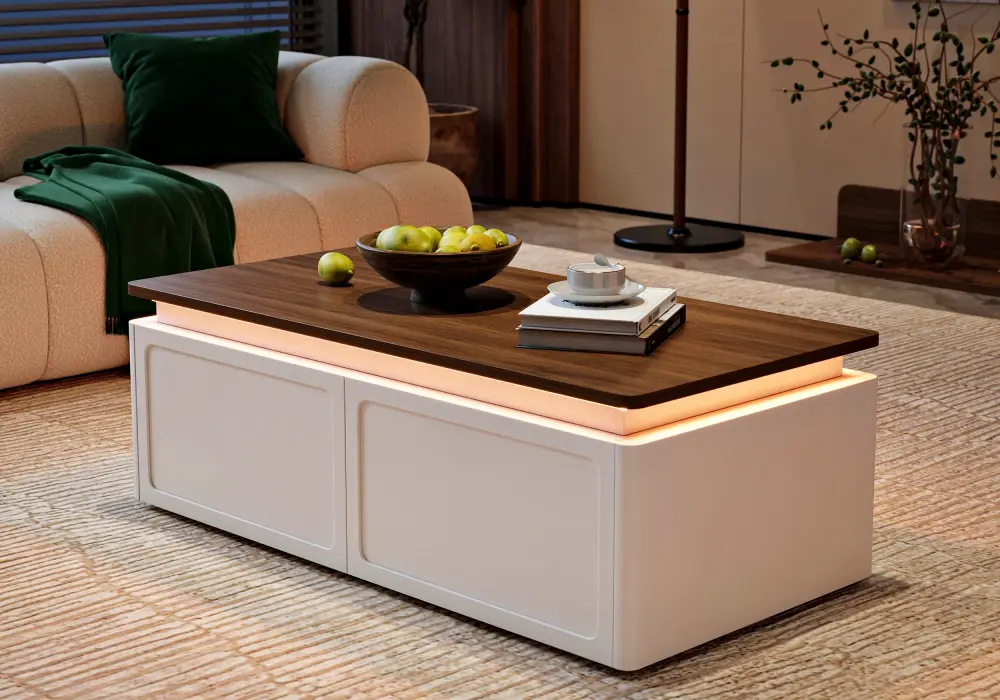
The Ambra 47" Walnut & White LED Coffee Table shows how the rectangular row works. At about 1200 mm long, it suits a sectional with a long side of around 2100 to 2400 mm. On a much longer sofa it would look short, and a longer rectangle or a pair of tables would balance better. Its clean rectangular outline lines up well with the straight edge of a sectional run.
Placement, Clearance and Chaise Orientation
Placement matters as much as shape, because a good table in the wrong spot still gets in the way.
- Distance from the sofa: leave about 350 to 450 mm (14 to 18 in) between the table edge and the front of the seat. That is close enough to reach, and far enough to stand up and stretch out your legs.
- Walkways: keep 750 to 900 mm (30 to 36 in) for the main route through the room. Also leave space in front of the TV unit or fireplace.
Chaise direction decides where the table should shift. Seen from above, the layout looks like this:
Nudge the table toward the long side and away from the chaise end. If it sits too close to the chaise, it blocks the legroom of whoever is stretched out there. Center it in the inside corner only when the chaise is short.
Three positions tend to cause problems. A table pushed against the chaise blocks stretching and getting up. A table pushed to the open side leaves the far seat out of reach. A table dead center in the corner blocks the diagonal route through the room.
Shape Solutions for Small Rooms, Large Rooms and Flexible Seating
Small living rooms
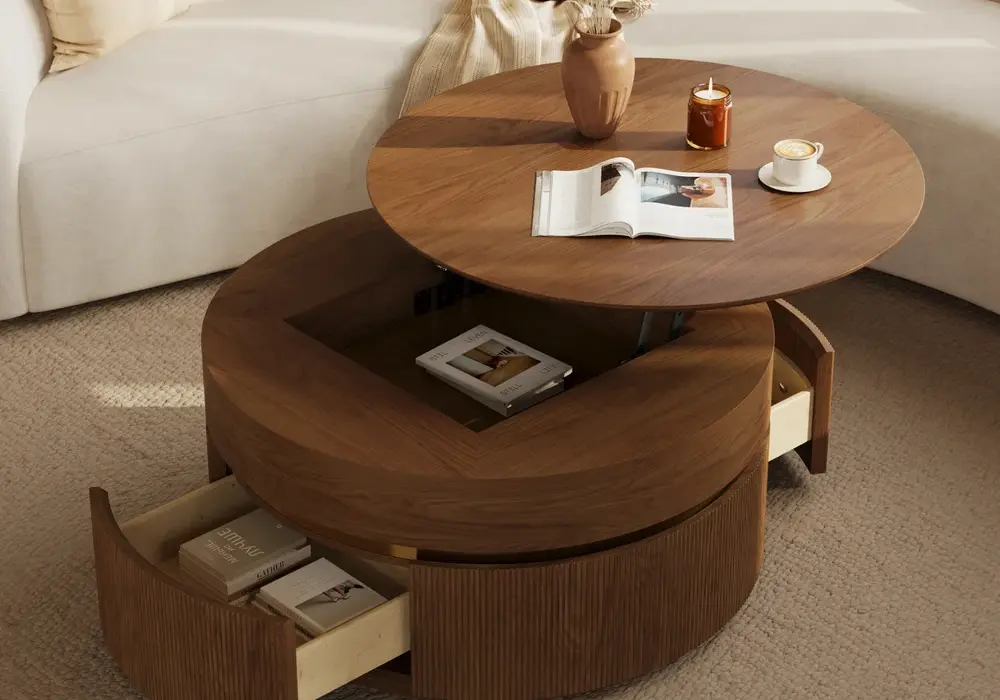
Choose round, narrow oval, or a small nesting pair, and prefer lighter bases or open frames. The goal is to keep the routes to the kitchen, hallway and balcony door open. The 32" Fluted Lift-Top Round Walnut Coffee Table with 2 Drawers suits this situation. At 32 inches (about 810 mm) across, a round footprint takes up little floor and has no corners to catch on. Its lift-top surface can rise to a working height, which helps when the same corner is used for a laptop or a meal. It works best with a compact to medium sectional, and a larger L-shape would call for a second surface nearby.
Large and open-plan rooms
You have more options here. Choose a larger rectangle, two matching tables placed side by side, a nesting set, or one main table plus a side table. The point is that every seat can still reach a surface.
Ottoman-style tables
An ottoman as a coffee table is a useful alternative shape. The soft edges are forgiving around children, it can offer extra seats, and a tray turns it into a table when needed. The downsides are that it is a poor surface for hot drinks and anything that needs a firm, stable base. Use it as a flexible option for casual rooms, and pair it with a small side table if you want stability.
Shape-Related Mistakes to Avoid
- Placing the table too far away. If you have to lean forward to reach it, it is too far or too small.
- Pointing sharp corners at play areas. In rooms with young children, round or rounded-corner shapes are safer.
- Squeezing a square table into the corner. A square tends to fill the inside of the "L" and block the route in and out.
- Ignoring the chaise. A shape that looks fine on its own may stop the chaise user from sitting or standing comfortably.
- Choosing a table that is too large. An oversized table makes the whole corner feel cramped. Heavy, large tables suit big rooms, while small rooms need lighter shapes and bases.
Ready to Choose?
Start by measuring three things: the long side of your sectional, the side the chaise is on, and the width of your walkways. Then use the decision table and the size guide above to narrow down the shape. A round table is the easiest answer for compact rooms, an oval or rectangle fits a longer layout, and a square works when you have space to spare. With those numbers in hand, you can compare options with confidence.
FAQ
What shape coffee table is best for an L-shaped sectional?
Round, oval and rounded-corner rectangular tables are the safest choices. Round suits compact rooms, oval suits a long chaise or narrow room, and rectangular suits long sectionals.
What size coffee table should I get for an L-shaped sectional?
Match the table to the long side of the sectional. For a 2400 mm (96 in) side, a round table of 800–900 mm or a rectangle of 1200–1400 × 600–700 mm usually works. Keep the height level with, or slightly below, the seat cushions.
What is the 2/3 rule for choosing a coffee table?
The table should be about two-thirds the length of the seating run it faces. Round tables can sit at the lower end of that range because they look larger than their width suggests.
Is a round or rectangular coffee table better for an L-shaped sectional?
Round is better for tight spaces, busy walkways and homes with children. Rectangular is better when the sectional is long and the room is wide enough to carry the extra length.
Can you use a square coffee table with an L-shaped sectional?
Yes, but only when both sides of the sectional are similar in length and the room is spacious. Otherwise a square tends to crowd the inside corner and block the route through it.
How much space should be between a sectional and a coffee table?
Leave about 350 to 450 mm (14 to 18 in) between the table and the front of the seats, and keep 750 to 900 mm (30 to 36 in) clear for the main walkway.
Are ottomans or nesting tables good alternatives to a coffee table for a sectional?
Yes. An ottoman has soft edges and can add seating. A nesting set can spread or tuck away as needed. Add a small side table if you need a firm surface for hot drinks.