

A wall hugger reclining sofa is a reclining sofa designed to sit much closer to a wall than a traditional recliner while still allowing the backrest to move into a comfortable reclining position. Instead of requiring the entire back of the sofa to travel backward as it reclines, a wall-hugger mechanism typically moves the seat and backrest forward as the back tilts, reducing the amount of clearance needed behind the sofa.
For homeowners furnishing an apartment, compact living room, basement, or home theater, this seemingly small mechanical difference can make a major difference in usable floor space. A traditional reclining sofa may require roughly 305–610 mm of clearance behind it, while some wall-hugger designs can operate with only a few inches, depending on the specific mechanism.
But choosing a wall hugger reclining sofa is not simply about finding the model that sits closest to the wall. The better purchasing decision considers reclining clearance, sofa dimensions, seating configuration, mechanism type, upholstery, electrical requirements, and how the sofa will actually be used.
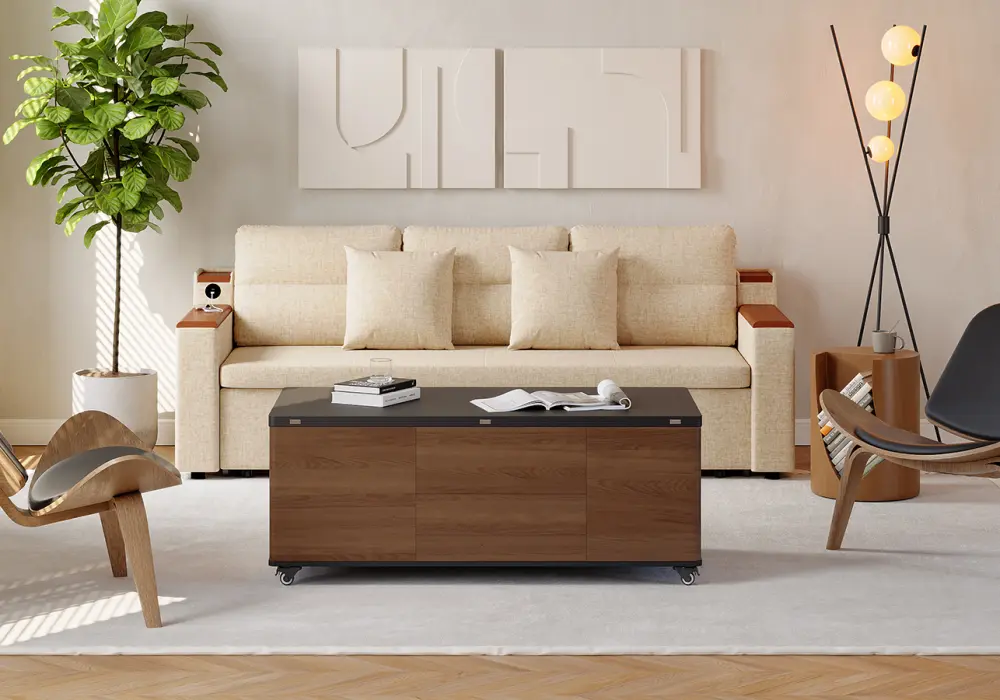
Source Homary
What Is a Wall Hugger Reclining Sofa? Definition and Use Cases
A wall hugger reclining sofa, sometimes called a wall-saver recliner, is a reclining sofa engineered to minimize rear clearance. The key difference is how the reclining motion is distributed.
With a conventional reclining sofa, the backrest typically moves backward as the footrest extends forward. That creates a large arc behind the sofa and requires more space between the sofa and wall.
A wall-hugger design uses a different movement path. Depending on the model, the seat may slide forward on a track while the backrest reclines, allowing the sofa to remain relatively close to the wall.
Typical Wall Clearance by Recliner Type
Reclining style | Typical rear clearance* | Best suited for |
Traditional reclining sofa | 305–610 mm | Large living rooms |
Wall-hugger reclining sofa | 76–203 mm | Apartments and compact rooms |
Power wall-hugger | About 76–203 mm | Convenience-focused spaces |
Fixed sofa | 0–76 mm | Maximum floor efficiency |
*Always follow the manufacturer's specifications because mechanisms differ.
The advantage becomes particularly noticeable in an 2×3 m living room. A conventional reclining sofa that consumes an additional 457 mm behind the back can make the room feel significantly tighter. A wall-hugger configuration can reclaim much of that area for a walkway, side table, or additional seating.
Wall huggers are available in more than one configuration. A compact loveseat can work well in a small apartment, while a three-seat reclining sofa may be more appropriate for a family room. Some larger sectionals combine reclining seats with a stationary center console, storage compartment, or cupholders.
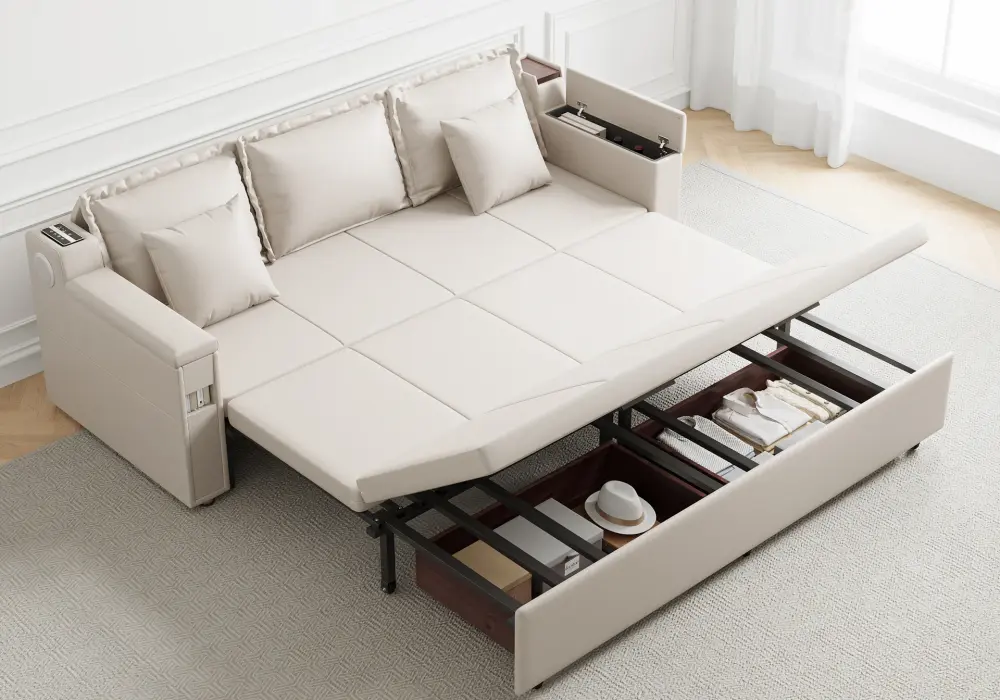
For example, a compact multimedia setup might combine a sleeper function with entertainment features. An 3-Seater Leather Sleeper Sofa can serve as a sofa, occasional sleeping surface, and media-oriented seating solution, which can be useful when every square foot has to serve more than one purpose.
The broader idea is important: a wall hugger is not merely a smaller recliner. It is a way to upgrade a living room from fixed seating to functional seating without automatically sacrificing the room's circulation space.
How Wall Hugger Mechanisms Work and What Types Are Available
The space-saving advantage comes from the reclining mechanism underneath the upholstery.
Instead of simply rotating the backrest around a fixed point, many wall-hugger systems use a combination of tracks, brackets, linkages, and pivot points. When the user reclines, the seat can move forward while the backrest changes angle.
This creates two simultaneous movements:
- The backrest tilts into a reclining position.
- The seating position shifts forward to reduce rearward movement.
The footrest then extends toward the front of the sofa. This means that reducing rear clearance does not eliminate the need for front clearance.
Manual vs. Power Wall-Hugger Mechanisms
Manual wall huggers generally use a lever, pull handle, or body-weight-assisted mechanism. They tend to have fewer electrical components and can be attractive for buyers who prefer straightforward operation.
Power reclining models use an electric motor to control the reclining movement. Depending on the design, a power sofa may allow smoother positioning and more precise adjustment of the backrest and footrest.
Feature | Manual wall hugger | Power wall hugger |
Operation | Lever or body movement | Electric motor |
Position control | Usually preset | More adjustable |
Power required | No | Yes |
Convenience | Good | Excellent |
Mechanism complexity | Lower | Higher |
Best for | Simple everyday use | Frequent reclining and customized positions |
Power reclining becomes particularly valuable when the sofa is intended for long periods of reading, watching TV, or relaxing. Adjustable headrests can further improve the seating experience because users can change head and neck support without dramatically changing the sofa's footprint.
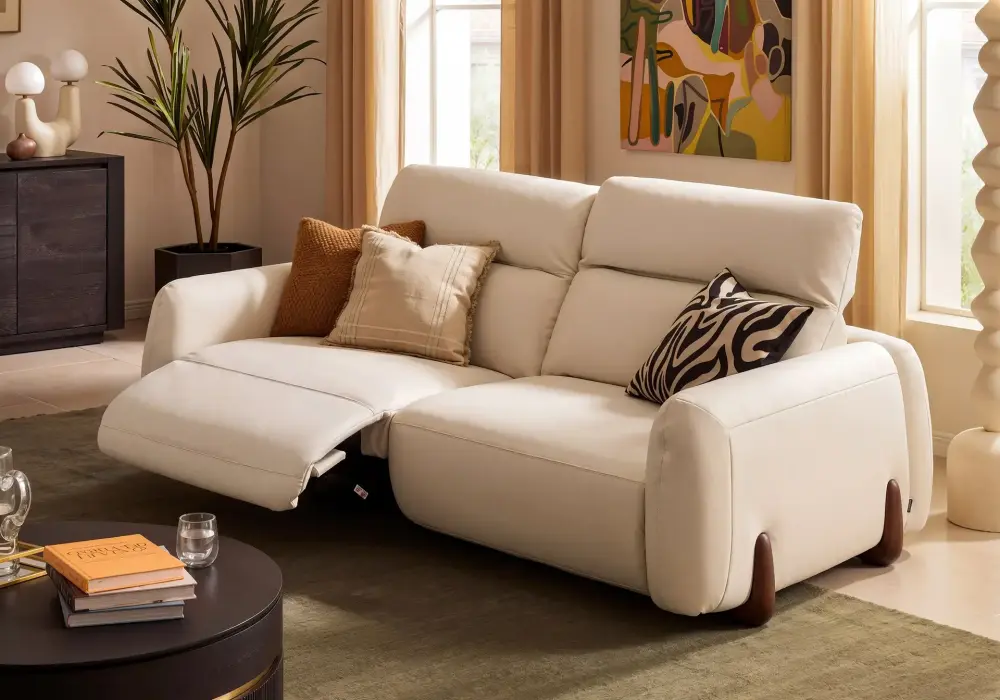
A good example is the Curva 85" Genuine Leather Power Reclining Sofa with Adjustable Headrest. Its combination of genuine leather, power reclining, and adjustable head support illustrates how a reclining sofa can function as a more complete relaxation station rather than simply a larger couch.
For shoppers comparing mechanisms, however, the important question is not whether power is automatically better. Instead ask:
Will the additional adjustment meaningfully improve how I use the sofa every day?
If the sofa is primarily used for occasional TV viewing, a manual mechanism may provide sufficient functionality. If multiple household members regularly use different reclining positions, power controls may justify the additional cost and electrical planning.
Space-Saving Measurements: How Much Clearance Does a Wall Hugger Need?
The most important measurement is not the sofa's advertised width. It is the entire movement envelope.
Before purchasing, measure the sofa in three states:
- Fully upright
- Fully reclined
- Footrest completely extended
For the rear, start at the wall and measure forward to determine how much floor depth remains available. Then check the manufacturer's specified minimum wall clearance.
A practical planning table looks like this:
Measurement | Planning target |
Wall clearance for wall hugger | 76–203 mm depending on model |
Main walkway | 762–914+ mm |
Comfortable walkway | About 914 mm |
Front clearance for footrest | Often 457–610+ mm |
Side clearance | About 76–152 mm minimum, depending on layout |
These are planning ranges rather than universal specifications. The manufacturer's dimensions should always take priority.
Example: 2×3 m Living Room
Imagine an 2×3 m room with a 1905 mm TV on one wall and a reclining sofa opposite it.
A traditional recliner may require 457 mm behind the sofa. If the sofa itself is approximately 1016 mm deep, the seating arrangement consumes about 1473 mm of room depth before accounting for the front footrest.
A wall-hugger sofa requiring 102–152 mm of rear clearance can return more than a foot of floor space to the room.
That reclaimed space can be used for a wider walkway or simply provide a less crowded visual arrangement.
Don't Forget Delivery Measurements
A sofa that fits your room may still fail to fit through the front door.
Before ordering, measure:
- Doorway width and height
- Door opening after removing the door slab
- Hallway width
- Stair width and landing depth
- Elevator door and interior dimensions
- Tight corners
- Ceiling height near staircases
For a large reclining sofa, also check the diagonal depth of the packaged and assembled components. This can determine whether the sofa can rotate through a narrow hallway.
Baseboards, radiators, windowsills, and wall outlets can also change the effective clearance.
Wall Hugger vs. Traditional Recliner: Which Is Better for Your Room?
A wall hugger is not automatically the best choice for every home. Its biggest advantage is spatial efficiency.
A traditional reclining sofa can work well when the room has plenty of depth and the sofa can float away from the wall. That configuration may also create a more flexible furniture arrangement.
A wall hugger becomes more compelling when the room is narrow or when the back of the sofa must remain close to a wall.
Factor | Wall hugger | Traditional recliner | Sleeper sofa |
Rear space efficiency | Excellent | Moderate | Excellent when closed |
Reclining function | Yes | Yes | Usually limited |
Sleeping function | Usually no | No | Yes |
Best for small rooms | Excellent | Moderate | Good |
Layout flexibility | Moderate | Good | Good |
Multi-function potential | High | Moderate | Very high |
A reclining sectional can be another option for larger families. Rather than combining several individual recliners, a sectional can concentrate seating, reclining, and storage functions into one coordinated furniture system.
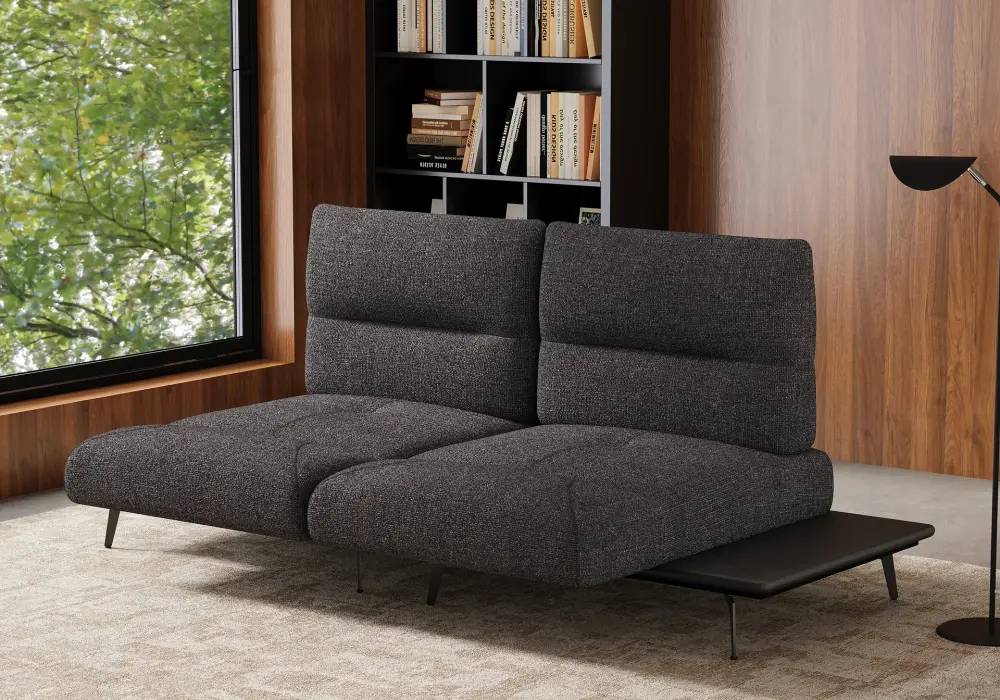
The 2-Piece Yarn-Dyed Fabric and Faux Leather Reclining Sectional Sofa is an example of this broader category. A mixed-upholstery sectional can create a dedicated relaxation zone while providing more seating than a standalone recliner.
For families, the decision should also consider how many people actually need reclining functionality. A fully reclining three-seat sofa may seem attractive, but if only one person reclines regularly, a configuration with one or two reclining seats and stationary seating may use the room more efficiently.
Upholstery, Durability, and Comfort: What Should You Look For?
Once the spatial requirements work, upholstery becomes the next major purchasing decision.
Genuine Leather
Leather provides a structured, premium appearance and is relatively easy to wipe clean. It can also develop a natural patina over time.
However, leather can feel warmer or cooler depending on the room temperature, and not every leather finish performs identically. Buyers should check the specific leather type, protective finish, and care requirements.
Faux Leather
Faux leather can provide a leather-like appearance at a lower price. It is often attractive for families who prioritize easy surface cleaning.
The trade-off is that longevity can vary considerably between materials and finishes. Product specifications should be checked rather than assuming all faux leather performs the same way.
Performance and Woven Fabrics
Textile upholstery can create a softer, more casual appearance and works particularly well with modern, farmhouse, and transitional interiors.
For households with children or pets, look for tightly woven fabrics, stain-resistant finishes, and clearly stated cleaning codes. Yarn-dyed fabrics can also provide visual texture while making the sofa feel less visually bulky than an oversized solid-color reclining sofa.
Regardless of material, evaluate three things before buying:
- Seat support: Does the cushion retain its shape?
- Frame construction: Is the structure designed for repeated reclining movement?
- Mechanism integration: Does the upholstery allow the mechanism to move without excessive friction?
A reclining sofa experiences more mechanical movement than a conventional fixed sofa, so the frame and mechanism deserve as much attention as the upholstery.
Choosing a Wall Hugger for Different Living Scenarios
The right configuration depends heavily on how the room is used.
For a Small Apartment
Prioritize:
- Wall-hugger construction
- Narrow arms
- Compact depth
- Two- or three-seat configuration
- Storage consoles
- Power USB ports if needed
Avoid selecting a sofa solely because it has the smallest overall width. A narrow sofa that requires substantial rear clearance may ultimately consume more usable space than a slightly wider wall-hugger.
For a Family Room
A larger reclining sofa or sectional can make sense when several people regularly watch TV together.
Look for a balance between reclining seats and stationary seating. Storage consoles, cupholders, USB charging, and power controls can reduce the need for additional side furniture.
For a Home Theater
Here, reclining performance becomes more important than conventional sofa styling.
Consider:
- Full footrest extension
- Head and neck support
- Power adjustment
- Adequate front clearance
- Individual seating control
- Durable upholstery
The goal is to create a dedicated viewing environment rather than simply placing a sofa in front of a television.
For Multi-Function Guest Space
If the room doubles as an office or guest room, a sleeper sofa can provide greater flexibility than a dedicated recliner.
In this situation, the buyer should compare the value of reclining functionality against sleeping functionality. A sofa that performs two jobs well may be more useful than one that performs one job exceptionally.
Long-Term Value
Finally, compare more than the sticker price. Look at the mechanism, frame, upholstery, electrical components, warranty coverage, and expected frequency of use.
A $1,000 sofa used occasionally and a $2,000 sofa used every evening should not necessarily be evaluated using the same value equation. For a household that spends several hours a day watching television or relaxing, better support and easier adjustment can have more practical value than a lower initial price.
Turn a Small Living Room Into a More Functional Relaxation Space
The biggest advantage of a wall hugger reclining sofa is not simply that it can sit close to a wall. It is that reclining functionality can be added without automatically consuming the entire room.
Start with measurements rather than appearance. Determine how much rear clearance your room can accommodate, how far the footrest will extend, and whether the sofa can reach its final position through the doorway.
Then choose the mechanism based on actual use. Manual reclining can keep the design straightforward, while power reclining and adjustable headrests make sense when personalized comfort is part of the everyday experience.
Finally, consider whether you need a sofa, sectional, sleeper, or multi-function entertainment seat. The best choice is the one that combines the right footprint with the functions your household will actually use.
Before you buy, measure once, mark the full reclining path on the floor, and compare the result against the manufacturer's specifications. That simple process can prevent the most common small-space mistake: buying a sofa that fits when upright but makes the room unusable when fully reclined.
Quick Buyer Decision Guide
If your priority is… | Consider… |
Minimum rear clearance | Wall-hugger recliner |
Personalized reclining | Power recliner |
Maximum seating | Reclining sectional |
Overnight guests | Sleeper sofa |
Premium appearance | Genuine leather |
Easy everyday cleaning | Faux leather or performance fabric |
Small apartment | Compact wall-hugger sofa |
Dedicated movie room | Power reclining seating |
FAQ
How much clearance does a wall hugger reclining sofa actually need from the wall?
Many wall-hugger sofas require approximately 76–203 mm of rear clearance, but the exact requirement varies by mechanism. Always use the manufacturer's stated minimum rather than relying on a generic number.
How does a wall hugger mechanism differ from a traditional recliner mechanism?
A traditional recliner typically moves its backrest backward as it reclines. A wall hugger uses tracks, linkages, or similar mechanisms to move the seat forward while reclining, allowing the sofa to operate closer to the wall.
Are wall hugger reclining sofas available in both manual and power models?
Yes. Manual models use a lever or mechanical mechanism, while power models use electric motors. Power reclining is generally preferable when users want smoother, more precise positioning or adjustable headrests; manual models can be preferable when simplicity is the priority.
What specific measurements should I take before buying a wall hugger sofa?
Measure the room footprint, required wall clearance, fully reclined depth, footrest extension, side clearance, doorway width, hallway width, stair turns, and elevator openings. Also account for baseboards, radiators, outlets, and other wall projections.
Can a wall hugger sofa work in a small apartment?
Yes. Wall-hugger construction is particularly useful in compact apartments because it reduces the rear clearance required for reclining. However, you still need enough space in front of the sofa for the footrest and enough room for normal circulation.
How do I maintain and troubleshoot common wall hugger problems?
Maintenance requirements depend on the upholstery and mechanism. Keep the area beneath the sofa free of objects that could interfere with moving components, avoid placing power cords where mechanisms can pinch them, and follow the manufacturer's upholstery and mechanism-care instructions. For electrical or mechanical failures, use the manufacturer's service guidance rather than attempting to disassemble the reclining mechanism yourself.
What warranty, weight capacity, and child/pet safety features should I look for?
Check the stated weight capacity, frame and mechanism warranty, upholstery coverage, and electrical-component coverage. For homes with children or pets, prioritize stable construction, protected moving mechanisms, durable upholstery, and controls that prevent unintended operation when appropriate. Also make sure children do not play underneath or around moving footrests and reclining mechanisms.