

When homeowners search for a luxury kitchen island, size is often the first thing that comes to mind. However, the feature that most strongly communicates quality is usually the material. A well-selected countertop can make a kitchen island feel architectural, custom-made, and built to last, while an oversized island with ordinary finishes can look surprisingly generic.
For that reason, the best approach is to design a luxury kitchen island from the material outward. The countertop establishes the visual focal point, while cabinetry, hardware, integrated appliances, and lighting are selected to complement and protect it. Even the island's scale and edge profile should respond to the characteristics of the chosen surface.
From natural marble and quartzite to engineered quartz, granite, premium wood, and responsibly sourced stone, each material creates a different version of luxury. Understanding those differences makes it easier to choose a surface that suits both the kitchen's design and its everyday demands.
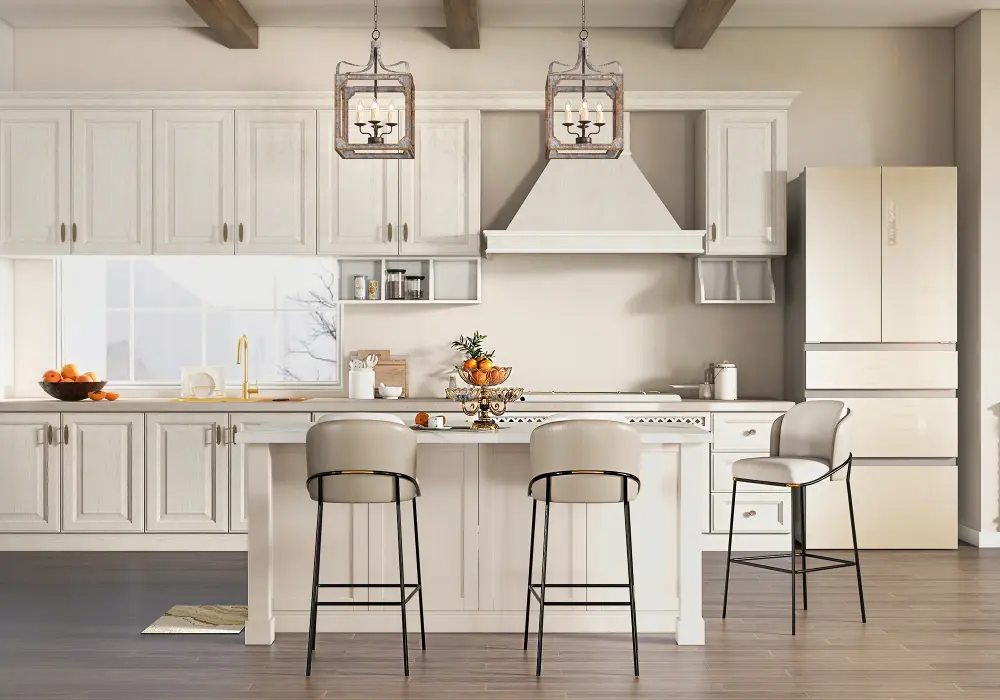
Modern 1829mm Wood Kitchen Island
Table of Contents
Premium Countertop & Surface Materials: The Defining Choice
The countertop is the most important material decision for a luxury kitchen island because it combines visual impact with daily performance. It is one of the largest continuous surfaces in the room, which means its color, texture, pattern, and edge treatment can influence the entire kitchen.
For homeowners comparing luxury kitchen island materials, the key questions are not simply which material looks most expensive. Consider durability, maintenance, heat resistance, stain resistance, fabrication requirements, slab size, and the way natural pattern will appear across the finished island.
Luxury Kitchen Island Material Comparison
Material | Luxury appeal | Maintenance | Heat & stain considerations | Long-term potential |
Marble | Exceptional veining and natural depth | Requires more care; can scratch or etch | Good heat tolerance, but acids may etch | Can last for decades with proper care |
Quartzite | Natural stone appearance with high hardness | Relatively straightforward maintenance | Strong durability; care varies by stone | Decades to lifetime-level service |
Quartz | Consistent color and engineered precision | Low maintenance; typically no sealing | Stain resistant, but direct high heat should be avoided | Long-term residential use |
Granite | Strong natural pattern and durability | Generally easy to maintain | Excellent heat resistance; localized thermal shock remains a concern | Decades or longer with suitable care |
Wood | Warm, tactile, handcrafted character | Requires refinishing or routine care | More sensitive to heat, moisture, and cutting | Can be repaired and renewed repeatedly |
Reclaimed / sustainable stone | Unique provenance and individuality | Depends on stone type and condition | Performance depends on the original material | Potentially decades with correct care |
Marble Kitchen Islands: The Traditional Luxury Choice
A marble kitchen island remains one of the most recognizable expressions of high-end design. Its greatest advantage is natural variation. No two slabs have exactly the same veining, and a carefully selected piece can become the visual identity of the entire kitchen.
Calacatta-, Carrara-, and other marble varieties can create very different moods, ranging from crisp and contemporary to soft and traditional. The most luxurious effect often comes from selecting the actual slab based on its veining rather than choosing from a small sample.
Marble does require a realistic approach to maintenance. Because marble is a calcium-based stone, acidic foods and liquids can cause etching. Sealing can help reduce staining but does not make the material completely resistant to chemical reaction.
For homeowners who appreciate natural patina and variation, this is not necessarily a disadvantage. Instead, it means a marble island should be chosen for both its appearance and the lifestyle it will support.
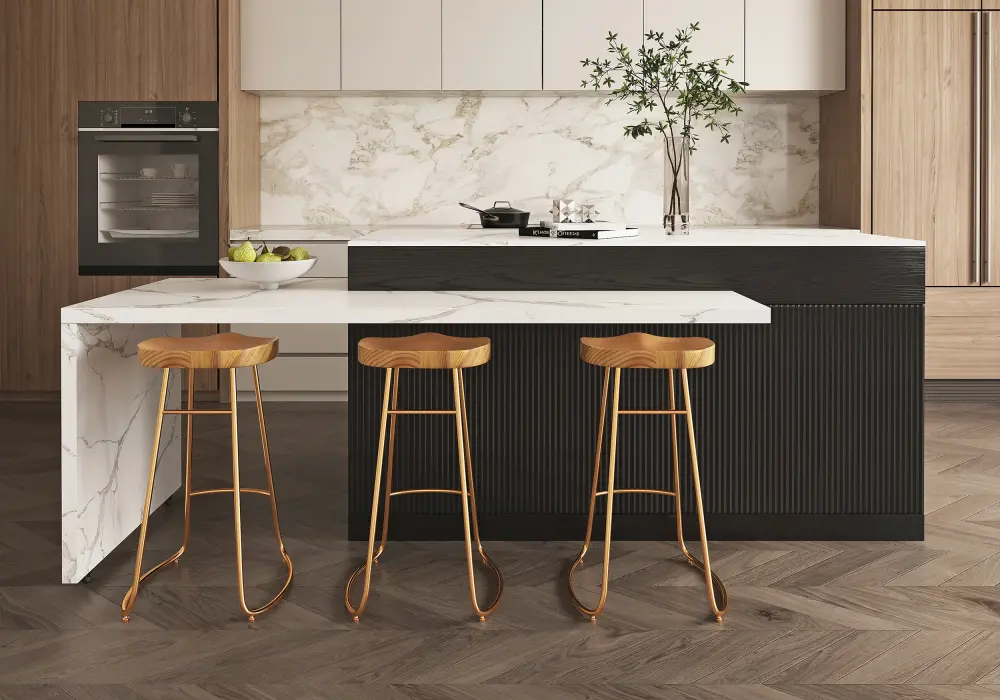
Extendable Marble Pattern Kitchen Island
Quartzite Kitchen Islands: High-End Style with Durability
A quartzite kitchen island can offer a compelling combination of natural beauty and performance. Quartzite is a natural metamorphic stone known for its hardness, density, and durability.
One of its biggest advantages in luxury design is the ability to achieve dramatic natural movement without giving up the substantial feel expected from a premium stone surface.
Quartzite is particularly effective when the slab has continuous veining. A fabricator can plan the layout so that the movement continues through the island's sides or selected edges, making the fabrication itself part of the design.
Because natural stones vary, homeowners should still confirm the properties and recommended care of the specific quartzite slab they are purchasing rather than relying solely on its name.
Quartz Countertops: Low-Maintenance Luxury
For a homeowner who wants a refined appearance with less routine maintenance, quartz can be an attractive alternative. Engineered quartz offers a wide range of colors and patterns, from minimalist solid surfaces to designs inspired by natural stone.
Because quartz is nonporous, routine sealing is generally unnecessary.
Its key limitation is heat. Manufacturers generally recommend using trivets or heat-resistant pads because direct or sudden high heat can damage the resin components in an engineered quartz surface.
For contemporary kitchens, quartz can communicate luxury through consistency, precision, and a clean architectural finish rather than through natural irregularity.
Granite Kitchen Islands: Durable Natural Stone
Granite remains relevant in luxury kitchen design because it combines substantial visual weight with strong everyday performance. According to the Natural Stone Institute, granite provides excellent abrasion resistance, durability, and heat resistance.
The difference between an ordinary granite island and a high-end one often comes down to slab selection and fabrication. A distinctive slab with unusual mineral variation can create a more customized appearance than a repetitive or predictable pattern.
For busy kitchens, granite can be particularly attractive when durability is a major purchasing consideration.
Wood Kitchen Islands: Warmth as a Luxury Feature
Not every luxury kitchen island needs to be dominated by stone. Premium hardwood introduces warmth, texture, and craftsmanship that can soften an otherwise architectural kitchen.
Wood can work especially well when used to contrast with stone. For example, a timber island countertop can create a warmer focal point against pale cabinetry and a stone perimeter countertop.
Its maintenance requirements are different from those of stone. Scratches, moisture exposure, and heat require greater attention, but one important advantage is repairability: depending on the finish and construction, wood can often be sanded, refinished, and renewed.
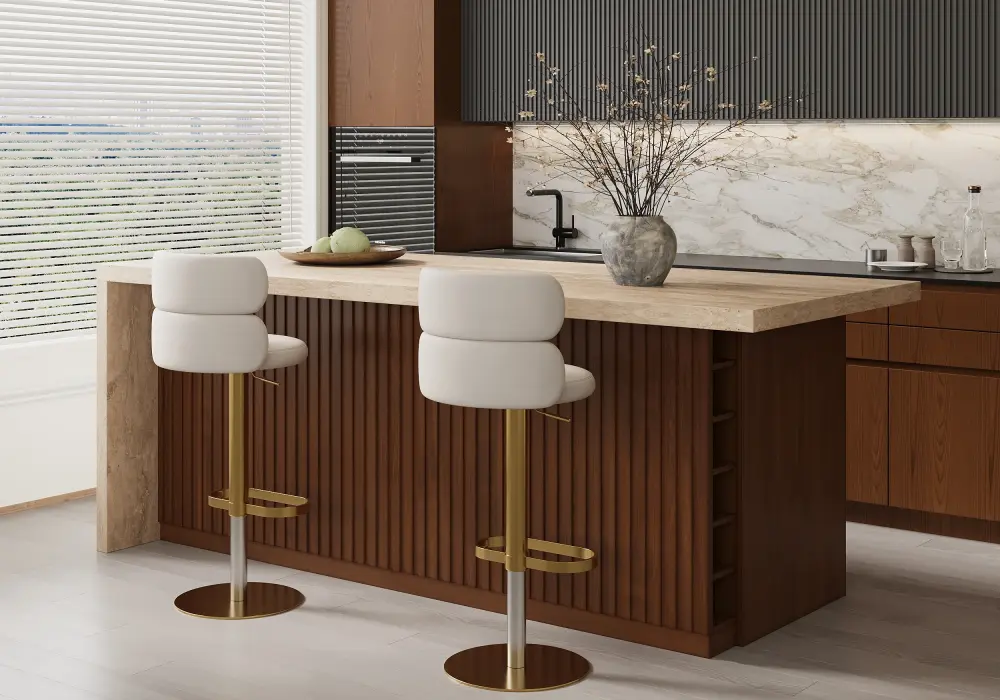
Modern Kitchen Island Walnut Laminate
Reclaimed and Sustainable Materials for Luxury Kitchens
Sustainable materials can also support a high-end kitchen island. Reclaimed stone, for example, can provide unusual texture and provenance while reducing the need for newly extracted material.
The commercial value of a sustainability claim depends on verification. For natural stone, buyers can look for documentation such as an Environmental Product Declaration (EPD) or certification associated with the ANSI/NSI 373 Natural Stone Sustainability Standard.
For wood, FSC certification can provide evidence of responsible sourcing. FSC labels distinguish between categories such as FSC 100% and FSC Mix, so the exact certification claim should be checked rather than assumed from the word “sustainable.”
How Material Choice Signals Different Luxury Levels
Material is also one of the clearest ways to establish a project's perceived price tier. A quality quartz countertop with restrained cabinetry can create an elevated look without extreme fabrication costs. Moving into rare natural stone, premium quartzite, oversized slabs, complex edge profiles, bookmatching, or waterfall fabrication increases both material and installation complexity.
The important point is that expensive-looking design is not simply about choosing the highest-priced material. It is about selecting a material whose natural or engineered qualities can be showcased through fabrication and detailing.
Slab Size, Veining and Waterfall Edges
The physical properties of the material should influence the island's final dimensions.
Large islands may require multiple slabs, making seam location and pattern continuity important design considerations. A highly veined marble or quartzite can look less impressive when a seam cuts through a major visual feature.
A waterfall kitchen island can create an especially dramatic effect because the countertop material continues vertically over the side panel. The best results depend on precise fabrication and careful vein matching.
In premium projects, the slab itself becomes part of the architecture. Veins may be aligned across a mitered edge, balanced around the island, or bookmatched to create intentional symmetry. This level of planning can be more visually meaningful than simply increasing countertop thickness.
Cabinetry & Hardware That Complement Premium Materials
Once the countertop has been selected, cabinetry should play a supporting role.
Choosing Cabinet Colors Around Stone Veining
For a dramatic marble or quartzite island, neutral cabinetry can prevent the kitchen from becoming visually overloaded. Warm white, natural oak, walnut, taupe, or muted gray can all work depending on the undertone of the stone.
The same principle applies in reverse. If the island uses a quieter surface, cabinetry can provide more texture or tonal contrast.
Two-Tone Kitchens and Material Contrast
Two-tone kitchens are particularly effective when the island is treated as the material centerpiece. A wood-toned island against painted perimeter cabinetry, for example, creates a clear visual hierarchy.
The most successful combinations do not try to match every finish. Instead, they establish relationships between undertones, grain, and veining.
Premium Hardware and Soft-Close Details
Hardware should reinforce the countertop rather than compete with it. Warm brass, brushed metal, polished chrome, or dark finishes can each work depending on the stone and cabinetry.
Once homeowners invest in premium countertop materials, the rest of the cabinetry should meet the same quality expectations. Soft-close drawers, durable hardware, accurate reveals, and well-made storage systems help the island feel genuinely custom.
Specialized inserts can also protect the material investment. Trivets, heat-resistant pull-outs, tray organizers, and concealed storage can prevent heavy cookware or hot items from unnecessarily stressing premium surfaces.
Integrated Features That Preserve the Material’s Look
A luxury kitchen island can contain a large amount of functionality without appearing visually busy. The key is to integrate these features in ways that preserve the countertop as the visual hero.
Flush-Mounted and Undermount Sinks
A flush or undermount sink creates a cleaner transition between the countertop and sink basin. With stone surfaces, this allows the material to appear more continuous and makes crumbs or spills easier to move directly into the sink.
The fabrication details matter. A high-quality installation should maintain clean, precise joins so that the sink does not visually interrupt an otherwise premium surface.
Hidden Refrigeration Drawers
Refrigeration drawers can be integrated into the island cabinetry without introducing a large visible appliance. This is especially useful when the homeowner wants the island to read primarily as furniture or architecture.
The same principle can apply to dishwashers, ice makers, and other appliances that would otherwise break up the cabinetry.
Disappearing Pop-Up Outlets
Power is essential in a modern kitchen, but visible outlets can interrupt a large expanse of premium stone or wood. Pop-up or concealed electrical solutions allow power access when required and keep the countertop cleaner when it is not.
For a luxury island, the best integrated feature is often the one that becomes almost invisible.
Lighting, Finish Pairing, Cost & ROI
Lighting should be planned specifically around the selected material. The objective is not simply to make the island bright, but to reveal the qualities that justified the material investment.
Lighting That Highlights Veining and Grain
Pendant lights positioned above an island provide functional illumination while also framing the countertop visually. On polished stone, the angle and intensity of lighting can influence reflections. On honed stone, softer illumination can reveal texture. On wood, directional light can emphasize grain and craftsmanship.
Under-cabinet and architectural lighting can provide another layer of illumination, particularly around the perimeter cabinetry surrounding the island.
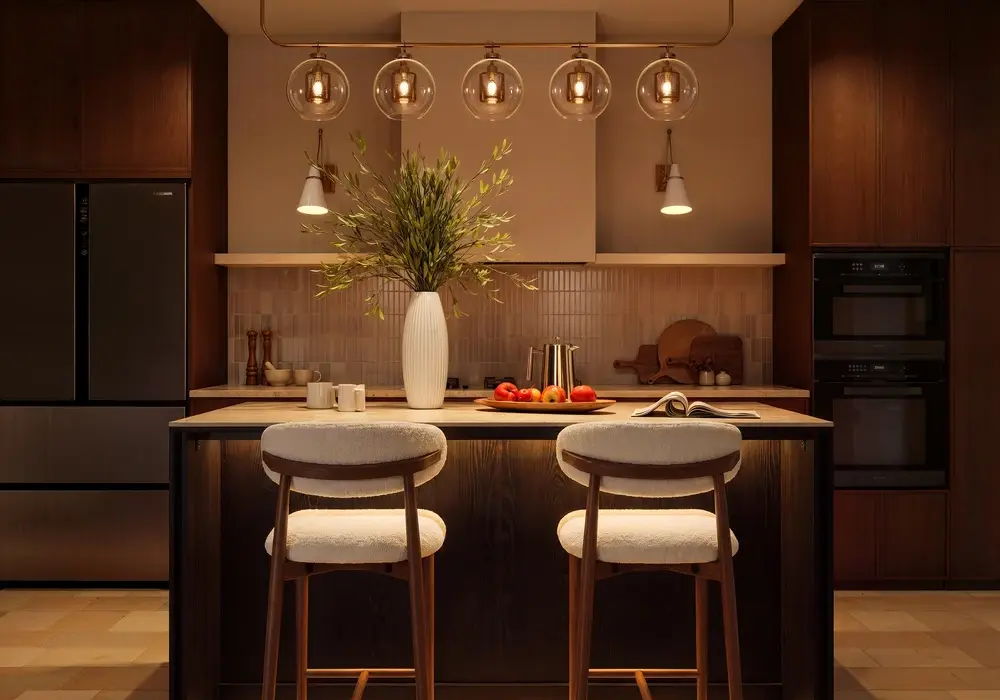
Faux Travertine Sintered Stone Kitchen Island
Metal Finishes That Support Premium Surfaces
Metal finishes should relate to the countertop's undertones. Warm brass can complement cream marble and warm timber, while cooler metals may work naturally with gray stone and contemporary cabinetry.
Rather than matching every fixture, use the countertop as the reference point and repeat selected tones throughout the kitchen.
Understanding Luxury Kitchen Island Cost
The cost of a luxury kitchen island depends on far more than its dimensions. The final investment is typically shaped by the countertop material, slab quantity, cabinetry construction, fabrication complexity, integrated appliances, plumbing, electrical work, installation, and the level of customization required.
Material choice can have a particularly significant effect on the overall budget. Standard engineered surfaces may offer a refined appearance with predictable fabrication requirements, while premium marble, quartzite, rare granite, reclaimed stone, or specialty timber can require a higher material investment. Large-format slabs, bookmatching, waterfall edges, thickened profiles, and complex cutouts can add further fabrication and installation costs.
Project scale also matters. A compact kitchen may create a strong luxury statement by concentrating the budget on one exceptional countertop and carefully detailed cabinetry. By contrast, a large open-plan kitchen may require multiple slabs, more extensive cabinetry, additional structural support, and more complex installation.
Rather than focusing only on the highest possible material price, a more practical approach is to allocate the budget according to visual impact and long-term performance. Investing in a distinctive, well-fabricated countertop, precise edge detailing, and high-quality installation can often contribute more to the perceived luxury of an island than simply increasing its size.
Because material availability, manufacturing standards, labor rates, and installation costs vary significantly between markets, luxury kitchen island pricing is best evaluated through a detailed project-specific quotation rather than a universal price range.
What Matters Most for Kitchen Island Resale Value?
There is no universal percentage that determines how much of a kitchen island investment will be recovered at resale. However, material quality contributes heavily to the perceived finish level of the kitchen.
A well-chosen countertop can remain visually relevant for many years, while an overly trend-driven surface may date more quickly. For this reason, durable, distinctive, and well-fabricated materials can be a strategic investment even when the primary goal is design rather than resale.
Ultimately, luxury is not created by spending the maximum amount. It comes from using the budget where the material has the greatest visual and functional impact.
FAQ: Luxury Kitchen Island Materials
What materials make a kitchen island look and feel truly luxurious?
Marble and quartzite are popular choices for homeowners who want natural veining and visual depth. Granite offers durability and natural variation, while quartz provides consistent patterns with relatively low maintenance. Premium wood can add warmth and handcrafted character. The right choice depends on the desired appearance, maintenance level, and daily use.
How does countertop material affect the ideal size and edge style of a luxury island?
The slab's dimensions, thickness, weight, pattern direction, and fabrication requirements should be considered before determining the island size. Large uninterrupted surfaces work particularly well with visually dramatic stone. Waterfall edges and bookmatched designs can increase the impact of premium materials but also require more precise fabrication.
What are realistic cost ranges for a luxury kitchen island?
Custom kitchen islands can range from several thousand dollars to 10,000 dollars or significantly more depending on size, cabinetry, appliances, labor, and countertop material. Premium slabs, complex edges, additional stone, and integrated features can increase costs substantially. Regional labor and material availability also affect pricing.
How do integrated sinks, refrigeration, and outlets preserve a premium island's appearance?
These features reduce visible interruptions. Undermount or flush-mounted sinks create cleaner countertop transitions, while concealed refrigeration drawers and pop-up outlets help maintain a visually uninterrupted surface. This allows the premium material to remain the island's focal point.
Which cabinetry finishes and lighting styles complement marble or quartzite?
Neutral cabinetry, natural timber, and restrained painted finishes usually allow dramatic stone to remain the focal point. Lighting should be selected to reveal the stone's veining, surface finish, and edge detail. Pendant lighting can provide both task illumination and visual framing.
Are sustainable or reclaimed materials suitable for a high-end kitchen island?
Yes. Reclaimed stone and responsibly sourced wood can create distinctive luxury interiors while supporting sustainability goals. Look for verifiable credentials such as EPD documentation, relevant natural-stone sustainability certification, or FSC certification for wood. Always ask the supplier for documentation supporting specific environmental claims.