

A grey couch is one of the easiest pieces of furniture to live with—but choosing a TV stand to go with it can be surprisingly tricky. Should you choose white, black, oak, walnut, or another shade of grey? The good news is that there is no single “correct” answer. The key is understanding the undertone of your grey couch before choosing a TV stand color.
Many homeowners focus only on whether their sofa is light, medium, or dark grey. However, two grey fabrics with the same depth can look completely different if one has warm beige undertones and the other has cool blue undertones. That small difference can make a wood TV stand look either perfectly coordinated or oddly out of place.
In this guide, you’ll first learn how to identify whether your grey couch is warm, cool, or neutral. Then we’ll compare the best TV stand colors and wood finishes for different grey sofas. We’ll also cover TV stand proportions, wall-mounted TVs, room layouts, lighting, rugs, and accessories. By the end, you should be able to look at your own living room and confidently choose a TV stand color that works.
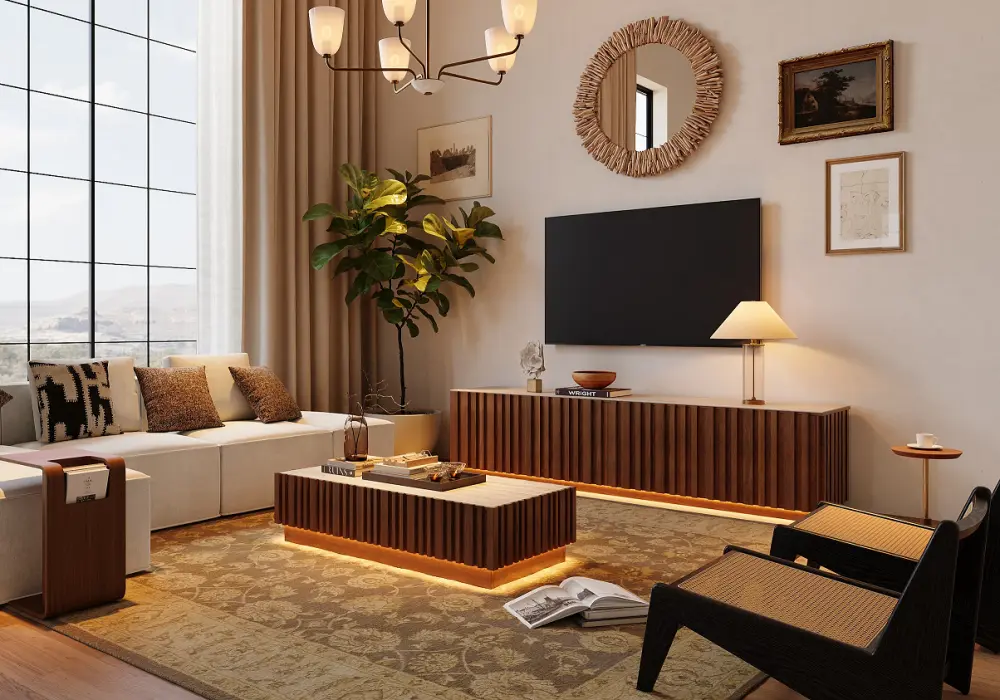
Aura 2108 mm Ash Wood Fluted Walnut TV Stand of Homary
Table of Contents
Is Your Grey Couch Warm or Cool? How to Find Its Undertone First
Before choosing a TV stand, determine the undertone of your sofa. This is more important than simply knowing that your couch is “grey.”
A warm grey usually contains subtle beige, brown, taupe, or yellow undertones. A cool grey tends to lean toward blue, green, or slightly violet tones. A neutral grey sits in the middle and works well with a wider range of colors.
Compare the Couch in Natural and Artificial Light
Start by looking at your sofa during the day, preferably near a window. Natural daylight gives you the clearest idea of its true color.
Then compare it under your regular living-room lighting at night. Warm LED bulbs can make grey fabric appear more beige or brown, while cool white bulbs may emphasize blue undertones.
Take a photo in both types of lighting if you are shopping online. If your sofa appears noticeably beige in daylight, it is probably warm grey. If it looks distinctly blue or silver, it is more likely cool grey.
Try the White Paper Test
The white paper test is a simple way to reveal an undertone.
Place a sheet of clean white paper directly next to the sofa. Avoid cream or off-white paper because it can distort the comparison.
Look at the grey fabric against the pure white background:
- If the fabric looks slightly beige, taupe, or brown, it is likely warm grey.
- If it looks blue, silver, or slightly green, it is likely cool grey.
- If it still looks simply grey without a noticeable shift, it is probably neutral grey.
This test works particularly well for upholstered sofas with textured fabrics, where subtle undertones can be difficult to see at first.
Use These Grey Samples as a Reference
HEX values can’t perfectly reproduce real upholstery, but they can give you a useful comparison when browsing furniture online.
Grey Type | Approx. HEX | Approx. RGB | Typical Undertone | Best TV Stand Directions |
Warm Grey | #A8A29A | 168, 162, 154 | Beige / Taupe | White, oak, walnut, brass |
Neutral Grey | #96999B | 150, 153, 155 | Balanced | Oak, black, white, walnut |
Cool Grey | #8E969F | 142, 150, 159 | Blue / Silver | Black, warm oak, walnut, white |
These are reference colors rather than exact fabric matches. Your sofa may look different depending on its material, lighting, and surrounding colors.
The Best TV Stand Colors for Light, Slate, and Charcoal Grey Couches
The depth of your grey sofa also matters. A light grey couch creates a very different visual balance from a deep charcoal sectional.
Light Grey Couch
A light grey sofa works particularly well with white, light oak, medium oak, walnut, or black.
For a small apartment, a white or light-oak TV stand can keep the room looking open and bright. This combination works especially well when your walls are white or pale beige.
For a modern room, try a black TV stand. The strong contrast gives a light grey sofa a sharper, more contemporary appearance without making the room feel overly dark.
Slate or Medium Grey Couch
Medium grey, sometimes called slate grey, is one of the easiest shades to style.
It pairs beautifully with:
- Natural oak
- Walnut
- Matte black
- Soft white
- Greige or taupe
For a modern mid-century living room, walnut is especially effective. The warm brown tones of walnut prevent the grey sofa from looking too cold, while the darker wood adds visual depth.
For a more relaxed farmhouse-inspired space, choose light or natural oak with simple hardware and clean lines.
Charcoal Grey Couch
A charcoal sofa already creates a strong visual anchor, so your TV stand does not always need to be dark.
A light oak or warm white TV stand can create contrast and prevent the room from becoming too heavy. A black TV stand, on the other hand, produces a dramatic monochromatic effect.
The best choice depends on the rest of your room:
Grey Couch | TV Stand Color | Overall Effect | Good For |
Light Grey | White | Bright and airy | Small apartments |
Light Grey | Light Oak | Warm and relaxed | Scandinavian rooms |
Light Grey | Black | Crisp and modern | Contemporary spaces |
Slate Grey | Oak | Balanced and natural | Casual family rooms |
Slate Grey | Walnut | Rich and sophisticated | Mid-century interiors |
Charcoal | White | High contrast | Minimalist rooms |
Charcoal | Black | Dramatic and modern | Modern interiors |
Charcoal | Warm Wood | Softer and cozier | Transitional spaces |
Oak, Walnut, Black, or White? Choosing the Right TV Stand Finish
Once you know the right color family, the next decision is the finish.
Oak: Bright, Versatile, and Easy to Style
Oak is one of the safest choices for a grey sofa. Its natural grain adds warmth without creating too much visual weight.
Approximate light-oak reference:
HEX #C9A66B | RGB 201, 166, 107
Choose oak when your room feels slightly cold or when you want a casual, natural look. It works especially well with light and medium grey sofas.
Oak is also practical because small scratches and everyday wear tend to be less obvious than they are on very dark finishes.
Walnut: Warm and Sophisticated
Walnut is darker and richer than oak, making it a strong choice for medium or cool grey sofas.
Approximate walnut reference:
HEX #6B4226 | RGB 107, 66, 38
A walnut TV stand can make a cool grey couch feel warmer without forcing you to repaint the room. It is particularly attractive in mid-century, contemporary, and transitional interiors.
Because walnut is visually heavier, however, make sure the room has enough light or lighter elements—such as a pale rug or white walls—to maintain balance.
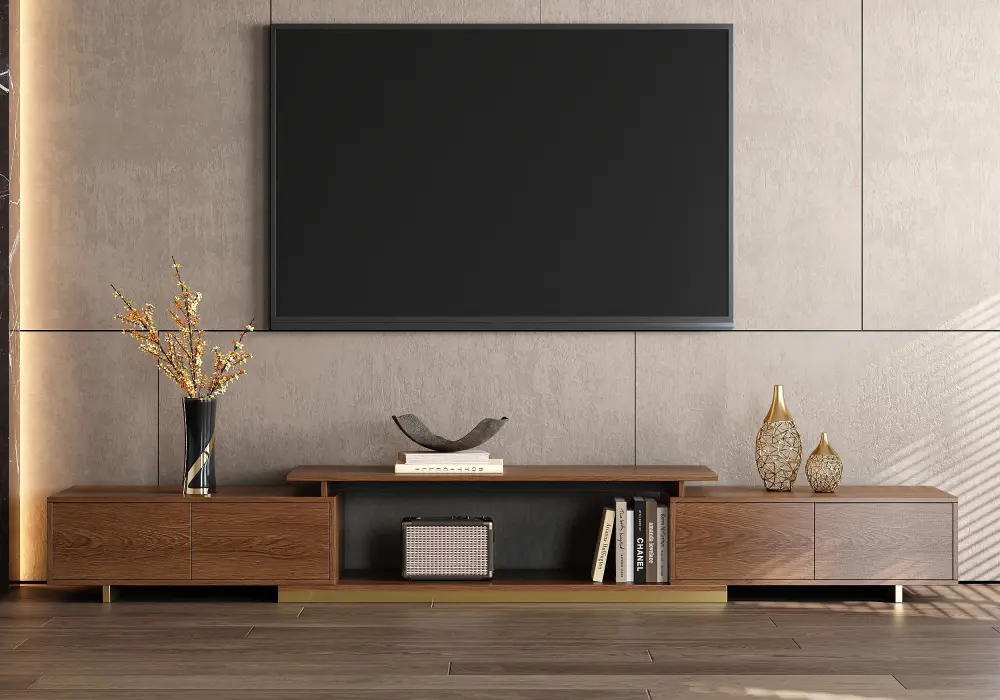
Mordel 1600 mm-2388 mm Extendable Walnut TV Stand of Homary
Maple: Clean and Subtle
Maple offers a lighter, softer wood appearance than walnut. It works particularly well when you want the warmth of wood without a strong orange or brown contrast.
Approximate maple reference:
HEX #D9B382 | RGB 217, 179, 130
Maple can be a good choice for neutral grey sofas, especially in minimalist rooms where you want furniture to feel light and understated.
Bleached or Smoked Wood
Bleached wood is ideal when you want a lighter, contemporary look. It can pair nicely with cool grey, white walls, and neutral textiles.
Smoked or darkened wood provides the opposite effect. It adds depth and works especially well with light or medium grey sofas.
Black vs. White TV Stands
A black TV stand is usually the better choice when you want contrast and a modern appearance. It visually anchors the television and can connect with black lamps, picture frames, hardware, or coffee-table legs.
A white TV stand creates a softer, brighter effect. It is especially useful in small rooms or rooms with charcoal sofas, because the contrast helps break up large areas of dark furniture.
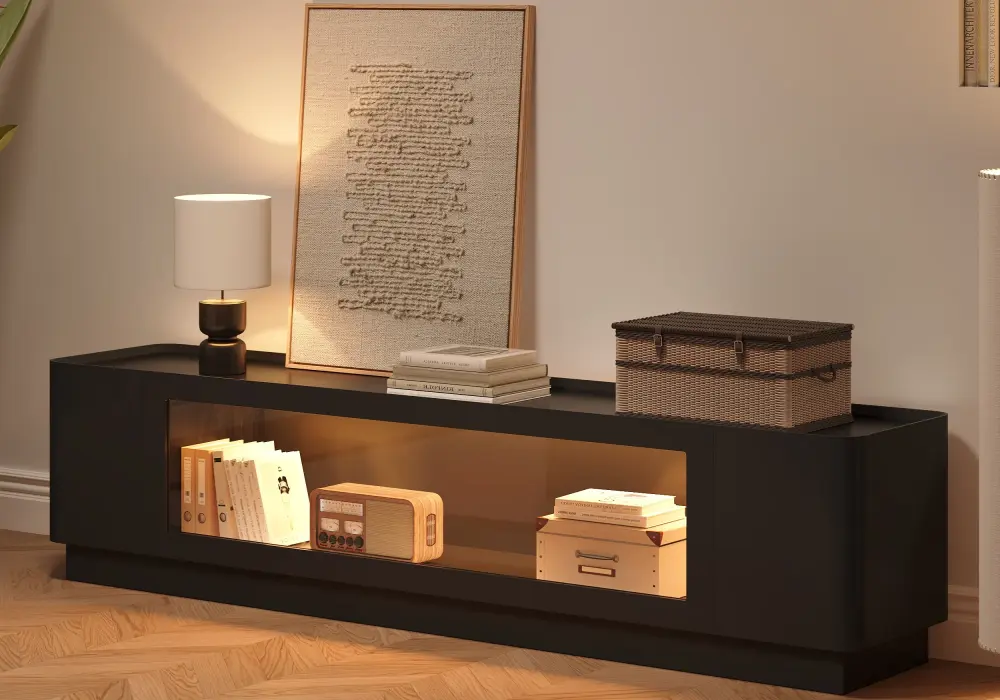
Glass Door Black TV Stand of Homary
Does Size Affect the Color Match? Proportion and Wall-Mount Considerations
Color does not exist in isolation. The size of your TV stand can change how that color feels in the room.
A useful starting point is to make the TV stand about 102–203 mm wider than the television on each side.
For example, if your TV is 1397 mm wide, a stand around 1600–1803 mm wide can create a more balanced appearance.
The formula is:
TV stand width = TV width + 203–406 mm
This isn't a strict rule, but it gives you a practical starting point.
Why Proportion Changes Color Balance
Imagine a small two-seat grey sofa paired with a massive black media console. Even if black technically matches the sofa, the room can feel visually top-heavy.
The same black finish on a properly scaled console may look elegant and intentional.
Large dark furniture creates a stronger visual block than light furniture. Therefore, when using black, walnut, or another deep finish, proportion becomes particularly important.
Height and depth matter too. A very tall TV stand can create another horizontal or vertical color band in the room, while a low console usually makes the wall feel more open.
Wall-Mounted TV vs. TV Stand
A wall-mounted television changes the composition considerably.
When the TV is mounted directly on the wall, you remove the physical mass of the television from the console. The eye sees more of the wall, and the TV stand becomes a separate furniture element rather than one large visual block.
This can make combinations such as grey sofa + oak TV stand + wall-mounted TV feel lighter and more spacious.
With a traditional floor-standing TV, the television and console visually merge into a larger zone. In this arrangement, choosing similar or intentionally contrasting colors becomes more important.
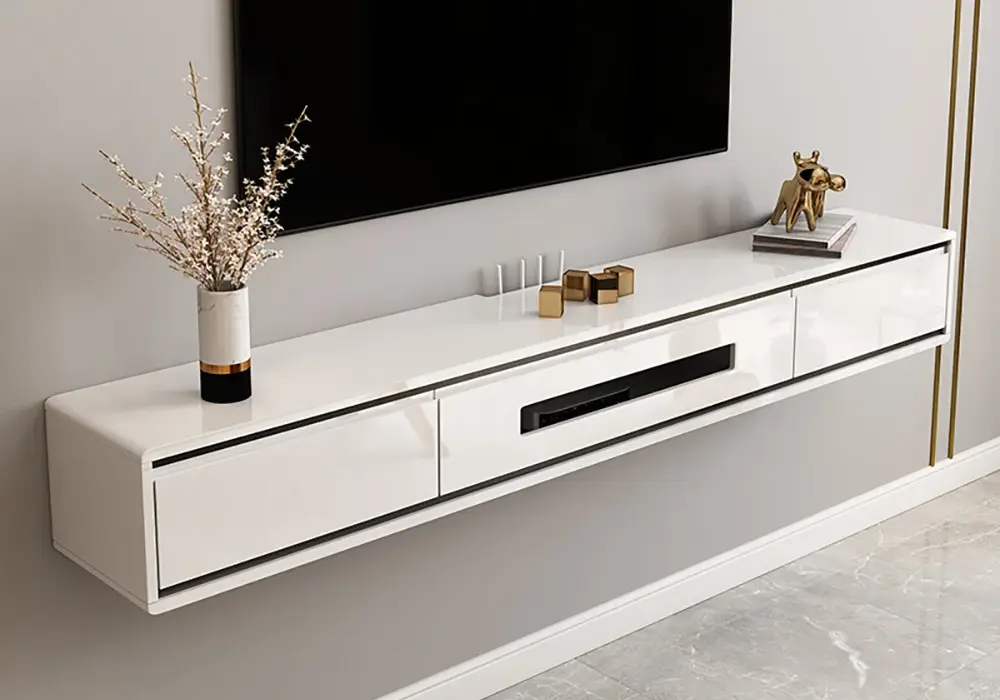
Floating TV Stand of Homary
Three Common Room Setups
Room Type | Suggested Combination | Layout Tip |
Small living room | Light grey sofa + light oak or white stand | Use a low-profile console to keep the room open |
Open-plan living/dining area | Medium grey sofa + walnut stand | Repeat walnut or black elsewhere to connect the zones |
Living room with fireplace | Charcoal sofa + light oak or white stand | Let the lighter console balance the dark fireplace |
In an open-plan home, repetition is especially useful. For example, a walnut TV stand can look more intentional when the dining chairs, coffee table, or shelving also include similar warm wood tones.
Finishing Touches — Lighting, Rugs, and Textiles to Tie It Together
Even a perfectly chosen TV stand can look disconnected if the rest of the room does not support it.
Pay Attention to Lighting
Lighting changes the way grey and wood colors are perceived.
Warm light around 2700K–3000K tends to emphasize beige, brown, and golden wood tones. Cooler light can make grey look bluer and make warm wood appear more contrasted.
For a warm grey sofa and oak TV stand, warm lighting usually creates a cohesive atmosphere.
For a cool grey sofa with a black console, neutral or slightly cool lighting can reinforce the clean, contemporary look.
Use a Rug as the Bridge
A rug is one of the easiest ways to connect the sofa and TV stand.
For a grey sofa with warm wood, look for rugs containing:
- Cream
- Beige
- Taupe
- Muted brown
- Soft terracotta
For a grey sofa with black or white furniture, consider:
- White and grey
- Charcoal
- Black
- Soft geometric patterns
- Greige
The rug does not need to match either piece exactly. It simply needs to contain one or two related colors.
Add Matching Metal Accents
Metal finishes can also help unify the room.
For warm wood and warm grey, brass, antique gold, or bronze can reinforce the cozy palette.
For cool grey and black, matte black, chrome, or brushed steel may feel more natural.
Don't Forget Cushions and Throws
A few cushions can create the final connection between the sofa and TV stand.
For example, with a medium grey sofa and walnut console, add cream cushions, a muted brown throw, and a rug with warm beige accents. Suddenly, the furniture pieces feel like part of one planned palette rather than separate purchases.
The goal is not to make every item the same color. Instead, repeat a small number of colors throughout the room.
FAQ
How do I know if my grey couch is warm or cool toned?
Place a sheet of pure white paper beside the sofa and look at it in natural daylight. If the grey appears beige, taupe, or slightly brown, it is warm. If it looks blue or silver, it is cool. If there is little noticeable shift, it is probably neutral.
What color TV stand works best with a light grey couch?
Light grey sofas are highly versatile. White and light oak create a bright, airy look, while black provides stronger modern contrast. Walnut can also work when you want the room to feel warmer and richer.
Should I pick oak or walnut for a TV stand with a medium grey sofa?
Both work well. Choose oak for a lighter, more casual room and walnut for a richer, more sophisticated appearance. Walnut is particularly effective with cool medium-grey sofas because its warm brown tones balance the cooler upholstery.
Is black or white better for a modern grey-couch living room?
It depends on the atmosphere you want. Black creates stronger contrast and a more dramatic modern look. White feels lighter and cleaner, making it especially useful in small spaces or rooms with darker grey sofas.
How wide should a TV stand be compared to my TV and couch?
As a practical starting point, choose a TV stand that is approximately 102–203 mm wider on each side of the TV. The stand does not have to be as wide as the couch, but it should be visually substantial enough to feel proportional to the seating area.
Wall-mounted TV or TV stand—which is better for a grey-couch living room?
A wall-mounted TV generally makes the room feel more open because it reduces visual mass. It is especially helpful in smaller rooms. A floor-standing TV and console create a stronger visual block and can be useful when you want the media area to feel more substantial.