

Choose a coffee table that solves a daily need, fits the seating arrangement, and leaves the room easy to use. When comparing coffee tables, begin with the job: a shared surface for drinks, concealed storage, occasional meals, or a raised work surface. Then check the dimensions, shape, height, and access around it. The most useful table is the one that suits your routine in its normal position, rather than one selected mainly for an impressive extra feature.
The question “what coffee table?” can lead to hundreds of attractive options. A shorter search begins with a simple sentence: this table needs to help us do a particular thing. That might be keeping remotes organized, serving snacks during films, or giving a small living room a surface that can change function.
Once the purpose is clear, appearance becomes easier to judge. You can compare finishes and forms among tables that already meet the room's practical requirements.
Table of Contents
Name Your Main Use Before Comparing Features
Think about the last few evenings in the room. Where did you put a drink, book, phone, or plate? Which objects stayed out because they lacked storage? Which activities would have been easier with a surface nearby?
Choose one primary use and one secondary use. For example, the main job might be drinks and snacks, with occasional puzzle space. Or it might be concealed storage, with a lift-top used for a short laptop session. This prevents a long feature list from distracting you from what you actually need.
Decide which activities belong elsewhere. If you already have a comfortable desk, a work-height mechanism can move down your list. If family meals happen at the dining table, a stable surface and accessible drawers matter more than a transforming top.
Write down the objects the table should hold during normal use. A pair of mugs and a remote require a different arrangement from several serving bowls or a large board game. Test with those objects instead of guessing from a styled photograph.
Size the Table Around the Seating and the Routes
Start with these widely used guidelines, then adjust for your room:
- Length: about two-thirds of the sofa's length. A 72-inch sofa pairs well with a 40–48 inch table; an 84-inch sofa with a 48–56 inch table.
- Distance from the sofa: 14–18 inches, close enough to reach a drink without leaning far, with room for your legs to pass.
- Walkways: leave at least 30–36 inches on any route people use to reach a seat or leave the room.
- Depth/width: 20–30 inches for a rectangular table; 32–40 inches in diameter for a round one. In a small living room, stay toward the lower end of each range.
Measure the open area between the sofa and the furniture opposite it. Include any route people use to reach another seat or leave the room. The available floor area is not simply the rectangle that remains after the largest furniture arrives.
Use removable, finish-safe tape to outline a candidate table. Sit down, stand up, and walk around it. Check that the surface is within comfortable reach without crowding your knees or forcing someone to turn sideways along a main route.
Compare length with the usable seating, rather than only the sofa's maximum exterior width. A long sofa with broad arms may present a different relationship from a slim sofa of the same overall size. With a sectional, test access from the corner and the chaise-side opening too.
Try more than one outline. A slightly shorter or narrower table can change the room substantially without reducing useful surface as much as expected. Keep the taped shapes long enough to observe everyday movement, not just a single careful walk through an empty room.
Match Height to the Actual Task
For a fixed table, aim for a top level with the sofa's seat or 1–2 inches lower. Most coffee tables fall between 16 and 18 inches tall, and a top higher than the seat is awkward for drinks and snacks. Sit in your normal position with the cushions in place to confirm.
If the table raises, test both positions. The lowered top needs to work as a coffee table, while the raised position needs to suit its intended activity. Confirm the top's movement direction, underside clearance, and the space needed to operate it.
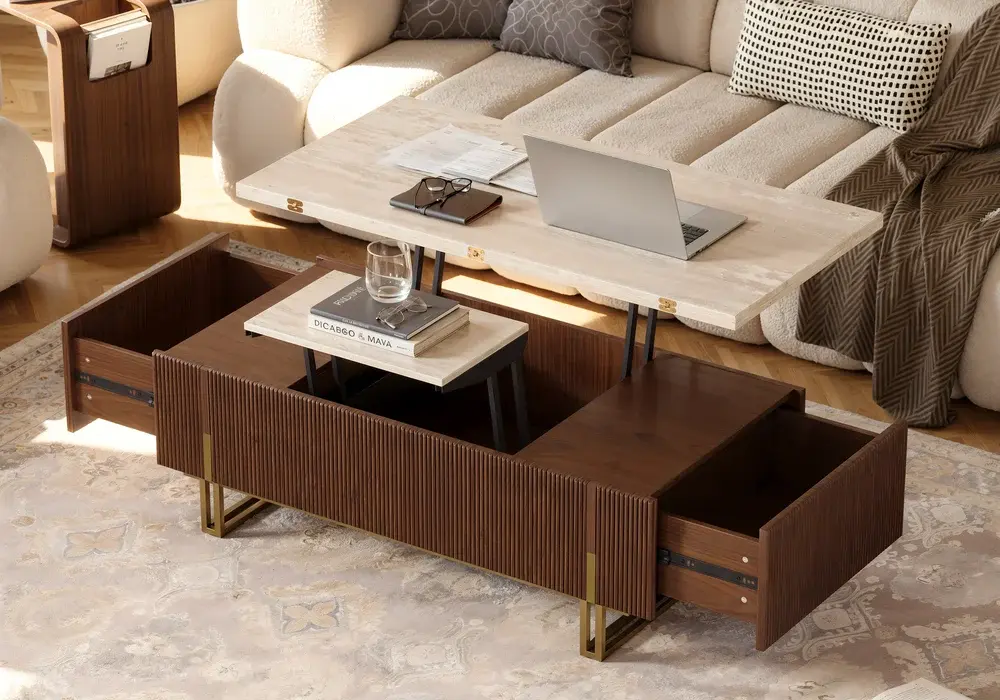
The Grovyn fluted lift-top coffee table illustrates a table serving several tasks. Its current listing gives a 47-by-24-inch footprint, a 17-inch overall height, and a 24-inch pop-up height. The 47-inch length suits a sofa of roughly 70–85 inches, and the 17-inch lowered height sits close to a standard seat. In daily use, that means it works as a normal coffee table for evening drinks and snacks, then lifts to 24 inches when you want to answer emails on a laptop or eat a takeaway meal without leaning over your knees. The two drawers hold remotes, coasters, and chargers, so the top stays clear when you raise it.
Choose the Shape That Preserves Access
A rectangle provides a useful long surface alongside a sofa and suits rooms where people use the table from several adjacent seats. Check that the corners and end routes work with your arrangement.
An oval or round shape softens the approach to the seating area. That helps near a turn or in an arrangement approached from multiple directions. Curved edges still occupy floor space, so compare actual widths and depths rather than assuming a round table is always compact.
A square works within a broad seating group, while two smaller surfaces give a more flexible room. Decide whether you need one shared center or several individual places to put things.
Look below the tabletop as well. A broad pedestal, projecting foot, or open shelf affects where feet land and how the table is approached. The top outline alone does not show the complete furniture footprint.
Decide Whether Storage Will Make Daily Life Easier
List the belongings that need a home, then compare their dimensions with the actual drawer or compartment interiors. A storage label does not tell you whether a game box, laptop, or stack of magazines will fit.
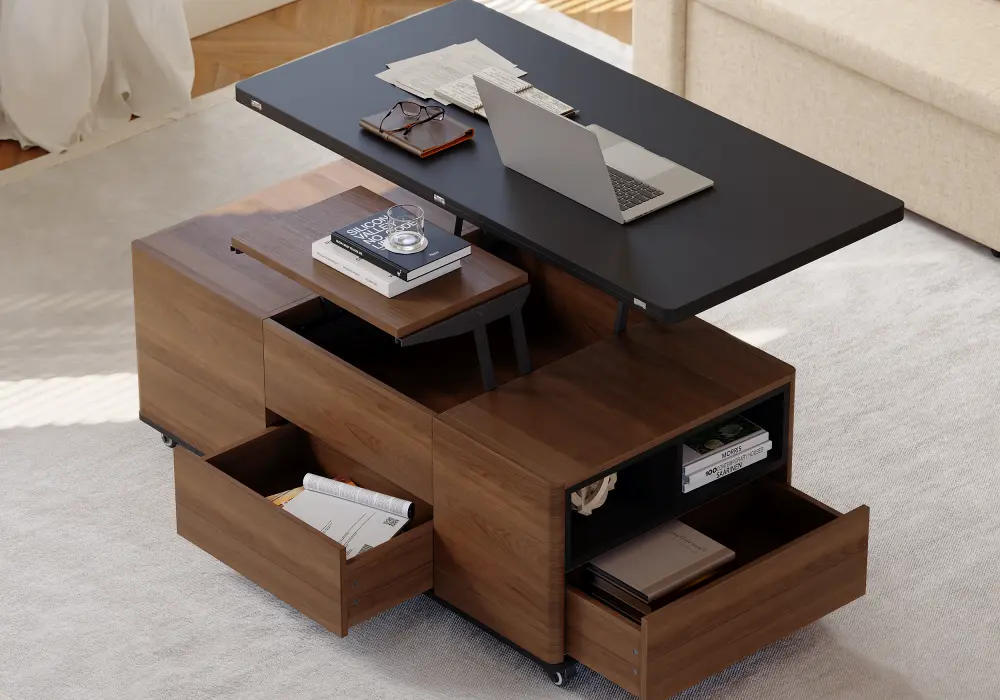
The Lift-Top Extendable Hidden Storage Coffee Table combines drawers, shelving, and a changing surface. Its current listing also identifies wheels. In a family living room, the three drawers can take game controllers, throw-blankets, and magazines, while the shelving keeps a few books or a tray within reach. The wheels let you roll the table aside for floor space, such as a kids' play area or a yoga session, then back in front of the sofa for movie night.
Choose storage that matches the frequency of access. A remote used every evening should be easy to retrieve, while occasional accessories can occupy a less immediate compartment. If accessing one object requires clearing the entire top, the routine will quickly become inconvenient.
Storage also needs a reset habit. A large compartment collects unrelated objects just as easily as a small open surface becomes cluttered. Give each drawer a purpose and leave enough room to return items without rearranging everything.
Assess Specialized Features Separately
The Cat Condo Hidden Storage Coffee Tablea is a specialized option for a household considering shared furniture and pet space. Its product description identifies an enclosed area with circular openings and a storage drawer. For a cat owner, this gives the pet a cozy spot in the room where the family spends its evenings, while the drawer holds toys, a brush, or leashes, and the tabletop still serves drinks and remotes. Evaluate the compartment's dimensions, access, and cleaning requirements separately from the tabletop's usefulness.

Not every pet will use the space, so consider your own pet's size and habits. Keep food, drinks, and stored household items separate from the pet area, and avoid making a pet feature the only reason to accept an otherwise unsuitable table.
The same principle applies to any unusual feature. Decide whether it solves a real need, how it will be maintained, and what it changes about the rest of the design. A specialized table pays off when those answers are clear.
If a feature will be used rarely, weigh it against the everyday tradeoff. Extra bulk, more moving parts, or a less convenient storage layout often matter more over time than an occasional transformation.
Read Materials and Care Before Choosing a Finish
Distinguish the surface appearance from the stated construction. A stone-look top, veneer, natural stone, and engineered-wood surface each call for different care. Read the exact specification and instructions instead of transferring a cleaning method from another table.
Think about the marks and spills the room is likely to see. Follow the manufacturer's recommended protection and cleaning routine, and use coasters where appropriate. Even a resistant surface can be damaged.
Consider the base and moving parts too. A table used for meals or work needs more frequent surface clearing and cleaning. Drawers and lifting sections should remain accessible for the checks and care described in the instructions.
Then choose a finish that relates to the room. You can repeat one existing material or color without matching every piece exactly. If the sofa, rug, or cabinetry already has strong texture, a quieter table provides enough contrast.
Compare the Finalists With a Short Checklist
Your main need | Feature worth comparing | What to verify before purchase |
Shared drinks and snacks | A usable fixed surface | Reach from regular seats and open space for use |
Concealed everyday storage | Drawers or compartments | Interior dimensions and convenient access |
Occasional raised surface | Lift-top mechanism | Height, movement path, permitted loads, and operation |
Flexible placement | Documented mobility features | Approved movement and locking procedure |
Specialized pet space | A purpose-designed compartment | Suitability, access, dimensions, and cleaning |
A narrow circulation area | A smaller or differently shaped footprint | Real movement around the complete base and top |
Use the table to compare two or three serious candidates. Remove any option that fails the essential fit or use test before comparing decorative details. That keeps the final choice focused rather than restarting the search around every new image.
Finish With Delivery and Assembly Checks
Measure the route to the room, including turns and door openings. Review package and component information where available. A table that fits the seating plan may still need a particular handling or assembly arrangement.
Identify where assembly will happen and how many people the instructions suggest. Wheels, a lift mechanism, or a compact appearance do not make a substantial table easy to handle alone, so arrange help before delivery.
Keep the care and operating instructions with the purchase record. When the table arrives, confirm the specified setup before using moving features or loading storage. Then adjust its room position through ordinary use rather than treating the first placement as permanent.
Frequently Asked Questions
What coffee table works best with a sectional?
Choose a rectangle or oval that keeps 30–36 inches of clearance around the chaise or corner opening and sits within easy reach of each regular seat. Outline round, oval, and rectangular options at full size with tape and pick the one that leaves the walkway clear.
Should I choose a lift-top or a fixed coffee table?
Choose a lift-top if you will regularly eat, work, or play games from the sofa and both positions fit the room. Choose a fixed top if the main needs are drinks, display, or shared snacks; it is simpler and usually lighter.
How much storage do I need in a coffee table?
Enough for the specific belongings you want nearby, typically remotes, coasters, books, and a few accessories. Measure those objects and check compartment interiors. Convenient, organized storage is more useful than a large undivided space.
Does a coffee table need to match the TV stand?
No. They can relate through a finish, color, texture, or repeated shape. Prioritize the table's fit and use, then choose a visual connection that suits the room.
Is a multifunctional coffee table always the better choice?
No. Extra features help only when you use them regularly. A straightforward table is often the better pick when your main needs are drinks, snacks, and display.