

You found the perfect sofa, it fits the wall, and the delivery team sets it in place. Then you lean back, the footrest rises, and it stops 25 mm from your coffee table, or worse, across the only path to the kitchen. This is the most common regret with wall hugger sofa recliners in small spaces: the sofa fit the wall, but its motion didn't fit the room.
A wall hugger recliner can solve a real problem, because it needs far less room behind the back. It does not remove clearance needs; it moves them to the front. This guide explains how wall hugger sofas differ from traditional reclining sofas, how to measure a small room in both the closed and fully reclined positions, and how to decide whether a wall hugger is the right choice at all.
Table of Contents
What Is a Wall Hugger Sofa Recliner?
A wall hugger sofa recliner is a reclining sofa whose mechanism moves the seat forward as the back tilts, so the sofa can sit close to the wall without the backrest hitting it. Compared with a traditional recliner, it needs much less space behind the sofa but more room in front.
How it works
A traditional reclining sofa tilts its back rearward around a fixed base, so it needs open space behind it. A wall hugger (also sold as a wall-away or space-saver recliner) slides the seat forward while the back changes angle. The sofa starts closer to the wall because more of the movement happens toward the room.
Wall hugger vs. traditional recliner
Wall hugger recliner | Traditional recliner | |
Motion | Seat moves forward as the back reclines | Back tilts rearward on a fixed base |
Space needed behind | Minimal; model-specific | Substantial; the back needs room to swing |
Space needed in front | More: forward travel plus footrest | Footrest projection only |
Best for | Rooms where the sofa must sit near a wall | Rooms with open space behind the sofa |
Watch out for | Seat moving toward a coffee table or rug edge | Sofa pulled far from the wall, wasting floor space |
Wall gap | Small, but still required by the manufacturer | Larger gap required |
The exact rear clearance depends on the model. "Wall hugger" is a mechanism category, not a measurement standard, so always use the manufacturer's stated clearance for the specific sofa and never a general number from another product.
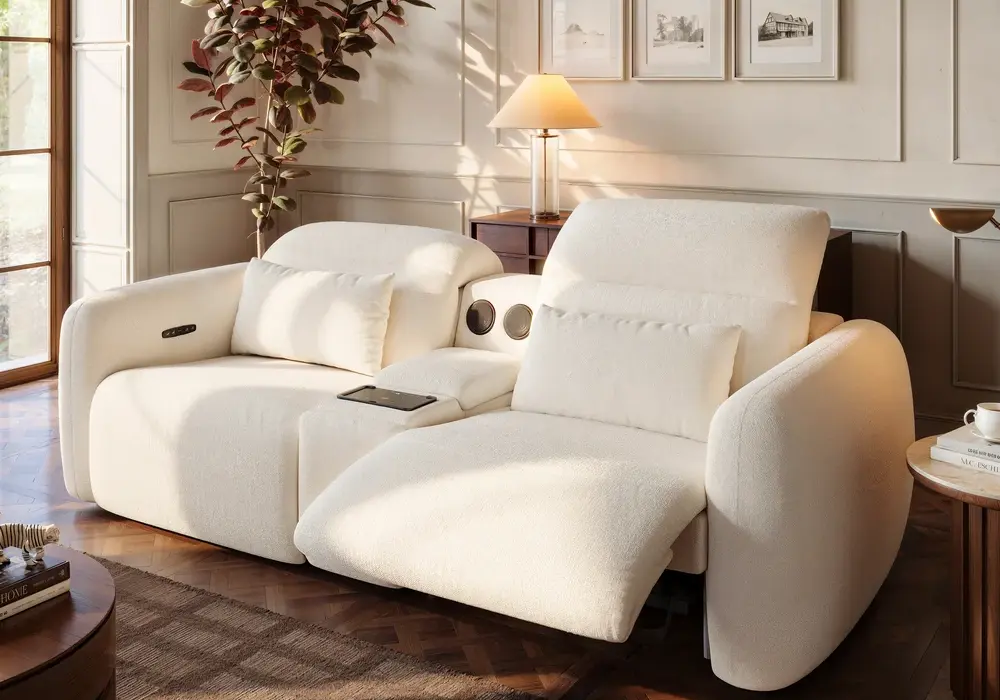
What a "zero wall" listing looks like. Retailers often use their own labels for this mechanism. Homary's Softplume Chenille Zero Gravity Power Reclining Sofa, for example, is described as a "zero wall" design that allows full reclining without moving away from the wall, and it pairs that with power controls and a zero-gravity recline position. Treat wording like this as a starting point rather than a measurement: ask for the exact rear clearance, the forward travel, and the fully reclined depth before you rely on it in a small room.
Measure the Room in Both Positions
Measure the wall and floor before you compare upholstery or color. Record:
- the usable wall width between trim, doors, windows, radiators, and outlets;
- the sofa's closed width and depth;
- the manufacturer's required rear clearance;
- the fully reclined depth and forward travel;
- the footrest's open height and projection;
- the main walkway with the recliner closed and open;
- door swings, cabinet access, and nearby furniture;
- the delivery path, including turns, stairs, elevators, and door openings.
Use painter's tape to mark the closed footprint, then add a second outline for the fully reclined position. Place a chair or box where the coffee table and side tables will sit, then walk through the layout. If reclining blocks the only path through the room, the sofa is too large even if its rear clearance is small.
The mistakes that cause the most returns: measuring only the wall; checking the sofa closed but not fully reclined; forgetting the space a seated person's feet occupy; assuming every seat reclines; and tucking a rug edge under the mechanism.
Choose the Right Configuration
Manual or power. Manual models need no outlet, but the lever or handle needs side access and some people find the closing force hard. Power models offer gradual positioning and may include USB ports, but they need a safe cord route and add electrical parts. Ask what happens in a power outage and whether a battery backup is available.
Which seats recline. Some sofas recline only at the end seats, with a fixed center. Others add a drop-down console, cup holders, or storage. Each feature adds weight, seams, and hardware, so choose only what you will use.
A center console is a good example of a feature that adds convenience and bulk at the same time. The Homary sofa above includes one with storage, Bluetooth audio, wireless charging, Type-C and USB-A ports, and hidden cup holders, which suits a movie-night setup. In a small room, check how much width the console takes from the seating area and where its ports and power connection sit relative to the outlet and the wall.
Removable or modular backs. Removable backs and modules can help a sofa get through narrow doors, but the assembled dimensions still control the room. Ask how modules connect and whether service requires moving the whole sofa away from the wall.
Check Comfort, Not Just the Word "Compact"
Small sofas get their size from narrow arms, shallow seats, thin backs, or tighter spacing between seats, and each choice affects comfort differently. Compare seat height, seat depth, back support, footrest length, arm height, and the distance between recliner mechanisms.
If possible, sit upright and fully reclined. Check that your heels are supported, the headrest meets your neck comfortably, and the lower back stays supported through the range. A deep seat can feel luxurious but be hard for a shorter person to exit.
Plan the Room Around Motion
Mark a no-furniture zone in front of every moving seat. A conventional coffee table often conflicts with the open footrest, so consider a smaller table, nesting tables, or side tables that stay outside the reclining envelope. Keep lamps, cables, toys, pet beds, and baskets out of the mechanism path, and make sure side tables do not block controls.
Reclining furniture has pinch points, so supervise children and pets and follow the manufacturer's instructions. Leave the specified wall gap rather than wedging the sofa in just because it technically fits; a wall hugger is designed to reduce wasted space, not to operate while touching the wall. You also need access for cleaning, dropped objects, and service. Choose upholstery based on the cleaning instructions, sunlight, pets, and expected wear, since in a small room every surface sees more contact.
When a Wall Hugger Is Not the Best Fit
A wall hugger can still be too deep when reclined. Consider an alternative when the room has a narrow central walkway, a door directly opposite the sofa, or a coffee table that cannot move.
- A compact reclining chair gives one reclined seat with less total width.
- A stationary apartment sofa keeps the footprint shallow.
- An ottoman supports your legs without a mechanism and can move aside.
- A chaise sectional offers lounging without a moving footrest, though its fixed projection must fit.
- A sleeper sofa adds overnight function, but its open bed footprint needs a separate test.
Do not treat every multifunction sofa as a substitute for a wall hugger. A sleeper or large L-shaped sectional solves a different problem and may need more floor space.
Questions to Ask Before You Buy
Get exact answers from the seller or manufacturer:
- What is the minimum rear clearance, and what are the fully reclined depth and forward travel?
- Which seats recline, and where are the controls and power connections?
- What are the sofa's weight and maximum supported load?
- Are the backs or modules removable for delivery?
- What wall, floor, and side clearances are required?
- What do the warranties cover for the frame, mechanism, motor, electronics, and upholstery?
- Are replacement controls, motors, transformers, and upholstery parts available?
Keep a copy of the dimension diagram and warranty before ordering. At delivery, confirm the model, upholstery, and visible condition, test every reclining seat through its full range, and recheck wall and floor clearance once the sofa settles into place.
Frequently Asked Questions
How close can a wall hugger recliner be to the wall?
It varies by model and mechanism. Use the manufacturer's specification for the exact sofa and confirm it with the sofa fully reclined.
Do wall hugger recliners move forward?
Many do. The forward movement reduces the space needed behind the back but increases the clearance needed in front, so keep furniture, rugs, cords, children, and pets clear of the full motion path.
Are wall hugger sofas good for apartments?
They can be, especially when rear clearance is the main constraint. They help less when the room lacks front clearance, has a narrow delivery path, or relies on an aisle directly in front of the sofa.
Is a power wall hugger better than a manual one?
Neither is universally better. Power offers gradual positioning but needs an outlet and adds electrical parts; manual avoids cords but may need more hand force and side access. Choose based on the user and the room.
Can I put a coffee table in front of a reclining sofa?
Yes, if the table sits outside the footrest and forward-travel zone and still leaves a usable walkway. Nesting or movable tables are easier in a compact room.
A wall hugger recliner is a space-management tool, not a promise that any sofa fits any small room. The right model is the one whose complete motion envelope works in your measured layout.