

The best sofa loveseat recliner arrangement positions the largest piece (the sofa) as the visual anchor facing the primary focal point, places the loveseat at a perpendicular or L-shaped angle to create conversation flow, and positions the recliner in a corner or secondary spot where its extended footprint will not obstruct walkways. When selecting power reclining furniture, the layout must account for the extended depth of each piece when fully reclined, the placement of power outlets for motorized mechanisms, and the viewing angles from each seat to the television or fireplace. A thoughtfully planned arrangement transforms three separate pieces into a cohesive seating group that maximizes comfort, conversation, and functionality.
Table of Contents
Key Principles for Arranging Reclining Furniture
Arranging a sofa, loveseat, and recliner differs from arranging standard living room furniture because each piece has a moving footprint. When a recliner extends, it adds 20 to 30 inches of depth. A power reclining sofa needs clearance behind it for the mechanism and beside it for the controls. These dynamic dimensions must be factored into your layout from the start.
Anchor first. Identify the room's focal point—typically a television, fireplace, or large window with a view—and place the sofa directly facing or slightly angled toward it. The sofa is the largest piece and sets the spatial tone for the entire arrangement.
Create conversation angles. Position the loveseat perpendicular to the sofa in an L-shape, or angle it across from the sofa to create a U-shaped conversation area. The goal is to make eye contact easy between people seated on different pieces without requiring them to turn their heads sharply.
Reserve the recliner's territory. A recliner needs its own dedicated corner or space where the extended footrest will not block a walkway, door swing, or another seating piece. Corner placement is ideal because it uses otherwise dead space and gives the recliner occupant a commanding view of the room.
Mind the gaps. Leave 18 to 24 inches between separate furniture pieces. This spacing allows for comfortable passage, prevents the arrangement from feeling cramped, and ensures each piece can recline without contacting its neighbor.
Measuring for Reclined Clearance
The most common mistake in reclining furniture arrangement is failing to account for the extended depth. Every reclining piece has two footprints: the closed footprint and the open (reclined) footprint.
Measure each piece's depth when fully reclined by extending the footrest and measuring from the back of the piece to the tip of the extended footrest. A sofa that is 49 inches deep in its upright position may extend to 72 inches or more when fully reclined. Leave at least 6 inches of additional clearance behind reclining pieces for the mechanism's rear travel.
For wall-hugger or zero-clearance recliners, the rear clearance requirement is reduced—these designs are engineered to extend forward rather than backward, making them suitable for placement closer to a wall. However, the forward extension still requires the full open-depth clearance in front of the chair.
Create a floor plan sketch with both footprints marked for each piece. This visual ensures that walkways, door openings, and adjacent furniture positions accommodate the furniture in all its configurations—not just when everything is upright.
Layout Patterns for Different Room Shapes
Different room shapes call for different arrangement strategies.
Rectangular rooms work well with an L-shaped layout. Place the sofa along the long wall facing the focal point. Position the loveseat perpendicular to the sofa at one end, creating the L. The recliner goes in the opposite corner or alongside the loveseat, angled slightly toward the focal point. This arrangement maximizes seating in a narrow space while maintaining clear walkways.
Square rooms benefit from a U-shaped layout. The sofa anchors one wall facing the television or fireplace. The loveseat and recliner are positioned on the side walls, angled inward to face the sofa. This creates an intimate conversation pit that also works for media viewing. Leave at least 36 inches between each piece for passage.
Open-concept spaces require the furniture to define the living area without walls. Use the sofa as a room divider, placing it with its back toward the dining or kitchen area to create a visual boundary. The loveseat and recliner face the sofa from across the defined living zone. An area rug beneath all three pieces anchors the grouping visually.
Small rooms may require a linear arrangement with all pieces along one wall. In this case, choose a reclining sofa and a compact recliner rather than a separate sofa, loveseat, and recliner, to reduce the total furniture footprint. Nesting tables or a narrow coffee table prevent the center of the room from feeling crowded.
Power and Electrical Planning
Power reclining furniture requires access to electrical outlets. Plan your layout around outlet locations, or budget for adding outlets before the furniture arrives.
Each power reclining piece needs its own standard outlet within reach of its power cord—typically 6 feet. Avoid daisy-chaining power strips, as the combined amperage of multiple reclining motors can exceed a standard circuit's capacity. If outlets are not conveniently located, consider having an electrician install floor outlets beneath or near the furniture before final placement.
Plan cord routing to minimize visibility. Run cords along baseboards using cord channels, or position furniture close enough to the wall that cords are hidden behind the pieces. For pieces placed in the center of a room, floor outlets are the cleanest solution.
Some premium power reclining furniture includes built-in USB and USB-C charging ports. Factor the location of these ports into your arrangement—place the sofa where its charging ports are accessible to the primary seating position, and ensure the recliner's charging ports are reachable without fully extending the footrest.
Focal Point and Viewing Angle Strategy
The arrangement should optimize viewing angles for the room's primary focal point while maintaining comfort for conversation.
For television-centric rooms, the ideal viewing distance is approximately 1.5 to 2.5 times the screen's diagonal measurement. For a 75-inch television, this means seating should be between 9.5 and 15.5 feet away. Position the sofa at this distance, with the loveseat and recliner angled to maintain reasonable viewing angles—ideally within 30 degrees of straight-on.
For fireplace-centric rooms, angle the furniture toward the hearth. The sofa faces the fireplace directly, while the loveseat and recliner are angled inward at 30 to 45 degrees. This creates a warm, inviting grouping that encourages conversation as much as viewing.
When the television and fireplace are on different walls, prioritize the television for the sofa and angle the recliner toward the fireplace. The loveseat can bridge both focal points by being positioned at a diagonal between them.
Complementary Furniture and Accessories
The sofa, loveseat, and recliner arrangement is incomplete without supporting pieces that enhance function and aesthetics.
Coffee tables should be positioned 16 to 18 inches from the sofa front, close enough to reach but far enough to extend legs. Choose a table width that is approximately two-thirds the length of the sofa. For L-shaped arrangements, a round coffee table softens the angular junction between the sofa and loveseat.
Side tables flank the recliner and the loveseat ends. These provide surfaces for lamps, drinks, and remote controls. Choose tables that are approximately the same height as the armrest of the adjacent furniture piece.
Area rugs should be large enough to anchor all seating pieces—at minimum, the front legs of the sofa, loveseat, and recliner should sit on the rug. A rug that is too small makes the arrangement feel disconnected and floating.
Lighting should include a floor lamp near the recliner, table lamps on the loveseat's side table, and ambient lighting that does not create screen glare for television viewing.
Recommended Reclining Furniture for Each Layout Role
Three pieces illustrate the range of reclining furniture available for different roles in a sofa loveseat recliner arrangement.
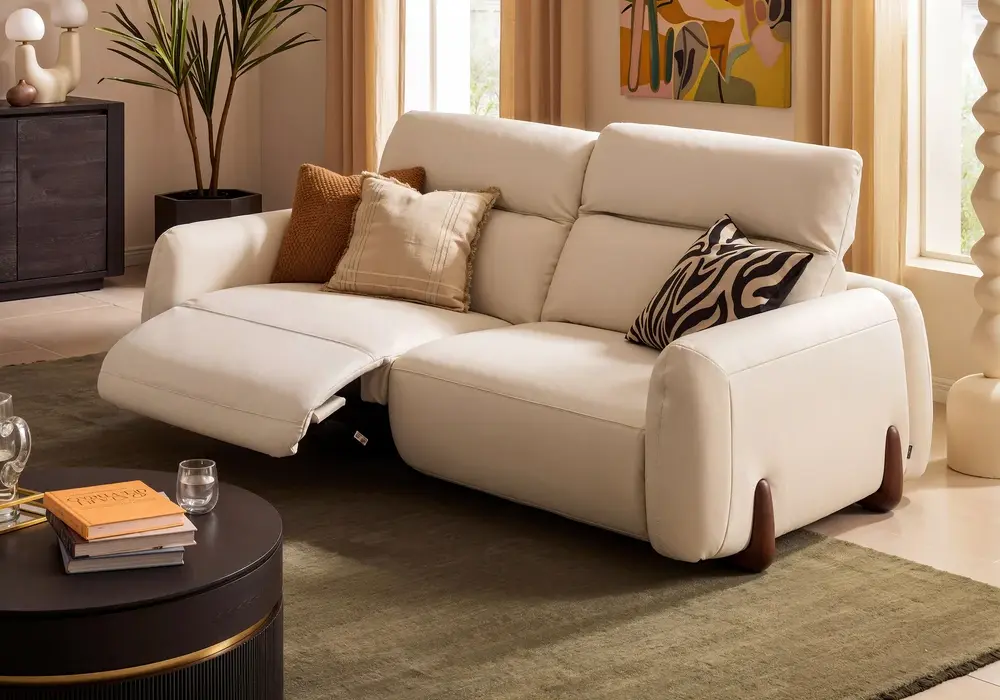
For the sofa role, the 85" Genuine Leather Power Reclining Sofa provides a two-seat power reclining option in genuine leather. At 85 inches wide with a depth of 49 inches, it serves as a commanding anchor piece. The adjustable headrests and built-in USB and USB-C charging ports make it ideal for the primary viewing position. The warm white leather and oak wood legs with a dark walnut finish create a sophisticated aesthetic that elevates the entire room.
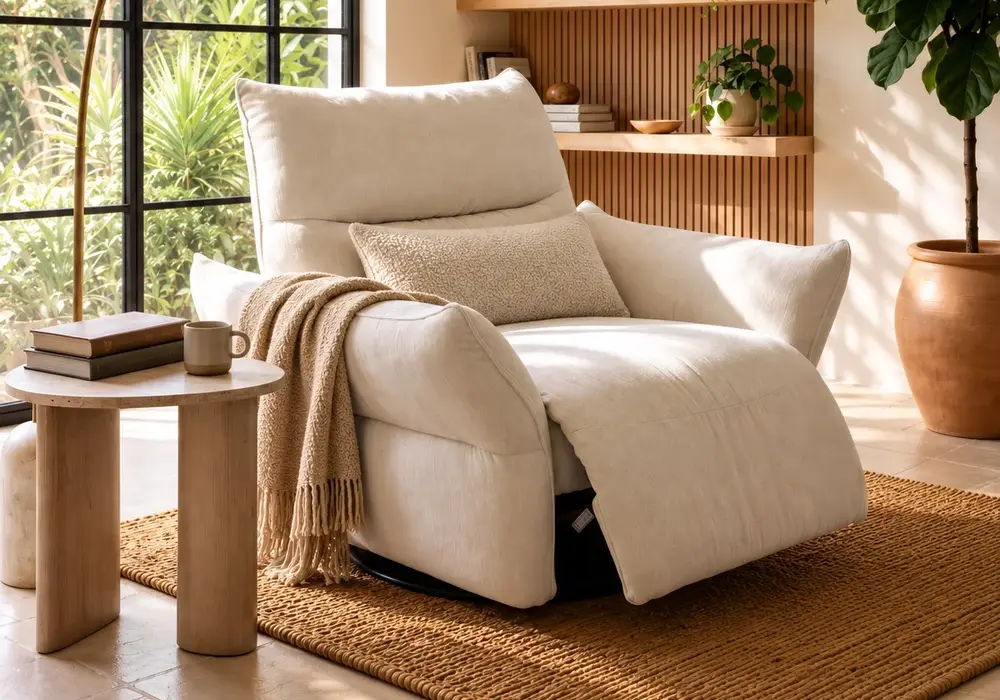
For the recliner role, the Performance Chenille Power Recliner Swivel Rocker Chair offers exceptional versatility. Its 270-degree swivel and rocking functions allow it to face any direction without being moved, making it perfect for corner placement where it needs to orient toward both the television and conversation area. The dual-motor system independently controls the backrest and footrest, and the adjustable armrests accommodate users of different sizes. At 41 inches wide, its footprint is compact enough for tighter spaces.
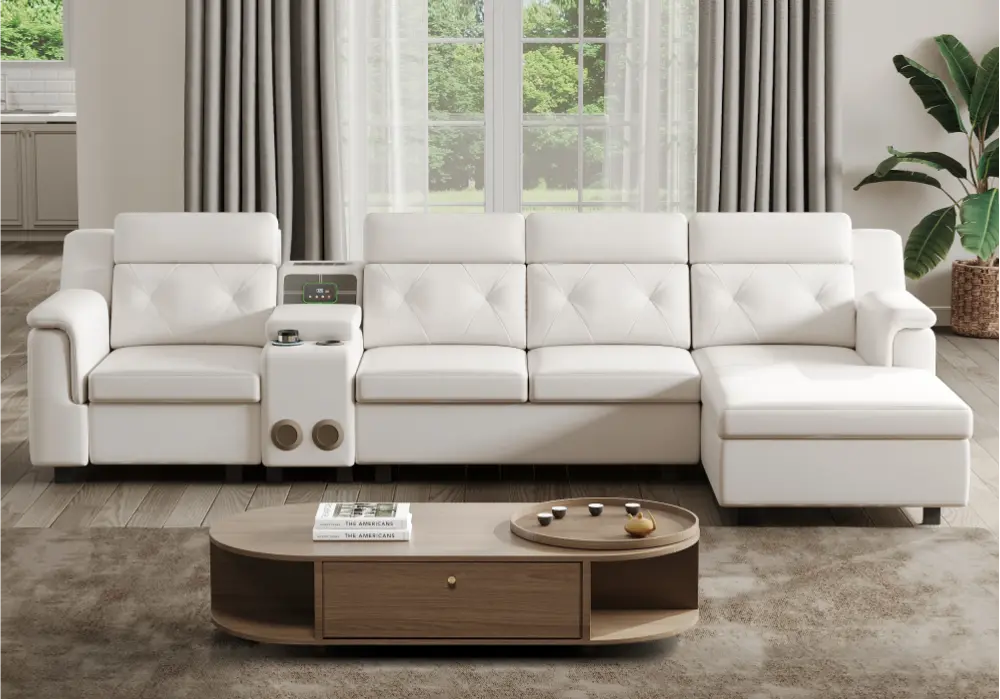
For a sectional alternative that combines the sofa and loveseat into one piece, the 134.6" White Power Reclining Sectional Sofa offers an all-in-one solution. At nearly 135 inches wide, it functions as both a sofa and a chaise lounge, with a pull-out bed for overnight guests. Built-in cup holders, Bluetooth speakers, storage compartments, and an air purifier make it a complete entertainment hub. In larger rooms, this sectional can replace a separate sofa and loveseat while pairing with the swivel recliner for the ultimate arrangement.
Frequently Asked Questions
How far apart should a sofa and loveseat be in a reclining arrangement?
Leave 18 to 24 inches between the sofa and loveseat to allow comfortable passage and prevent the pieces from feeling cramped when both are reclined.
How much space does a recliner need when fully extended?
A recliner typically extends 20 to 30 inches beyond its upright depth when fully reclined. Always measure the open footprint and ensure no walkways or doors are obstructed.
Can I place a power reclining sofa against the wall?
Standard power reclining sofas need 4 to 6 inches of rear clearance for the mechanism. Wall-hugger or zero-clearance designs can be placed closer to the wall, but always check the manufacturer's specified clearance.
What is the best arrangement for a small living room with reclining furniture?
In small rooms, use a linear arrangement along one wall or choose a wall-hugger recliner and a compact power reclining sofa. Avoid separate loveseats; instead, pair the sofa with a single recliner and nesting side tables.
Do I need a special outlet for power reclining furniture?
No special outlet is required, but each power reclining piece should have its own standard outlet. Avoid overloading a single circuit with multiple reclining motors on one power strip.
How do I arrange reclining furniture for both TV viewing and conversation?
Position the sofa facing the television at the optimal viewing distance. Angle the loveseat and recliner at 30 to 45 degrees toward the sofa, creating a setup that works for both media viewing and face-to-face conversation.