

Small coffee tables for small spaces need to do more than fit in front of a sofa. The right table should leave enough room to walk, keep drinks and everyday items within reach, and add useful storage or work space without making the room feel crowded.
Start with the space around your sofa rather than the table itself. Measure the sofa-to-table gap, the main walking route, and the table's footprint when drawers are open, the top is raised, or nesting pieces are separated.

Irregular Cloud-Shaped Abstract Coffee Table
Table of Contents
Start With the Space the Table Can Actually Occupy
Before choosing a style, determine how much room the coffee table can realistically use. In a small living room, the usable footprint includes the space needed for legs, drawers, moving parts, and everyday traffic.
Measure the sofa-to-table gap
A gap of about 305 to 457 mm is a useful starting point for many seating arrangements. Sit on the sofa and check whether drinks, books, or a laptop are within easy reach without forcing your knees into the table.
A coffee table around one-half to two-thirds of the sofa length is also a practical starting range. The final size depends on the sofa, room shape, and surrounding furniture.
Protect the main walking route
Identify the route people use most often through the room. Mark the proposed table footprint with painter's tape, then walk around it while carrying a laundry basket or serving tray.
This simple test can reveal problems with sofa arms, chair legs, doorways, or narrow corners that are easy to miss in photos.
Measure the working footprint
The table's listed dimensions are only the starting point. Measure the working footprint as well.
For a fixed table, that means the actual length and depth. For a nesting set, include both pieces when separated. For a swivel table, consider the area needed for the moving section. For a lift-top model, measure the tabletop in its raised or extended position.
What to measure | Starting point | Why it matters |
Sofa-to-table distance | About 305–457 mm | Balances reach and legroom |
Table length | About 1/2–2/3 of sofa length | Keeps the table proportionate |
Table height | Around sofa-seat height or slightly lower | Keeps the surface comfortable to reach |
Main walking space | About 762 mm where practical | Preserves circulation |
These measurements are starting points rather than universal requirements. A narrow room may require a shorter or slimmer table even when the sofa is large, while a larger sectional may need more tabletop area to serve all the seats comfortably.
Choose a Shape That Fits Your Traffic Pattern
Once you know how much floor space is available, choose a shape that works with the way people move around the room. In a small living room, shape affects more than appearance. It changes how much usable surface you have, where corners sit, and how easily someone can walk around the table.
Round coffee tables
Round coffee tables can work well where people need to move around several sides of the table. Without projecting corners, the outline can feel easier to navigate in a compact seating arrangement.
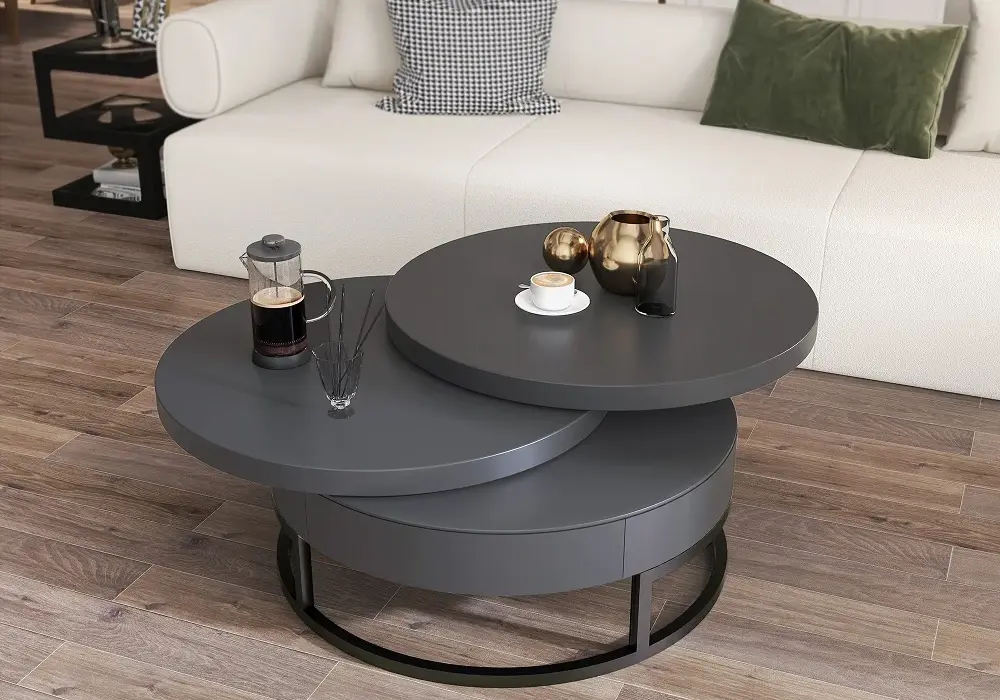
Homary's Modern 813 mm Round Swivel Wood Coffee Table with Storage combines a circular footprint with a rotating tabletop and storage. This type of design can be useful when several seats need access to the tabletop, but the rotating section also needs room to move.
Oval coffee tables
Oval tables provide some of the longer usable surface of a rectangular table while keeping rounded ends. They can be useful in front of a longer sofa when a round table feels too small but sharp rectangular corners would interfere with movement.
Rectangular coffee tables
Rectangular tables work naturally with long sofas and can provide plenty of usable surface. In a narrow room, however, depth becomes critical. Tape both dimensions on the floor before choosing a larger rectangular table.
Square coffee tables
Square tables can suit sectionals or seating arranged around several sides. Their four corners make the footprint easy to measure, but they may interfere with traffic more than a round or oval design in a tight room.
Match the Function to What You Actually Do
Once size and shape are clear, choose features based on how you use the room. More functions are not always better; the useful feature is the one that solves a real space problem.
Choose nesting when extra surface is occasional
Nesting tables are useful when you need more surface only sometimes. One table can stay tucked away until guests arrive or extra drinks and snacks are needed.
Homary's Nesnesis Modern Round Lift-top Nesting Wood Coffee Tables combine two nested tables with lift-top functionality and two drawers. Before choosing a nesting set, decide where the smaller table will go when it is pulled out.

Choose storage when clutter is the main problem
Drawers and enclosed compartments can keep remotes, chargers, books, and other small items out of sight. Check the opening direction as carefully as the storage capacity. A drawer that cannot open comfortably from the sofa is not especially useful.
Choose lift-top furniture when one table needs to do several jobs
A lift-top table can make sense in a studio or multifunctional room when it replaces an occasional desk or dining surface.
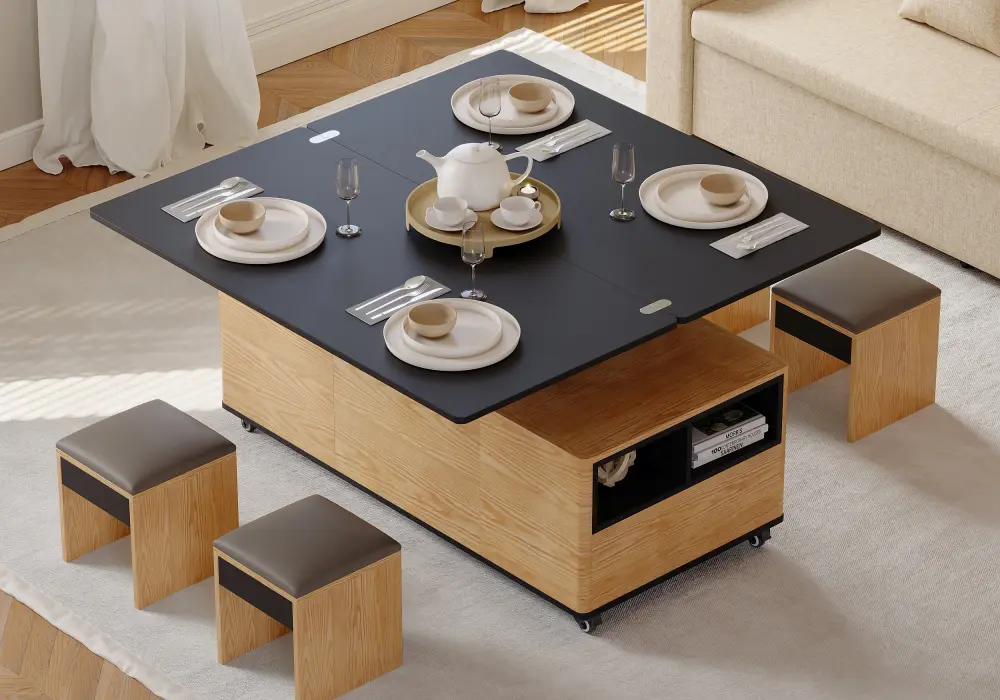
Homary's 1194 mm Lift-Top Extendable Coffee Table with Drawers & Cabinet combines a lift-top surface with drawers, cabinet storage, open cubbies, and caster wheels. Its larger footprint means it should be measured in both closed and raised positions.
Choose mobility only when you will actually use it
Swiveling and wheeled designs can make reconfiguration easier, but movement should solve a real problem. If you must move the table every day simply to walk through the room, the layout may need to change instead.
Test the Table in Real-Life Positions
A coffee table should work when the room is occupied, not just when it is empty. After marking the footprint on the floor, sit in your usual seat and test the reach, legroom, and tabletop height. Then recreate the situations that matter most in daily use: raise the lift-top, rotate the swivel section, pull apart the nesting pieces, or open the drawers and doors. Check whether any open position blocks your knees, television view, sofa, or main walking route. It is also worth walking through the room while carrying a basket or serving tray to see whether the table still leaves enough practical clearance.
Your floor surface matters as well. A thick rug can make wheels or movable pieces harder to reposition, while a lightweight table may slide more easily on a smooth floor. Check the actual base, casters, and operating instructions for the model you choose, and test the table on the rug or flooring it will actually sit on.
Common Small-Space Coffee Table Mistakes
Small rooms leave less room for trial and error. Most problems come from evaluating the table as a static object rather than considering how it behaves during everyday use.
Choosing by closed dimensions only
A lift-top, drawer, swivel section, or nesting piece can require additional space when used. Always consider the fully opened position before ordering.
Using every available inch
A table can technically fit while still making the room uncomfortable. Preserve the main walking route before maximizing tabletop size.
Ignoring the sofa relationship
Consider the table's length and height in relation to the sofa. A long sofa may need more surface, while a compact room may need less depth.
Buying storage you cannot access
Make sure drawers and doors can open while someone is seated and without blocking the main route.
Choosing a shape before mapping the room
Mark the footprint on the floor first. This makes it easier to compare round, oval, rectangular, and square options in the actual space.
Frequently Asked Questions
What shape coffee table works best in a small living room?
Round and oval tables can work well where traffic is tight because they avoid projecting corners. A slim rectangular table may work better with a long sofa. Clearance matters more than shape alone.
What size coffee table is best for a small space?
Start with the sofa length and available floor area. A table around one-half to two-thirds of the sofa length is a useful starting point, but depth and walking space should determine the final size.
How far should a coffee table sit from the sofa?
About 305 to 457 mm is a practical starting range. Sit on the sofa and check your own reach and knee room before finalizing the layout.
Are nesting coffee tables good for small spaces?
They can be useful when an extra surface is needed only occasionally. Test both the nested and separated positions and decide where the smaller table will go.
Will a lift-top coffee table fit a small room?
It can, especially when it replaces an occasional desk or dining surface. Measure the closed and raised positions, then check knee room, storage access, and circulation.