

Your coffee table and TV stand do not need to match. They usually look more intentional when they share a color, material, or design detail while differing in another way. When comparing TV stands and media consoles, start with the piece you already own, then choose a coffee table that supports the room’s proportions and everyday use. A coordinated room can include different woods, contrasting shapes, and a mix of open and closed bases.
The useful question is how the two pieces relate across the room. A matching finish can create continuity, but matching every surface can make a small living area feel repetitive. Equally, two individually attractive pieces may feel disconnected if neither relates to the sofa, flooring, rug, or other furniture. You need a few visible connections, rather than an identical set.
Table of Contents
Decide what the room needs before choosing a finish
Look at the room from the entrance and from your usual seat. The TV stand forms part of the wall composition; the coffee table sits within the seating arrangement. Their positions give them different jobs, so they do not need the same dimensions, height, or visual weight.
Ask which piece should attract attention. If the media wall already includes a large screen, artwork, or a fireplace, a quieter coffee table may help the room feel settled. If the media console is simple and low, a sculptural table can become the more expressive element. Both approaches work when the surrounding furniture gives them room.
Also list what you need to store. A console may handle cables and media equipment, while the coffee table holds remotes, books, or a tray. Buying two storage-heavy pieces can be useful for a busy household, but it can also crowd a compact room visually. Let function determine the furniture types before color narrows the choice.
Choose one strong connection between the pieces
Start with a visible link that is easy to recognize from across the room. That might be warm wood, a pale stone-like surface, a black base, rounded edges, or a repeated vertical detail. One strong connection often gives you enough freedom to vary the rest.
Shared feature | A way to introduce variety | What to check in the room |
Warm wood tones | Different tabletop materials | Whether both woods sit comfortably beside the floor |
Pale tops | Different base colors | Whether the room needs more contrast |
Black accents | One open base and one solid cabinet | Whether the pair feels too heavy |
Rounded profiles | Different lengths and heights | Whether the shapes fit the seating layout |
Vertical texture | One textured piece and one smooth piece | Whether repeated grooves become too busy |
Think of these as styling options, rather than rules. A room with many existing finishes may benefit from closer coordination. A mostly neutral room can often accommodate more contrast. The best connection is the one you can see without needing every detail to be identical.
Coordinate wood tones without chasing an exact match
Wood furniture can vary in grain, finish, and apparent color under different lighting. A product photograph is useful for direction, but it does not guarantee an exact match to an existing piece. If matching is important, request available finish information or samples before committing.
Compare the overall warmth of the woods. A honey-colored console and a warm walnut-toned table may feel related even when their depths differ. A pale cool floor, orange-toned cabinet, and reddish table can be harder to balance because each introduces a separate color direction. Place samples together in the actual room where possible.
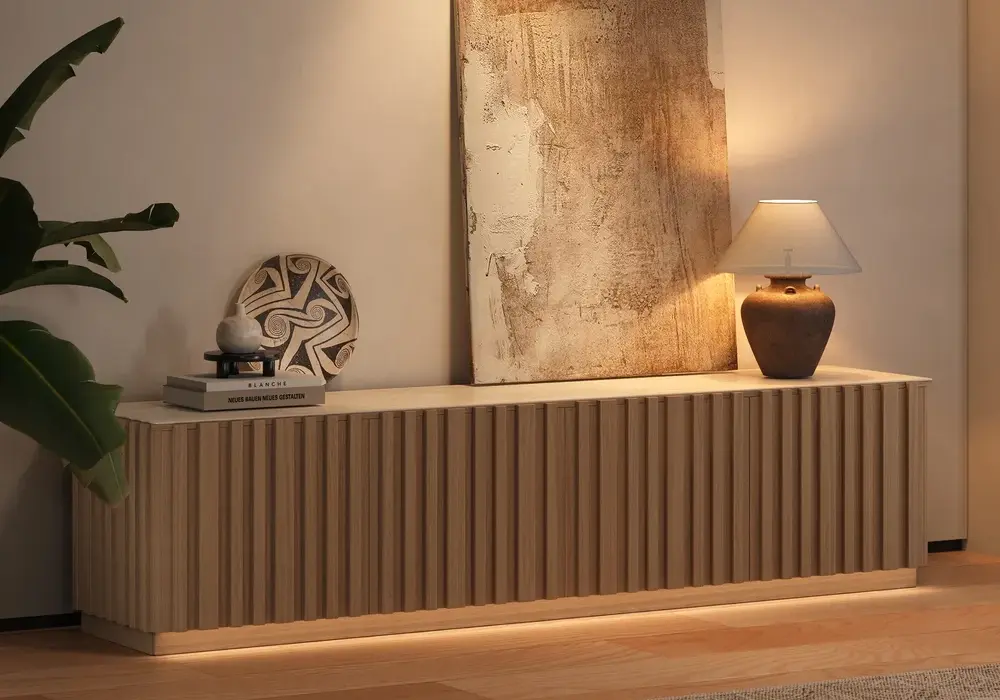
The Aura natural TV stand with a sintered stone top offers ash wood fluted detailing and a pale top as two possible starting points. For a quieter pairing, consider a smooth coffee table that repeats either the warm wood character or the light surface. It does not need to repeat both, and its base can be more open if the media cabinet already feels substantial.
Avoid buying a table simply because its finish has the same name. “Natural” and “walnut” are broad retail descriptions, and different constructions can produce different appearances. Look at the actual color, grain direction, sheen, and scale of the pattern. Those visible qualities matter more to the pairing than the label alone.
Use contrast to balance a strong media wall
Dark furniture can anchor a bright room, while a lighter piece can introduce separation beside a dark sofa or rug. When mixing colors, repeat the darker tone elsewhere through something you already need, such as a lamp, picture frame, or side table. This gives the contrast a place in the wider room.
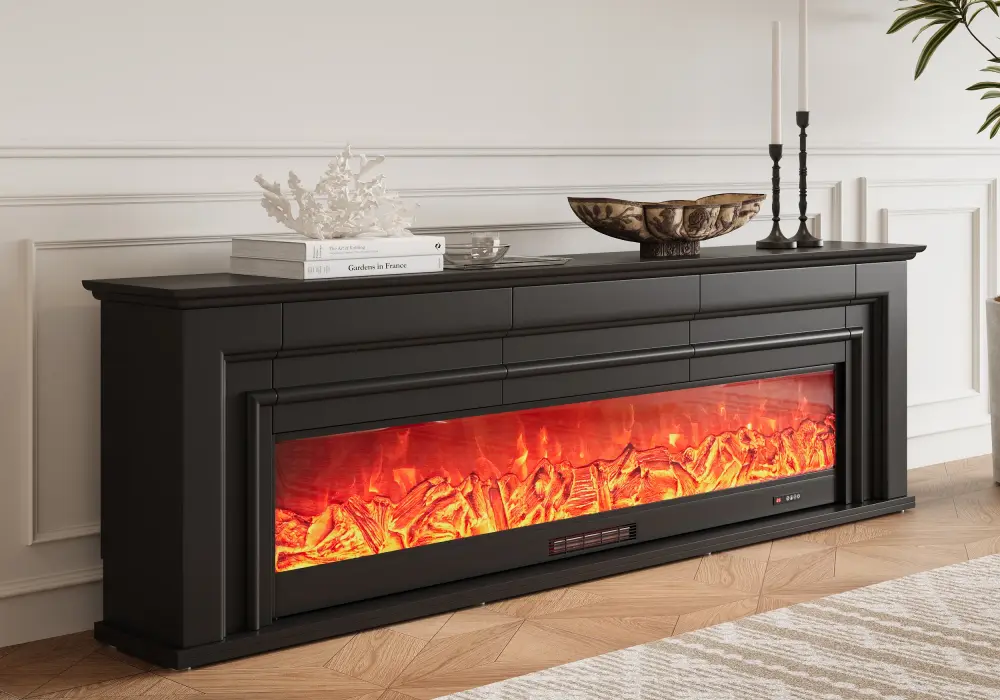
The black electric fireplace TV stand with remote control creates a stronger focal point through its dark cabinet and integrated fireplace. A lighter coffee table or a visually open base can balance that weight. Keep furniture placement and nearby decorative items consistent with the fireplace’s own clearance instructions; styling preferences do not establish a safe operating distance.
You can also pair a dark console with a dark coffee table if the room has enough relief through upholstery, wall color, and floor space. Check the combination from the entrance: if the two pieces read as one large dark block, try a lighter rug, a smaller table footprint, or a base that exposes more floor.
Let shape and scale do different jobs
A long rectangular console follows the wall and screen. A round or oval coffee table can soften that horizontal line and make movement around a sectional easier to plan. A rectangular coffee table may instead suit a long sofa where several people need access to the surface. Neither choice requires the console to change shape.
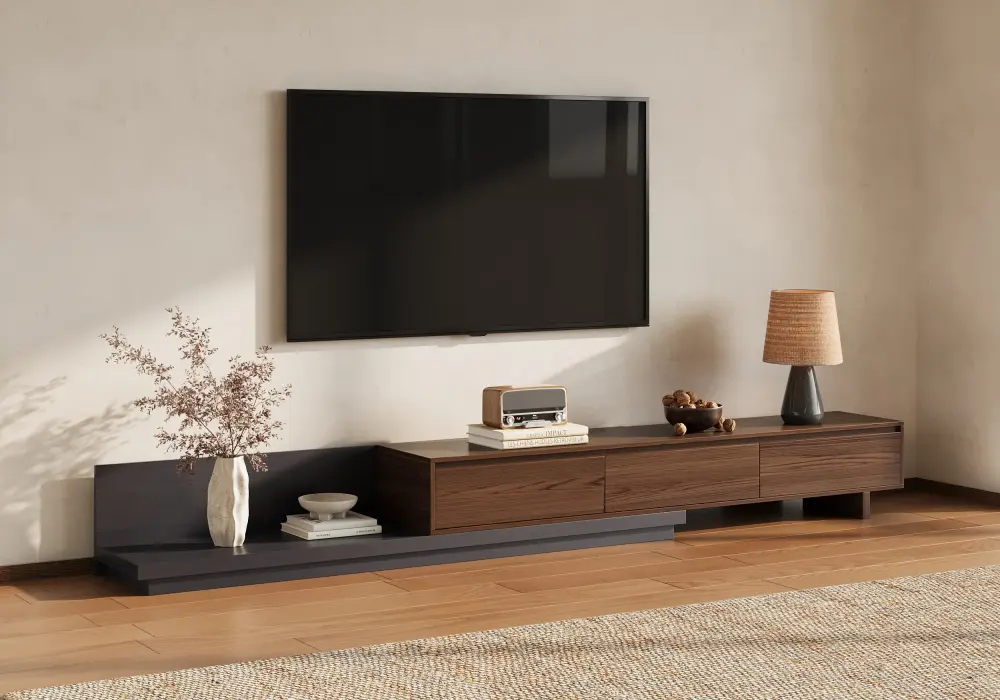
The Fero extendable TV stand with three drawers provides a flexible horizontal composition. Its adjustable length can help balance a wider media wall, while a coffee table should still be sized around the seating group. Do not extend the console merely to imitate the table’s proportions; check the manufacturer’s permitted configurations and the room’s usable wall space.
For the coffee table, make a paper or tape outline before buying. Sit down, reach for a cup, and walk past the outline from the doorway. Check access to console drawers as well as the sofa. A harmonious finish will not compensate for a table that blocks the route or prevents storage from opening.
Test the pairing with a small room palette
Gather photographs of the sofa, flooring, console, coffee table, and rug in one place. View them at a similar scale so a tiny product thumbnail does not conceal a bulky base. Then identify the colors or materials repeated across the whole group.
If every piece introduces a new finish, simplify one choice. If everything is almost the same but slightly different, introduce a clearer contrast. An intentional difference can be easier to live with than an unsuccessful attempt to match a finish exactly.
Keep decorative accessories restrained while judging the furniture. A crowded tray or several competing patterns can distract from the relationship you are trying to assess. Add the essential items first, then decide whether the room needs another texture or color. You may find that the furniture already supplies enough variation.
Frequently Asked Questions
Can a walnut coffee table go with a natural wood TV stand?
Yes. Compare their warmth and grain character rather than expecting an exact color match. A warm rug or textile can connect the tones, but it should support an already comfortable pairing. If the finishes appear to clash in daylight, choose a clearer contrast or repeat one material through another existing piece.
Should the coffee table be the same height as the TV stand?
No. Coffee table height relates primarily to the sofa and how you use the surface. Console height relates to its storage function and the television arrangement. Matching their heights across the room is usually less useful than checking comfort, access, and each piece’s proportions in its own location.
Can I mix a stone-top coffee table with a wood console?
Yes. The different surfaces can create useful contrast. Connect them through a base color, warm undertone, or repeated curved detail. Check the tabletop’s care instructions and construction separately; a stone appearance does not tell you whether the material is natural stone, sintered stone, or another finish.
Is a matching furniture set a bad choice?
No. A matching set can make a room easier to coordinate, especially when other finishes are already busy. Before buying, assess each piece individually. You still need an appropriate coffee table footprint, useful console storage, and enough circulation space. The convenience of a set should support those practical requirements.
How can I coordinate furniture I already own?
Choose the strongest common feature, then repeat it sparingly through items the room needs. A lamp base might connect black accents, or a rug might bring together warm and pale tones. Avoid replacing serviceable furniture just to eliminate every difference; begin by improving placement and reducing competing accessories.