

Buy a reclining sofa if you regularly lounge with your feet raised, can accommodate its fully open position, and value adjustable seating enough to accept the extra mechanism and maintenance. Homary’s power reclining sofas offer several approaches to that tradeoff. A reclining sofa is a less convincing purchase when your room mainly serves conversation, you frequently rearrange furniture, or the footrest would block the route through the room.
The useful question is how often the reclining function will improve an ordinary evening. Start with your household’s habits, then test the fit, controls, upholstery, and service arrangements. An impressive feature list cannot compensate for a seat that feels wrong when you sit upright.
Table of Contents
Start with the way you actually use your sofa
Think about the last seven evenings. Were you watching a full movie, reading for an hour, hosting visitors, or sitting briefly between other activities? Regular, extended lounging creates a stronger case for reclining seats than occasional use. If you currently pile cushions behind your back and put your legs on a separate stool every night, adjustable seating may simplify that routine.
Count the people who need the function at the same time. A sofa with several cushions does not necessarily have a motorized seat behind each one. A stationary center seat may work well for family gatherings but disappoint someone expecting every position to recline. Compare the number and location of reclining seats with the places people naturally choose.
Also consider mixed activities. One person might want an upright position for a conversation while another wants to lean back. Independent adjustments can accommodate that difference. However, a large fixed console can separate people who would rather sit together. Seat layout deserves as much attention as the recline itself.
Compare the ownership tradeoffs
Decision | A reclining sofa makes sense when… | A stationary sofa may suit you when… |
Daily use | Raised-leg lounging is a regular habit | Most use is upright conversation |
Room layout | The open footrests leave a usable route | The sofa faces a narrow passage |
Power | An appropriate outlet is accessible | A central floating layout has no practical supply |
Flexibility | The seating position will stay fairly consistent | You often move furniture between rooms |
Upkeep | You accept checking controls and mechanisms | You prefer fewer moving components |
These are purchasing criteria, not a ranking of comfort. A supportive stationary sofa with a well-positioned ottoman can be a better match than a reclining sofa with the wrong seat depth. Likewise, someone who dislikes moving a separate footstool may find an integrated footrest worth the added complexity.
Measure the sofa while it is open
Overall width tells you whether the sofa fits along a wall. It does not tell you whether it fits your life. Obtain the fully reclined depth, the required rear clearance, and any clearance needed beside moving components. These dimensions vary by mechanism; a general recliner measurement is not a reliable substitute for the selected model’s drawing.
Mark the closed outline on the floor with removable tape, then mark the open outline separately. Add the coffee table, doorway swing, and main walking route. Walk through the arrangement carrying a laundry basket or tray. This exposes problems that a photograph of an empty room can hide.
A wall-saving mechanism may reduce the space needed behind the back, but it does not remove the space occupied by an extended footrest. If the open seat reaches the coffee table, moving the table away may make it inconvenient for people sitting upright. Small side tables can sometimes solve that conflict more effectively than a large central table.
Test upright comfort before testing the recline
Sit in the position you use for conversation first. Check whether the seat supports you without requiring you to perch at the front or slide backward. Then test the range of adjustment. The head support should work for your preferred activity rather than push your gaze toward the ceiling when you want to watch television.
Try the controls while seated naturally. A switch that looks discreet in a photograph may be difficult to reach beside a wall or neighboring cushion. If two household members have different heights, both should assess the sofa. One person’s comfortable seat depth can leave another reaching awkwardly for support.
Treat terms such as zero gravity as descriptions of a reclining configuration. They do not establish that a sofa will relieve a medical condition. Choose on demonstrated comfort and fit, and seek appropriate professional advice if the purchase is driven by a specific health need.
Compare three different product directions
Homary describes the Softplume Chenille Zero Gravity Power Reclining Sofa as a chenille model with dual motors and a zero-gravity recline. It is a useful starting point if adjustable lounging is your main priority. Check the selected configuration’s dimensions before planning the room around it.
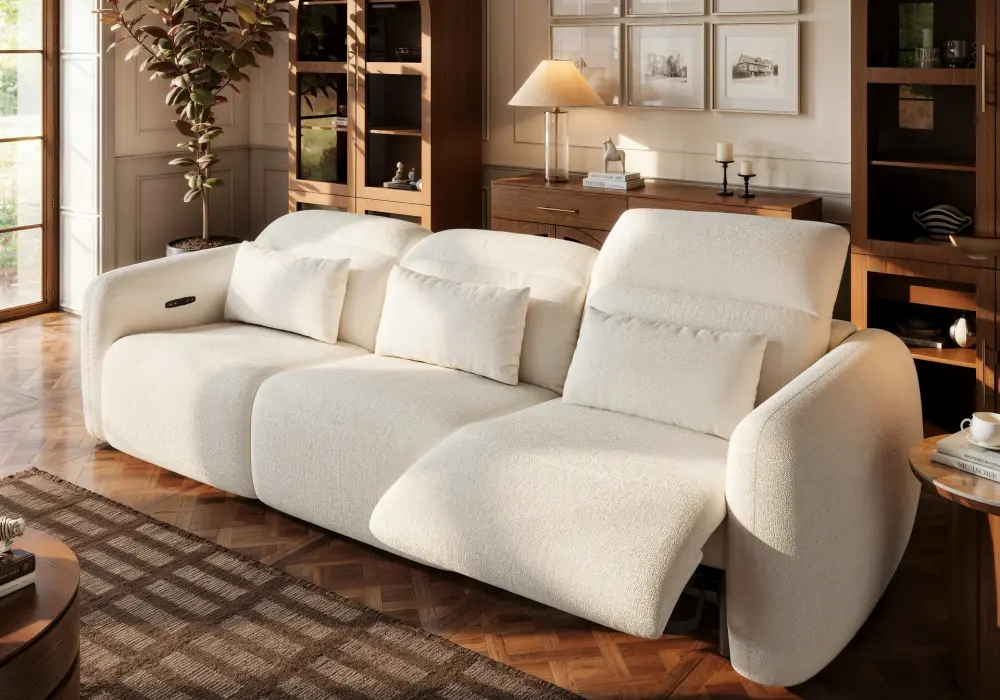
The Glidio Curva Genuine Leather Headrest Power Reclining Sofa has powered end seats and manually adjustable headrests, according to Homary. The listing specifies genuine leather on contact areas. That distinction matters when comparing upholstery descriptions; it does not mean every exterior surface is leather.
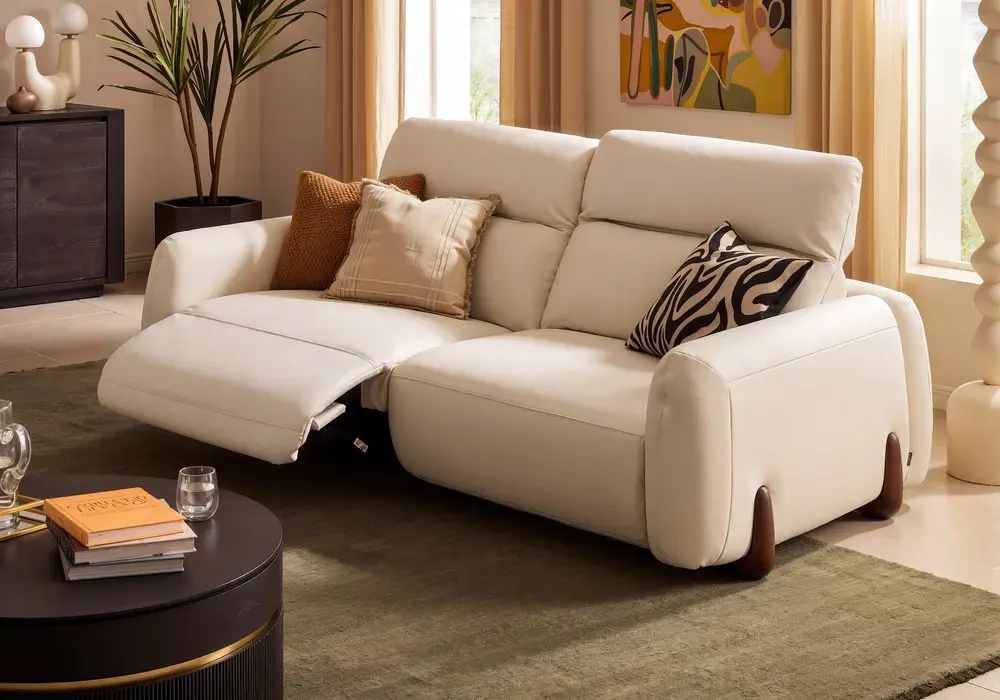
The Glidio Chenille Power Reclining Sofa combines independent recline, adjustable headrests, and charging ports in performance chenille. Homary describes the fabric as spill-resistant. Compare its everyday seating layout with your household’s needs, and follow the supplied cleaning instructions rather than assuming the fabric is waterproof.
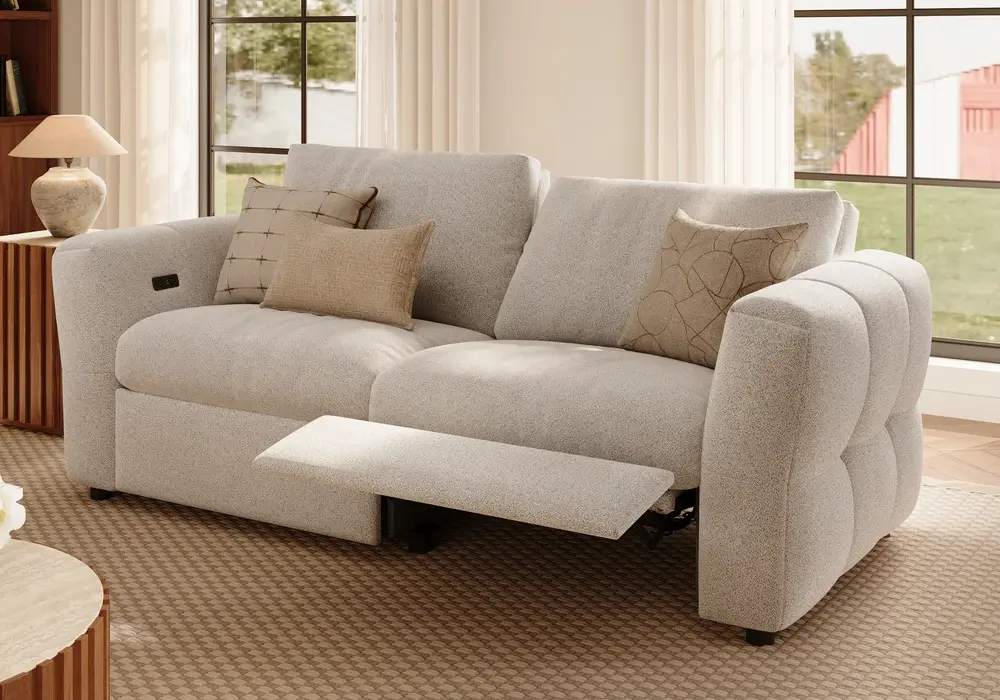
Use those examples to identify your preferred direction: substantial lounging features, leather contact surfaces, or textured fabric with independent adjustment. Then compare the exact configuration, rather than assuming similarly named versions have identical dimensions and controls.
Plan for power, cleaning, and service
A power reclining sofa needs an approved electrical supply for its motorized functions. Decide where the adapter and cord will go before ordering. The cable should remain clear of moving components, and the arrangement should not depend on hiding a loose lead under a rug. Battery compatibility must be confirmed for the exact model; charging ports do not prove that the sofa contains a rechargeable power supply.
Ask how servicing works where you live. Upholstery, motors, controls, and labor may have different coverage, so read the actual terms. Find out who diagnoses a fault and whether a replacement component can be installed locally. A promise of comfort is less useful than a clear answer about what happens if one seat stops moving.
For cleaning, distinguish the upholstery instructions from the mechanism instructions. Do not assume a fabric cover is removable or machine washable. Keep objects away from the moving base, and never reach into an operating mechanism. The U.S. Consumer Product Safety Commission has documented entrapment hazards around recliner footrests and linkages; checking for children and pets before movement is a practical household habit.
Make the final choice with a simple test
Buy when three things are true: you will use the movement frequently, the open sofa fits without compromising circulation, and you understand the controls and ownership requirements. Pause when you are choosing mainly because reclining seems like an upgrade, while the basic seat or room arrangement remains unresolved.
Before ordering, keep the selected product drawing, delivery measurements, upholstery description, and service terms together. Compare the shortlisted sofa against that information, then choose the configuration that improves your normal routine.
Frequently Asked Questions
Is a reclining sofa worth buying for occasional use?
It can be, but occasional use makes the tradeoff less compelling. Compare it with a stationary sofa and movable ottoman. If the latter arrangement provides the same comfort while keeping your room easier to change, the reclining mechanism may offer limited additional value.
Can a reclining sofa work in a small living room?
Yes, if the fully open footprint and walking route fit. Look beyond the closed width and verify rear clearance, footrest travel, and table placement. A compact-looking sofa can still need substantial depth when reclined.
Are all the seats on a reclining sofa adjustable?
No. Some designs have powered end seats and a stationary middle position, while others use different arrangements. Confirm the number of reclining seats and which adjustments each position provides before comparing prices.
Is manual or power reclining better?
Manual operation avoids an electrical requirement for the movement. Power operation can make gradual adjustment convenient. The better choice depends on control accessibility, the effort you find comfortable, and whether the room has a suitable power arrangement.
Does a reclining sofa replace a bed?
Do not assume so. A reclining seat and a designated sleeper sofa serve different purposes. If overnight accommodation matters, look for an explicitly supported sleeping configuration and assess its dimensions and instructions separately.