

A reclining sofa can work surprisingly well in a small living room—but only if you choose the sofa around the room rather than trying to squeeze a full-size reclining sectional into an undersized floor plan.
For apartments, townhomes, narrow living rooms, and open-plan spaces, the key decisions are not simply how wide the sofa is. You also need to consider its closed depth, fully reclined footprint, wall clearance, doorway dimensions, traffic paths, mechanism, and usable seating width. A sofa that looks compact in a showroom can occupy considerably more floor space once its footrests and backrests are extended.
The good news is that small-space reclining furniture has become more flexible. Wall-hugger mechanisms can reduce the amount of space needed behind the sofa, while compact loveseats, narrow-arm designs, modular configurations, and multifunctional seating can deliver reclining comfort without overwhelming the room.
The right approach is to measure the room first, identify how the sofa will actually be used, and then choose a configuration that preserves enough space for everyday movement.
Source Homary
Space-Saving Reclining Sofa Styles and Layout Options
For a small living room, the best reclining sofa is rarely just the smallest sofa available. Instead, look for a configuration that concentrates comfort into the footprint you actually have.
Wall-Hugger Reclining Sofas
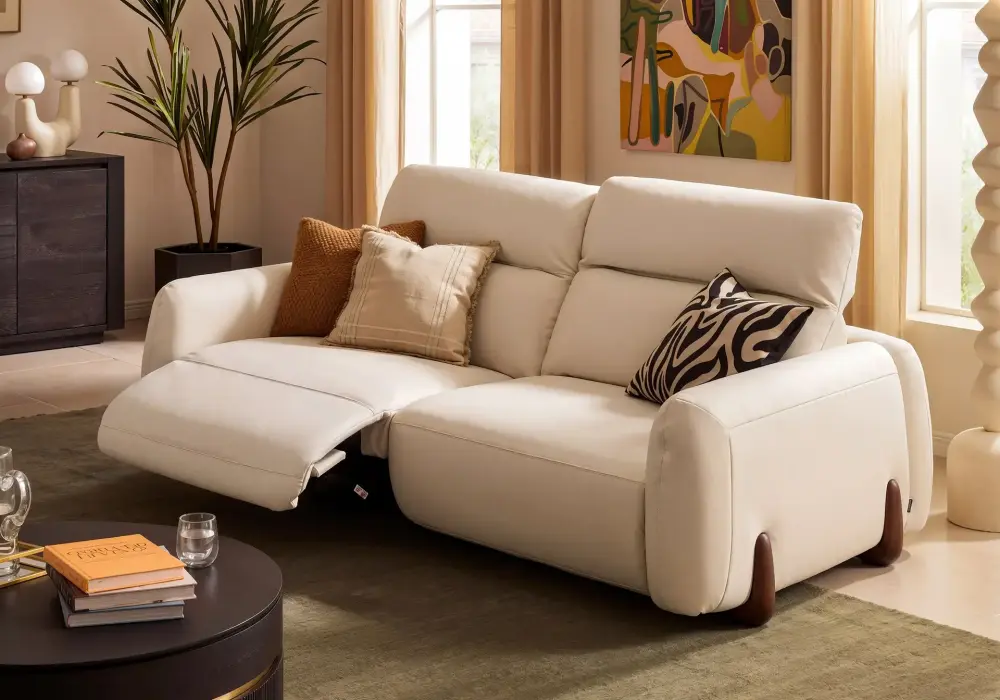
A wall-hugger or wall-away reclining sofa is one of the most useful options for compact rooms. Unlike a conventional recliner that may need substantial space behind the backrest, a wall-hugger mechanism moves the seat forward as it reclines.
The exact clearance depends on the mechanism, so never assume that every "wall-hugger" requires the same distance. Some current wall-reclining products are designed to operate only a few inches from the wall. For example, La-Z-Boy lists some wall recliners at approximately 102–178 mm from the wall, depending on the model.
This can make a major difference in a narrow apartment living room where every few inches behind the sofa affect the usable walkway.
Compact Reclining Loveseats
A reclining loveseat is often a better solution than a full three-seat sofa when the available wall is short.
A compact loveseat can provide two independent reclining positions while leaving more room for a side table, floor lamp, or passageway. This is particularly useful when the sofa faces a TV wall and the room is wider than it is deep.
Narrow-Arm Reclining Sofas
Arm width can consume surprisingly large amounts of usable seating space.
Two sofas with the same outside width may provide very different amounts of actual seat width if one has oversized rolled arms and the other uses narrow track arms. When comparing models, look at:
- Overall width
- Inside seat width
- Arm width
- Seat depth
- Fully reclined depth
For a small room, prioritize usable seating per inch of floor space rather than simply choosing the shortest overall sofa.
Small Modular Reclining Configurations
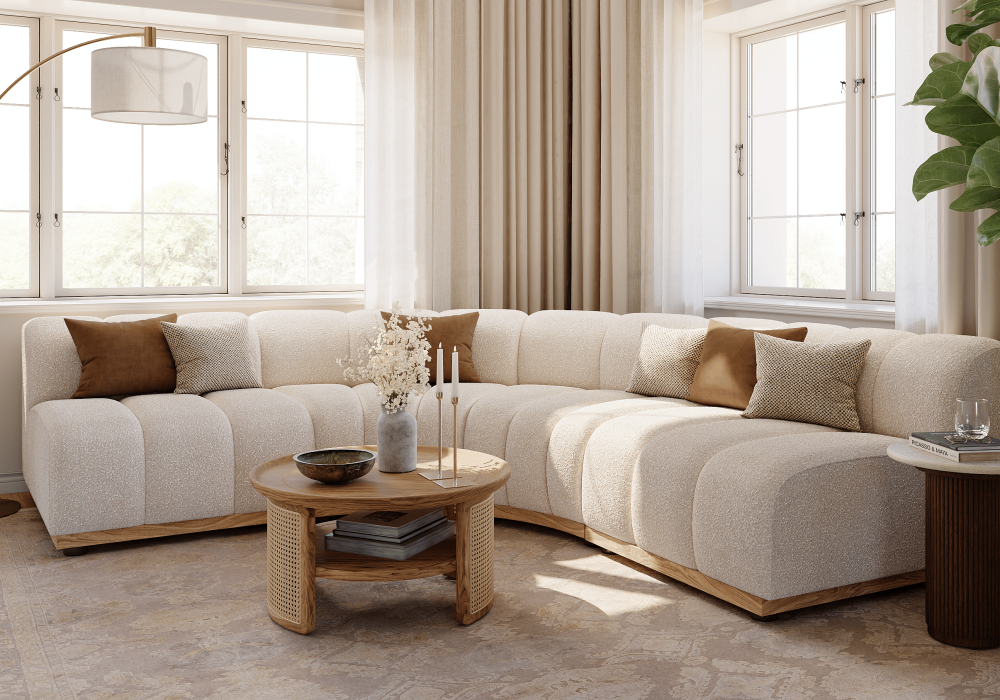
A compact modular reclining sectional can work when the room has an awkward corner that a conventional sofa cannot use efficiently.
For example, an L-shaped configuration can place one section against the longer wall and turn the corner without requiring a separate chair. This can actually improve circulation compared with placing a sofa and recliner independently.
However, measure each module individually. A sectional that looks space-efficient in plan view may become difficult to maneuver through a narrow hallway or stairwell.
Three Small-Room Layout Examples
Room scenario | Recommended configuration | Planning priority |
Small one-bedroom living room | 2-seat wall-hugger loveseat | Preserve main walkway |
Narrow living room | Compact reclining sofa + slim side table | Minimize front-to-back depth |
Open kitchen/living area | Small reclining sectional | Define living zone without blocking kitchen traffic |
For a very small room, avoid automatically choosing a large reclining sectional simply because it provides more seats. If the sofa blocks the kitchen path, balcony door, or primary walkway, the additional seating may reduce the room's overall functionality.
Measuring, Clearance, and Moving Through Tight Spaces
Before buying a reclining sofa, measure three different footprints: the sofa when closed, the sofa when fully reclined, and the route required to deliver it.
This is where many small-space purchases go wrong.
Source Homary
Start With the Closed Footprint
Measure:
- Wall length available for the sofa.
- Maximum sofa depth.
- Ceiling height around the delivery route.
- Distance to nearby doors and furniture.
- Main walking paths.
- Location of windows, outlets, vents, and radiators.
Then check the manufacturer's dimensions for the fully reclined position.
A compact reclining sofa might have a closed depth around 965–1016 mm but extend substantially farther into the room when the footrest and back are fully deployed. For example, a current La-Z-Boy Finley Wall Reclining Sofa measures 2159 mm wide by 965 mm deep when closed and has a listed fully extended dimension of 1727 mm.
That difference matters more than the sofa's closed depth alone.
A Practical Clearance Framework
Measurement | Compact-room target | Why it matters |
Behind a wall-hugger | Check model specification; some require only about 102–178 mm. | Allows the back to recline without hitting the wall |
Main walkway | About 762–914 mm where possible | Keeps everyday circulation practical |
In front of fully extended footrest | Measure the manufacturer's full extension | Prevents the footrest from blocking circulation |
Between sofa and coffee table | About 356–457 mm | Allows comfortable seated reach and passage |
Side clearance | About 76–152 mm minimum where practical | Allows access and prevents visual crowding |
These are planning targets rather than universal code requirements. The manufacturer's fully reclined dimensions should always take priority.
Measure the Delivery Route, Not Just the Room
A sofa can fit perfectly once assembled and still fail to enter the home.
Measure:
- Front door opening
- Interior door openings
- Hallway width
- Stair width
- Stair landing
- Elevator opening and interior depth
- Tight corners
- Ceiling height at turns
A common U.S. residential doorway may be around 762–914 mm wide, but the actual clear opening can be smaller because of the frame, hinges, trim, or door position.
For a tight delivery route, also ask whether the sofa has removable legs, detachable backs, or separable modules. These features can be more valuable than a few inches of reduced sofa width.
Use a Floor Template Before Ordering
A simple way to test a reclining sofa is to mark its footprint on the floor using painter's tape.
Mark both:
- Closed footprint
- Fully reclined footprint
Then walk through the room while the "sofa" is taped on the floor.
This immediately reveals whether the extended footrest blocks the coffee table, kitchen path, doorway, or another seat.
Mechanisms, Accessibility, and Multi-Function Features
Small-space buyers should evaluate the reclining mechanism as part of the room plan, not merely as a comfort feature.
Manual vs. Power Reclining
Feature | Manual reclining | Power reclining |
Power required | No | Yes |
Controls | Handle or lever | Buttons |
Position adjustment | Usually preset positions | Often more precise |
Electrical planning | Minimal | Outlet and cable required |
Weight | Often lighter, model dependent | Often heavier |
Best for | Simple setups | Frequent daily adjustment |
A manual recliner can be attractive when you want fewer electrical requirements. A power recliner, however, can offer more precise positioning and may be easier to operate for users who find mechanical handles difficult to use.
Power should not automatically be viewed as a disadvantage in a small apartment. The real question is whether you have a convenient outlet and enough room to route the cord without creating a trip hazard.
Source Homary
Wall-Hugger Power Recliners
A wall-hugger mechanism combines two useful characteristics for compact rooms: limited rear clearance and powered positioning.
But do not assume that "wall-hugger" means zero clearance. Check the exact manufacturer's specification for the model you are considering.
Lift-Assist and Accessibility
For households with older adults or users who benefit from additional standing assistance, a lift-assist recliner can be worth considering.
The trade-off is usually greater weight and a somewhat more specialized footprint. In a small room, make sure the lift movement does not interfere with a side table, doorway, or adjacent chair.
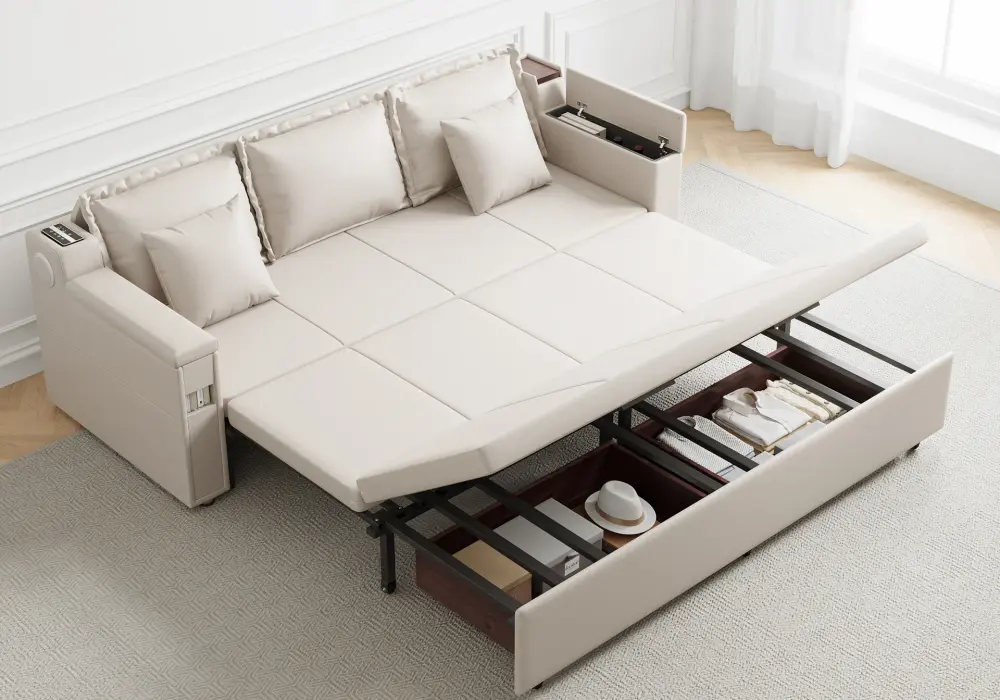
Multifunctional Reclining Furniture
Small homes often benefit from furniture that performs more than one role.
Possible features include:
- Hidden storage
- Console storage
- USB charging
- Drop-down tables
- Sleeper functions
- Modular sections
- Adjustable headrests
- Lumbar support
However, every added mechanism can increase weight, complexity, or footprint. Do not pay for a feature simply because it sounds useful.
Instead, ask:
Does this function replace another piece of furniture?
A center console with storage, for example, may eliminate the need for a separate side table. That can actually make the overall room more efficient.
Fabric, Durability, Pets, and Care
Once the dimensions work, upholstery becomes the next major purchasing decision.
For small homes, the sofa often becomes one of the most heavily used pieces of furniture because there are fewer alternative seating areas. Therefore, durability should be evaluated alongside appearance.
Leather
Leather can provide a sophisticated appearance and is relatively easy to wipe clean. It can be attractive for households concerned about food spills or pet hair.
However, different leather grades and finishes behave differently. Ask about the specific leather type rather than assuming every leather sofa has identical durability.
Source Homary
Performance Fabric
Performance upholstery is often a practical choice for families and pet owners because many fabrics are designed to resist staining, moisture, or everyday wear.
When shopping, look beyond the phrase "performance fabric" and check:
- Cleaning code
- Abrasion rating, if provided
- Stain resistance
- Colorfastness
- Manufacturer cleaning instructions
Microfiber and Microsuede
Microfiber-style fabrics can provide a soft hand feel while making everyday maintenance relatively straightforward. They can also be less visually formal than leather, which works well with casual contemporary interiors.
Faux Leather and Synthetic Upholstery
Synthetic upholstery can offer the visual appearance of leather at a lower price point. Its long-term performance varies considerably by material and construction, so inspect the upholstery specifications and warranty rather than judging solely by appearance.
Upholstery Comparison
Material | Main advantage | Main concern | Good for |
Leather | Easy surface cleaning, premium look | Higher cost; finish varies | Modern, traditional rooms |
Performance fabric | Stain and everyday-use options | Specifications vary | Families and pets |
Microfiber | Soft, casual, practical | Can show texture or shading | Apartments, casual rooms |
Synthetic leather | Lower-cost leather look | Long-term wear varies | Budget-conscious buyers |
Standard fabric | Wide style selection | May require more care | Lower-use rooms |
The important point is that small-space furniture often gets more use, not less. Choose upholstery based on the household's actual habits.
Budget, Brands, Retailers, and Warranties: Finding Value in Compact Recliners
Price should be evaluated against the mechanism, construction, upholstery, delivery service, and warranty—not just the sofa's dimensions.
A practical U.S. planning framework is:
Budget | What to expect | Best strategy |
Under $800 | Basic compact or manual options | Prioritize dimensions and mechanism |
$800–$1,800 | More upholstery and feature choices | Compare construction, comfort, and warranty |
$1,800+ | Premium mechanisms, upholstery, customization | Focus on long-term fit and service |
These ranges are planning guidelines rather than fixed market tiers. Promotions, upholstery selections, power features, and local pricing can move a sofa between categories.
Comparing Retail Channels
Large online marketplaces can provide a broad selection and make it easier to compare dimensions quickly. However, verify the fully reclined dimensions, delivery method, return conditions, and whether the item arrives assembled.
Specialty furniture retailers can be useful when you need in-person testing, design assistance, delivery coordination, or customization.
For example, La-Z-Boy currently lists compact wall-reclining products designed for smaller spaces, including models that specify small-scale body dimensions and limited wall clearance. Its current Finley Wall Reclining Sofa is 2159 mm wide and 965 mm deep, with a limited lifetime warranty.
IKEA also publishes limited warranties for qualifying seating furniture, with some sofas, armchairs, sleeper sofas, and ottomans covered for 10 years and certain products for 25 years; however, its warranty specifically excludes some recliners, so the individual product's coverage must be checked before purchase.
That illustrates an important buying principle: never compare warranties by brand name alone. Check what is actually covered on the specific reclining model.
Is Extended Warranty Worth It?
Consider the cost of:
- Reclining mechanism
- Power components
- Frame
- Upholstery
- Labor
- Replacement parts
A more expensive warranty is not automatically better. Read exclusions, coverage duration, service requirements, and whether labor is included.
For a high-use power reclining sofa, stronger coverage can be more meaningful than for an inexpensive manual loveseat.
How to Decide if a Reclining Sofa Will Actually Fit Your Small Space
Before purchasing, reduce the decision to five questions:
- Does the closed sofa fit the wall? Measure the usable wall length rather than the entire wall.
- Does the fully reclined sofa fit the room? Use the manufacturer's extended dimensions, not an estimate.
- Can people still walk around it? Protect the primary route between the entrance, kitchen, hallway, and other rooms.
- Can the sofa enter the house? Measure doors, halls, stairs, elevators, and turns.
- Does the mechanism solve a real problem? Choose wall-hugger, power, storage, lift-assist, or modular features only when they improve the way your household uses the room.
A compact reclining sofa should make a small room more comfortable without making it feel more crowded. That is the real measure of whether the purchase works.
Make Your Small Living Room Work Harder
If you are comparing compact reclining sofas, start with measurements before looking at upholstery colors or extra features. Record your available wall width, maximum closed depth, fully reclined depth, doorway width, and main walkway.
Then compare models using the same measurement checklist.
For a high-ticket furniture purchase, spending ten minutes with painter's tape and a measuring tape can reveal more than a showroom photo ever will. Once you know your usable footprint, you can choose between a wall-hugger, loveseat, compact sectional, or multifunctional configuration with much greater confidence.
FAQ
How do I measure my room and doorways to ensure a reclining sofa will fit when both closed and fully reclined?
Measure the sofa's closed width and depth, then check the manufacturer's fully extended dimensions. On the floor, tape both footprints and verify that the extended footrest does not block the main walkway. Separately measure every doorway, hallway, stair landing, elevator opening, and tight turn along the delivery route.
What clearance in front, behind, and to the sides should I leave for different reclining mechanisms?
There is no universal clearance for every model. Standard recliners generally need substantially more rear space than wall-hugger designs. Some current wall-hugger models specify approximately 102–178 mm from the wall, while the front clearance must still accommodate the fully extended footrest. Always use the manufacturer's exact dimensions for the final decision.
What are the trade-offs between manual and power recliners for small apartments?
Manual recliners require no outlet and can be simpler to place, while power recliners provide more precise adjustment but require electrical planning and cable management. Power models can also be heavier, so delivery access should be checked carefully.
Which upholstery materials are best for homes with pets and children?
Performance fabrics, microfiber-style upholstery, and appropriately finished leather are common choices for high-use households. The best option depends on the manufacturer's cleaning code, stain resistance, abrasion information, and the type of pet or activity in the home. Always follow the upholstery manufacturer's cleaning instructions rather than assuming a material is universally stain-proof.
Can a reclining sofa also function as a sleeper or provide meaningful storage without taking up excessive space?
Yes, but multifunctional designs involve trade-offs. Storage consoles can replace separate tables, while sleeper functions can add value in apartments where a dedicated guest room is unavailable. Check the furniture's open footprint and weight because additional mechanisms can make the sofa heavier or more difficult to deliver.
What are the best practical techniques to get a reclining sofa through narrow doorways, staircases, or small elevators?
Measure the entire delivery path before ordering. Ask whether the back, legs, arms, or individual modules can be removed. Measure the narrowest point rather than relying on the nominal doorway width, and confirm the retailer's delivery requirements before purchase.
What price ranges should I expect for compact reclining sofas, and which U.S. brands or retailers offer the best warranties and value for each budget tier?
A useful planning range is under $800 for basic options, $800–$1,800 for a broader mix of features and upholstery, and $1,800+ for premium mechanisms, materials, customization, and service. Warranty value depends on the specific model. For example, La-Z-Boy currently lists a limited lifetime warranty on several wall-reclining models, while IKEA's qualifying seating warranties can extend to 10 or 25 years, with exclusions that include some recliners. Compare the actual warranty terms, delivery service, return policy, and mechanism coverage before making a decision.