

Recliner sofa size is not a single number — it is four separate measurements that pull in different directions, and buying on only one of them is how people end up with a sofa that fits their wall perfectly and cannot be operated in the room. A reclining sofa needs to be measured four ways: overall width across the wall, closed depth front to back, fully reclined depth, and the seat dimensions that determine whether it is comfortable for the people using it. Most sizing problems trace back to ignoring the third of those four.
Table of Contents
The Four Measurements That Define Recliner Sofa Size
Measurement | Typical range | What it determines |
Overall width | 2032–2794 mm | Space occupied across the wall; includes arms and any center console |
Closed depth | 914–1067 mm | The resting footprint, front to back |
Fully reclined depth | 1524–1829 mm | The footprint once the footrest is extended |
Overall height | 914–1041 mm | Upright height; also the height of the tallest shipping component |
Rear wall clearance | 51–152 mm for zero-wall designs; 305–457 mm for standard recliners | Space needed behind the back for the mechanism to move |
Two-seat recliners typically run 2032 to 2286 mm wide. Three-seat models, or two-seaters with a center console, run 2413 to 2794 mm.
The single most important thing to understand is that closed depth and fully reclined depth are not the same measurement, and a listing that gives only one of them has not given you the number you need. A sofa with a 1041 mm closed depth may need 1778 mm of space when fully reclined. That 737 mm difference is not an abstract number — it is where your coffee table has to go, or where it has to not go. For a deeper look at the same principles, see our guide to full-size reclining sofa.
Match the Width to Your Wall, Not to the Seating
Overall width includes the arms and any built-in console, while seat width is the space you actually sit in. These are different numbers, and a generous arm or a console can absorb a surprising share of the total.
A wide sofa may have generous arms, deep padding, or a center console that takes up part of the total width. These features are useful, but they reduce how much of the footprint is sitting space.
Decide who sits there and how often, then count reclining seats from the product specifications rather than from the overall length. Some designs have fixed sections, shared mechanisms, or a console where a seat would be. Three questions settle it: how many people sit comfortably, how many positions recline independently, and how much room the whole sofa takes. Two sofas of similar width can answer those very differently.
A general guide to matching width to room:
Room size | Wall available | Recommended width | Best fit |
Small (about 3048 × 3658 mm or less) | 2438–2743 mm | 2032–2235 mm | Two-seat zero-wall sofa |
Standard (about 3658 × 4572 mm) | 3048–3658 mm | 2235–2540 mm | Two- or three-seat sofa, with or without console |
Large (4572 × 5486 mm or more) | 3658 mm+ | 2540–2794 mm | Wide sofa with center console |
These are typical ranges. The exact model's dimension drawing gives the final numbers, so check it before you buy.
Account for Wall Clearance Behind the Sofa
This is the measurement most shoppers skip, and it is the reason a standard recliner often cannot go against a wall at all.
Zero-wall or wall-hugger designs pivot forward as they recline, so the back barely moves. They need about 51 to 152 mm of clearance behind them. This makes them the right choice for a room where the sofa must sit close to the wall, which is common in apartments and narrow living rooms.
Standard recliners translate backward as the footrest opens, so they need 305 to 457 mm of clearance behind the back. Many are also designed to be used at an angle rather than flat against a wall, so the footrest has somewhere to go.
Check for the things that eat into your rear clearance: curtains and their rods, radiators, a wall-mounted TV bracket, a light switch, a socket, and any furniture directly behind. If you need a wall-hugger to fit, say so when you shop rather than hoping a standard model will squeeze in.
Plan the Fully Reclined Footprint
Draw the closed sofa first, then add a second outline for its maximum operating position, using the manufacturer's drawing when you have it. Keep operating space and circulation space as separate zones on your drawing. A clear patch of floor in front of an upright sofa disappears when the footrest extends, and if someone has to step over an open mechanism to reach the kitchen, the layout is wrong.
Worked example. Take a 2159 mm sofa on a 3048 mm wall. Centered, it leaves 445 mm on each side, which fits a narrow end table on both ends. For depth, add 102 mm of rear clearance, 1041 mm of closed depth, 711 mm of footrest projection, and a 914 mm walkway: roughly 2769 mm, or about 2.74 m from the wall to the clear walking path. If your room is shallower than that, move to a smaller sofa or a different layout.
Zero wall describes an approach, not a free pass. It reduces the space needed behind the sofa, and you still need room in front for the footrest.
Place the Coffee Table After Checking Motion
A coffee table placed for upright sitting often blocks the footrest. Place the table with the fully open mechanism in mind, then check that you can still reach a drink from your usual seat.
- For upright sitting: keep a coffee table 406 to 457 mm from the sofa front.
- If the table stays in place while you recline: its near edge needs to be at least 762 mm from the sofa front.
- If one table cannot do both jobs: use the two-table approach — a pair of end tables beside the sofa, or a small movable table on casters that slides over the footrest.
A large central table placed 762 mm out is technically correct and practically useless, because it is too far to reach from an upright seat. Test your plan with masking tape or cardboard before buying. Furniture you have to move every evening just to recline will soon feel like a chore.
Match Seat Dimensions to the People Using Them
Overall size does not tell you how a sofa will feel. A deep seat can leave a shorter sitter unable to reach the back comfortably, and a shallow seat can feel cramped to someone with longer legs.
Compare seat height, depth, and usable width against a chair or sofa you already like.
- Seat height is measured from the floor to the top of the seat cushion, allowing for compression. Around 432 to 483 mm suits most adults.
- Seat depth is measured to the back cushion, not to the frame's outside depth. Roughly 508 to 559 mm suits average-to-taller adults; deeper than 559 mm often needs a cushion to sit comfortably.
- Usable seat width is the space between the arms or console, not the overall width.
When you try a sofa, sit with your back supported in the upright position first. Then check that the controls are easy to reach and the footrest supports you through the whole range. If you cannot try it in person, ask for the seat height, depth, and width, and read the return policy before you buy.
Include Doors, Corridors, and Assembly Access
Room fit and delivery fit are separate checks. Measure the narrowest doorway, hall turn, staircase, and elevator on the route, including projecting rails and light fixtures.
Ask for package dimensions and the size of the largest assembled section. Many reclining sofas ship in separate components — a 2159 mm sofa commonly arrives as two boxes, each around 1118 to 1295 mm long and 787 to 1143 mm deep. Read the assembly instructions to confirm what comes apart before you rely on it.
A listed minimum door width is only a starting point. Corners and stair turns matter just as much, and they are the part people measure wrong.
Plan a clear assembly area and arrange the help the manufacturer specifies. Decide where the packaging will go so it does not block access. Once assembled, test every function before you arrange other furniture tightly around the sofa.
Product Options at Common Widths
Three recliner configurations cover most living rooms, and each solves a different sizing constraint.
An 2159 mm Two-Seater With Charging for Smaller Rooms
The 2159 mm 2-Seater Genuine Leather Power Reclining Sofa measures 2159 mm wide, 1041 mm deep, and 940 mm high, with a 1626 mm seat width and a 457 mm seat height. It is a zero-wall design with push-button power recline and built-in USB and USB-C charging, and it can pass through doorways as narrow as 813 mm.
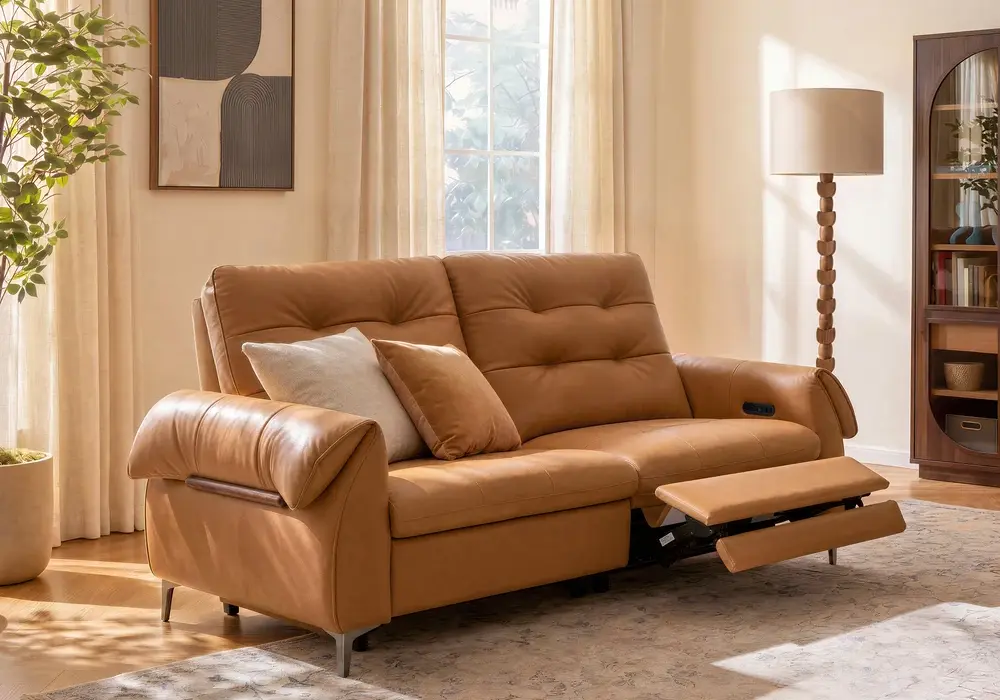
This is the pick for apartments and compact living rooms with a 2438 to 3048 mm wall. The zero-wall construction lets you place it close to the wall without the usual 305-to-457 mm gap, and the built-in charging ports can replace a charging station on a side table.
An 2159 mm Two-Seater With Adjustable Headrests for Taller Sitters
The 2159 mm Genuine Leather Power Reclining Sofa has the same 2159 mm width but is deeper: 1245 mm deep and 762 mm high, with a 660 mm seat depth. It has motorized seats at both ends and manually adjustable headrests.
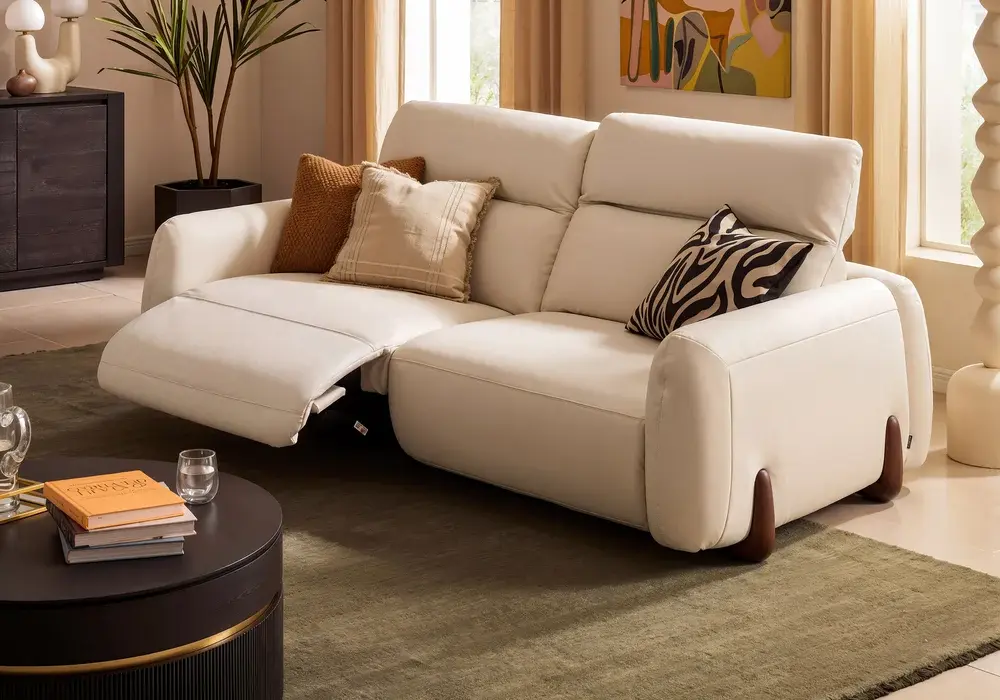
Compared with the model above, it adds 203 mm of overall depth and 102 mm of seat depth. That suits taller people and long lounging sessions, as long as the room has the depth for it. If floor space is tight, choose the shallower model.
A Recliner Chair When a Sofa Will Not Fit
The Modern Leather Power Recliner High Back Sleeper Chair measures 813 mm wide and 813 mm deep, with a 1041 mm height and a high back.
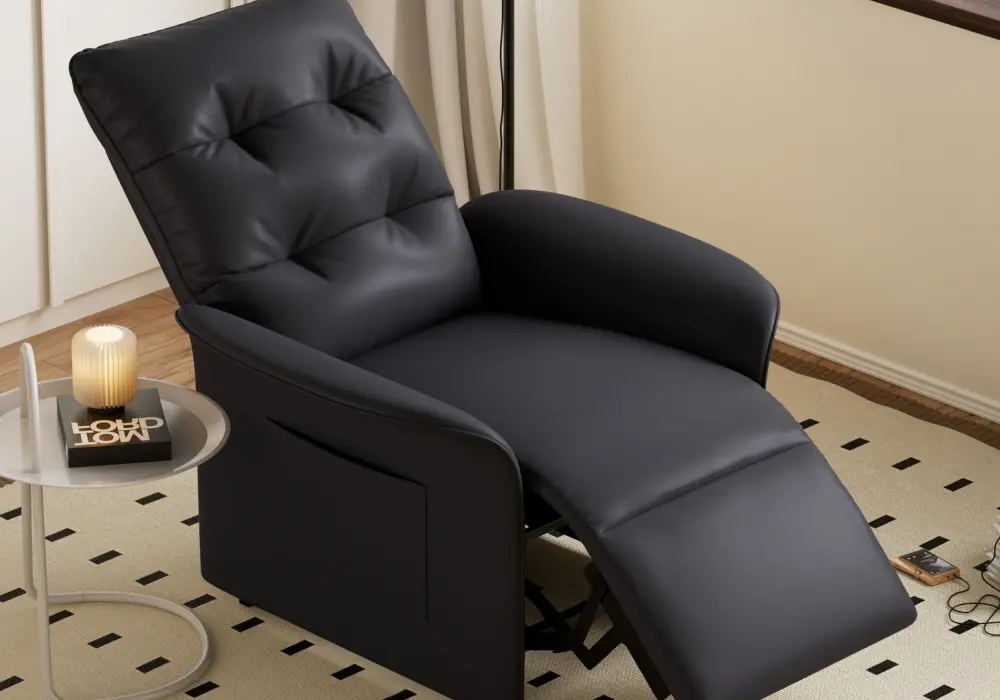
At 813 mm square, it fits corners and alcoves where no sofa can go, and it works alone in a reading corner or beside a separate sofa. The side pocket holds a remote or phone, which helps when there is no coffee table within reach.
Consider the Space Used by Everyday Habits
A reclining sofa affects more than film nights. Think about vacuuming, opening curtains, reaching shelves, and moving between the seating area and the rest of the house.
If one person naps while others walk past, test the route with the sofa open. If a child plays on the floor nearby, keep the mechanism's operating area separate from the play area, follow the manufacturer's precautions, and check for people, pets, and objects before moving a powered section.
A rug should sit flat and let the sofa stand as designed. Do not put objects under the mechanism to change its height, and make any leveling adjustments as the instructions describe.
In an open-plan room, use furniture outlines to define the lounge without cutting across the main route. Sometimes a smaller sofa plus a chair works better than one wide sofa; in other rooms, one sofa keeps the layout simpler. Compare the whole arrangement, not one product dimension.
Frequently Asked Questions
What is the standard size of a recliner sofa?
Most reclining sofas are 2032 to 2794 mm wide, 914 to 1067 mm deep when closed, and 1524 to 1829 mm deep when fully reclined. Two-seat models run 2032 to 2286 mm wide; three-seaters and console models reach 2413 to 2794 mm.
How much clearance does a reclining sofa need behind it?
Zero-wall models need about 51 to 152 mm behind the back, while standard recliners need 305 to 457 mm. Both types need roughly 711 mm of clear space in front for the footrest.
How far should a coffee table be from a reclining sofa?
Keep it 406 to 457 mm from the sofa front for upright sitting. If it stays in place while you recline, its near edge must be at least 762 mm out, so end tables or a small movable table often work better.
How do I measure for a reclining sofa in a small room?
Add the rear clearance, the closed depth, about 711 mm for the footrest, and your walkway. If the total exceeds your wall-to-wall depth, choose a shallower model or a wall-hugger design.
Is an 2159 mm reclining sofa too big for a living room?
No, if your wall is at least 2438 to 3048 mm and the room has depth for the footrest. Depth, not width, is usually the deciding factor, because the footrest is what intrudes.
What size recliner chair fits in a small room?
A power recliner accent chair is typically about 813 mm wide and deep, so it fits corners and alcoves where a sofa cannot. Allow extra depth in front for the reclined position.