

A calm Christmas doesn’t need a decoration on every shelf. Minimalist Christmas decor means choosing fewer, better pieces: two or three colors, one clear focal point per room, and surfaces left open. Picture one slim tree with a handful of wooden ornaments, a runner of greenery down the dining table, and a wool throw on the sofa. Add natural wood and textiles you actually use, and you get a Scandinavian-inspired look that feels warm rather than empty, built mostly from what you already own.
Table of Contents
Decide what should remain visible
Look at the room before adding anything seasonal. Notice the forms you enjoy: the curve of a chair, the grain of a table, or a clear view through a window. A restrained decorating plan should leave those qualities visible. Decorations can support the room without covering the features that already give it character.
Choose one main focal point in each important space. A tree, a console arrangement, or a dining-table display can each do that job. If every surface carries an equally strong scene, the result becomes harder to read. Keep nearby areas quieter so that the main choice feels deliberate.
Store a few everyday accessories while the seasonal ones are displayed. This creates room for change without increasing the total number of objects. It also makes the arrangement easier to maintain, especially in an apartment or a room that serves several purposes.
Build a limited palette from existing finishes
Start with the upholstery, walls, wood, and metal already present. Choose one seasonal color and a restrained supporting detail. Green with cream, warm neutrals with a metallic accent, or another compatible combination can work. The useful question is how the colors relate in your room, not whether they match a trend label.
Repeat the palette in different proportions. The main living area can carry the strongest accent while the entryway uses a smaller echo. A bedroom may need only a textile detail. Continuity comes from a relationship between rooms rather than an identical arrangement repeated in each one.
Use contrast carefully. A darker object against a lighter surface can establish a focal point without requiring many pieces. A metallic finish can reflect light, but too many reflective elements may compete. Test the actual objects under the room's evening lighting before adding another layer.
Let shape and material provide variety
Within a limited palette, vary texture and form. Wood, a matte surface, and a restrained glass detail can provide interest without more color. Use a small number of material relationships and repeat them where useful. Avoid collecting unrelated objects simply because each one looks individually minimal.
The White Sintered Stone Pedestal is a good example of a piece that can anchor a display. Set it in a living room corner or beside the tree and put one thing on top: a ceramic vase holding a few pine or eucalyptus branches, a shallow bowl of pinecones, or a single candle in a simple holder. The white surface sets off dark greenery and natural wood, and it stays useful after the holidays as a plant stand or sculpture base. Just leave enough clearance that it doesn't narrow a walkway.
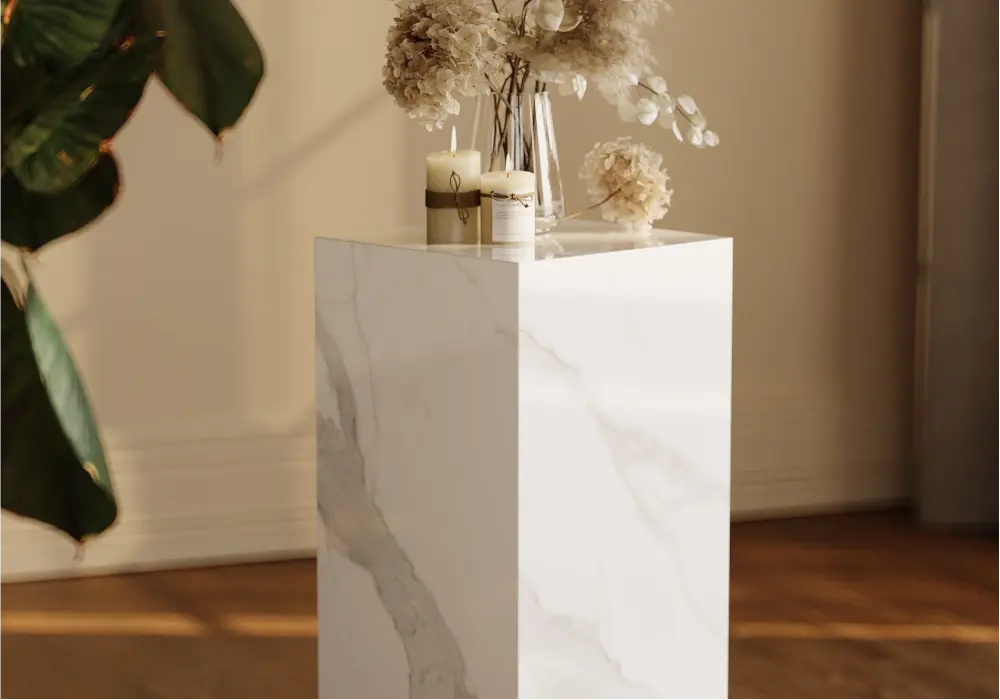
Treat the space around the pedestal as part of the arrangement. One suitable object may be enough on top. You do not need to fill the floor beside it or surround it with smaller accessories. The contrast between the main form and the open area can do much of the visual work.
Keep the display easy to move so the pedestal and whatever sits on it can be cleaned or shifted without a complicated setup.
Minimalist Christmas decor ideas to try
If you want something concrete to start with, these ideas each rely on one or two pieces and work in most homes:
- A branch instead of a full tree. Stand a large bare or lightly flocked branch in a heavy vase and hang six to ten small ornaments in wood, ceramic, or matte white. It takes up little floor space and suits apartments.
- A single-color tree. Pick one ornament color, such as cream, or natural wood with one metallic accent, and use only that. Space the ornaments out so the branches stay visible.
- A table runner of greenery. Lay a strip of cedar, fir, or eucalyptus down the center of the dining table with two or three candlesticks of different heights. Clear it easily when you need the table.
- One wreath on a plain wall or door. Choose a simple ring of greenery with no bow or only a thin ribbon, and leave the surrounding wall bare so it reads as the focal point.
- A calm entryway. Add a small bowl of pinecones or clementines on the console and a single candle. Keep keys, mail, and shoes organized so the seasonal touch stands out.
- Textiles that do double duty. Swap in a chunky knit or wool throw and linen napkins in a seasonal shade. They add warmth and you will use them every day.
- Warm light, kept simple. Use a single string of warm white lights on the tree or along one shelf, and let the existing lamps do the rest. Keep controls easy to reach.
Give Scandinavian-inspired styling warmth
Use the wood tones and useful textiles already in the room as part of the seasonal scheme. A throw that is genuinely comfortable to use or a simple fabric napkin can contribute more than another purely decorative object. Warmth can come from texture, scale, and practical use rather than a large quantity of ornaments.
Keep decorative forms clear enough to read. A small grouping with a visible main element can be more effective than many tiny pieces scattered across shelves. Leave ordinary belongings organized so the seasonal accents do not have to compete with accumulated visual clutter.
Choose lighting according to how the room is used. Begin with the existing lamps and task lighting, then decide whether a decorative light treatment adds something useful. A room should still be comfortably usable when the seasonal lights are off.
Personal details can belong in a restrained scheme. A meaningful ornament or inherited object does not need to be excluded because its shape is less simple. Give it a clear place and reduce the surrounding elements so it can be appreciated.
Adapt modern neutral and metallic variations
For a modern interpretation, use clearer silhouettes and more defined spacing. A single sculptural element with a lower supporting detail can establish a composition. Keep the palette connected to the furniture rather than adding a seasonal color that requires changing everything else.
For a neutral scheme, vary the value and texture of the materials so the arrangement does not become visually flat. Light and darker neutrals can work together when their relationships are deliberate. A neutral palette is a choice of color, not a requirement to remove contrast or personality.
For white and gold, use the metallic finish as an accent rather than assuming both colors must appear equally. Check how reflective details look beside existing fixtures. A small repeated finish can connect the room more naturally than replacing every accessory with a coordinated set.
If you enjoy a mid-century reference, let an existing furniture form or wood tone guide the detail. Avoid adding several different style references at full strength. A room is easier to understand when one direction leads and the others remain supporting accents.
Keep the budget focused and the arrangement flexible
Review what you own before shopping. Sort decorations by color, material, and scale so that useful relationships become visible. You may find that a coherent arrangement already exists within the collection, even if the pieces were bought in different years.
Choose one missing role rather than a long list of accessories. You might need a lower container, a simpler textile, or a suitable display surface. Buy only if it improves a specific part of the room. Minimalist styling is undermined when the effort to look restrained generates unnecessary purchases.
Edit the finished display after using the room for a day. Remove anything that blocks a routine or feels visually redundant. Keep a simple storage plan for the pieces you put away. The most useful arrangement can be enjoyed without constant adjustment or an elaborate reset after ordinary use.
Frequently Asked Questions
How do minimalist and Scandinavian Christmas styles differ?
Minimalist styling focuses on editing and clear visual relationships. A Scandinavian-inspired interpretation may also emphasize simple forms, existing wood tones, and useful textiles. The approaches overlap, and you can adapt either to your own room rather than treating them as rigid categories.
Which colors suit a minimalist Christmas palette?
Start with the room's established finishes and add a limited seasonal accent. Green, cream, warm neutrals, or a restrained metallic detail can work. Choose relationships that look coherent in the actual space rather than following a universal color formula.
Can I create the look on a budget?
Yes. Sort and reuse existing pieces, keep fewer display areas, and buy only for an identified gap. A considered arrangement depends on spacing and proportion as much as the number or price of the accessories.
Can modern and vintage pieces work together?
They can when there is a connecting element such as color, scale, or material. Give one meaningful vintage piece a clear position and simplify its surroundings. Mixing styles is easier when the objects have different supporting roles rather than competing equally.
How do I keep restrained decor from feeling cold?
Use comfortable textiles, useful lighting, and personal details. Preserve the existing character of the room and vary texture within the palette. A small number of meaningful elements can feel warmer than a larger collection chosen only for visual consistency.