

To style an oval coffee table, keep the surface about two-thirds filled, build three layers of height (a base layer, a mid-height object and one tall accent), and leave the curved edges clear for drinks and elbows. Because an oval has no corners to anchor a grid of objects, it rewards loose, slightly off-center groupings rather than rigid symmetry. If you are still choosing the piece itself, the coffee tables collection shows how shape, material and storage change what you can put on top.
Table of Contents
Why Oval Coffee Tables Are Easy to Style (and Where They Get Tricky)
An oval table softens a room full of straight lines. Sofas, TV walls, rugs and windows are all rectangular, so a curved top gives the eye somewhere to rest and removes the sharp corners that people bump on their way past. That is also why oval tables suit narrow living rooms and walkways: you can slide by without catching a hip.
The curve is also the challenge. On a rectangle you can line up a tray, a stack of books and a candle along straight edges and it looks deliberate. On an oval, the same row looks stiff, and objects placed at the extreme ends can feel like they are about to slide off. The fix is to think in clusters, not lines. Treat the center of the table as the stage and the two rounded ends as breathing room, or build one main cluster slightly toward one end and keep the other end open for use.
Two other traits matter for styling. First, the usable surface of an oval is smaller than a rectangle of the same length, because the ends taper. Second, an oval tends to look best when objects have a mix of shapes: round bowls and vases echo the table, while one or two rectangular items, such as a book or a tray, keep the arrangement from looking too soft.
Start With Size and Clearance Before You Add Decor
Styling falls apart when the table is the wrong size for the seating, so check the basics first. These are widely used design rules of thumb rather than hard standards, so treat them as starting points.
Measurement | Common guideline | Why it matters |
Table length | About two-thirds the length of the sofa | Keeps the table in proportion with the seating |
Distance from sofa | Roughly 14 to 18 inches | Close enough to reach a cup, far enough to stand up |
Walkway beside the table | About 30 inches where people pass | Prevents shuffling sideways |
Table height | Level with, or an inch or two below, the sofa seat | Makes it comfortable to reach from a seated position |
An oval makes the walkway rule more forgiving. Rounded ends reduce the footprint at the corners, so the same table can sit closer to the sofa arms or a chair without feeling cramped. If you are working with a sectional, measure the long side of the sofa, not the whole L, and pick an oval that fits that run.
Orientation also matters. Place the long axis parallel to the sofa so the table frames the seating area. Turning it perpendicular can work in an open-plan room where you want to divide a conversation zone from a walkway, but it usually blocks access to the middle seat.
Use the Three-Layer Method
Once the table is in place, build the surface in three layers. This is the simplest way to make a small collection of objects look curated instead of cluttered.
Layer one: a base that gathers things. A shallow tray, a stack of two or three coffee table books or a low bowl. The base gives smaller items a home and turns a handful of objects into one composition. On an oval, an oval or round tray repeats the table shape; a rectangular tray adds contrast.
Layer two: a mid-height object. A ceramic vase with a few stems, a sculptural object, a candle in a glass vessel or a small plant. Aim for something roughly six to ten inches tall, placed on or beside the base.
Layer three: one tall accent. This is the focal point: a taller vase, a branch arrangement or a slim lamp-style candleholder. Keep it modest, because a tall item sits between you and the person across from you. A good limit is about as tall as the table is long divided by four, which for a 47-inch table is roughly a foot.
Odd numbers tend to look more natural than even ones, so group objects in threes or fives. Mix materials as well: something matte, something glossy and something organic such as wood, linen or greenery. If your table is wood, add ceramic or glass. If it has a stone top, bring in warm wood or woven textures.
Then leave space. A common mistake is covering every inch. Aim to keep about a third of the surface empty, and leave one clear zone near the edge where you actually put your drink.
Styling an Oval Coffee Table With Storage
Storage changes the styling rules because the surface has to stay lighter, and the contents of the cabinet become part of the room's tidiness. A good example is the 47" Modern Oval Walnut Solid Wood Fluted Coffee Table, which pairs a solid ash wood top and walnut finish with two sliding grooved tambour doors and flexible internal compartments for items such as books and remotes.
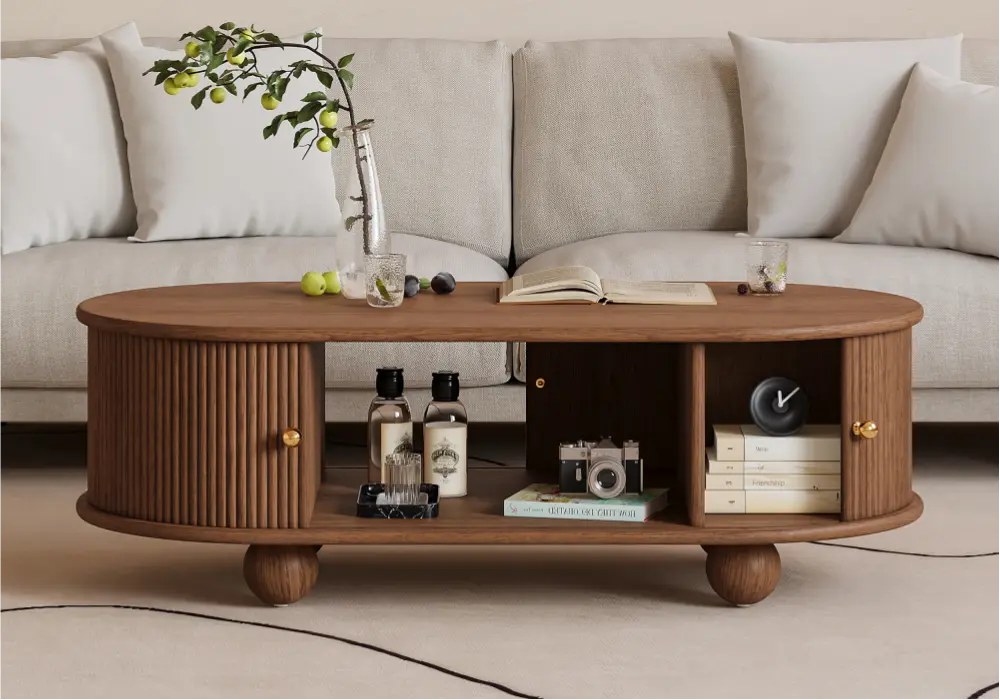
The fluted doors already provide texture, so the top does not need to work as hard. Here is a simple way to style a table like this:
- Keep the surface to one cluster. With visible storage underneath, you can move remotes, coasters and throw-blanket overflow out of sight. A single tray or book stack, one vase and one small object is enough.
- Choose objects that contrast with the grooves. Smooth ceramic or glass looks cleaner against a ribbed front than another heavily textured piece would.
- Echo the metal. The page describes brass handle detailing, so a brass or warm-metal candleholder or tray handle can tie the surface to the hardware.
- Use the compartments deliberately. Store the things you reach for daily, such as remotes and a notebook, in the easiest compartment, and keep seasonal items in the farthest one.
Because the top is wood, a coaster or a tray with a protective base is a sensible habit for hot mugs and condensation, whatever the finish.
Match the Styling to Your Room Layout
The same oval can look very different depending on what surrounds it.
With a single sofa and two chairs. The oval acts as a hub. Keep objects low on the side facing the chairs so nobody has to lean around a vase, and place the tall accent nearer the sofa.
With a sectional. Center the table in the L, and keep the arrangement fairly flat, since you will be seeing it from several angles. A tray plus one low bowl often looks better than a vase that blocks the view from the chaise.
In a small living room. Choose one lighter-looking base and skip the third layer entirely. The oval's curved edges will already make the room feel less boxed in. A single stack of books topped with a small object can be all the styling you need.
In an open-plan space. Let the table help define the seating zone and style it to be seen from both sides. Avoid placing the tall item at either end, where it will look off-balance from the dining or kitchen side.
Swap the Look Through the Seasons
Because the structure stays the same, you can refresh the table without buying anything new. Keep the base tray and the largest object, then rotate the middle and tall layers.
- Spring and summer: fresh stems in a clear vase, a lighter linen coaster set, a bowl of lemons or green apples.
- Autumn: a ceramic pumpkin or dried grasses, a candle with a warm scent, a stack of darker book spines.
- Winter: pinecones or evergreen sprigs in a low bowl, a pair of candles, a textured throw folded within reach.
If you use real flowers, change the water often and keep arrangements low enough that people across from each other can still talk. If you burn candles, keep them on a stable base and away from paper and fabric.
Common Oval Coffee Table Styling Mistakes
- Lining everything up. Straight rows fight the curve. Cluster instead.
- Going too tall. Anything above roughly a foot starts to block sightlines.
- Filling the whole top. If there is nowhere to set a drink, the table is overdecorated.
- Using only one material. All-wood or all-metal arrangements look flat. Mix at least two textures.
Frequently Asked Questions
How many items should go on an oval coffee table?
Three to five objects is a good range. Use a tray or book stack as a base, one mid-height piece and one accent, then add a coaster set if you use the table often. If the table is small, drop to three.
Should I use a tray on an oval coffee table?
A tray is helpful because it groups small items and gives the arrangement a defined edge. Choose an oval or round tray to echo the table, or a rectangular one for contrast. Leave room around the tray so the table still looks open.
What should I put in the center of an oval coffee table?
Place your main cluster slightly off-center, not dead center, such as a vase beside a stack of books. A true center placement can look rigid on a curved top. If you prefer symmetry, use a single low bowl or candle in the middle and keep everything else around the edges.
How far should an oval coffee table be from the sofa?
A gap of roughly 14 to 18 inches is a common guideline. It keeps drinks within reach while leaving room to stand up. In tight rooms, the rounded ends let you push the table a little closer without blocking the path.
Can I style an oval coffee table in a small living room?
Yes, and it is a good shape for it. Choose a table no longer than about two-thirds of the sofa, keep decor to one low cluster and leave a third of the surface empty. Using storage underneath helps keep clutter off the top.
Do I need to match the coffee table to the side tables?
No. Pairing materials, such as wood with wood or stone with metal, ties a room together, but the shapes can differ. An oval coffee table with a round or square side table works well as long as the finishes and tones feel related.