

To style a round dining table, build everything outward from the center: one centerpiece with a clear focal point, evenly spaced place settings and a rug or light fixture that echoes the circle. A round top has no head or foot, so it works best when the decor looks balanced from every seat. If you are still deciding between shapes, browse a few styles of dining tables and picture how each would sit in your room. Then use the steps below to make a round table look finished.
Table of Contents
What Makes a Round Table Different
Round tables are known for conversation. Everyone faces the center, nobody is stuck at the end, and guests can talk across the table without leaning. That shape also changes how you decorate it:
- The center is the focal point. On a rectangular table you can run decor along the length. On a round one, the eye goes straight to the middle, so that is where your best piece belongs.
- Radial symmetry. Elements arranged in a ring or in even intervals feel natural, while a long, linear arrangement looks off.
- Limited width. Reaching across a round table takes longer than across a narrow rectangle, so the centerpiece needs to be compact enough for people to pass dishes around it.
Think of the table as a clock face. Everything either sits at the center, or it repeats around the edge at even spacing.
Match Your Styling to the Table's Material and Base
The look of the table decides how much decor it needs. Two examples show the range.
The 47"–79" extendable walnut wood dining table has a fluted base, and its listing describes a solid wood build with oak veneer that transforms from round to oval and seats four to six.
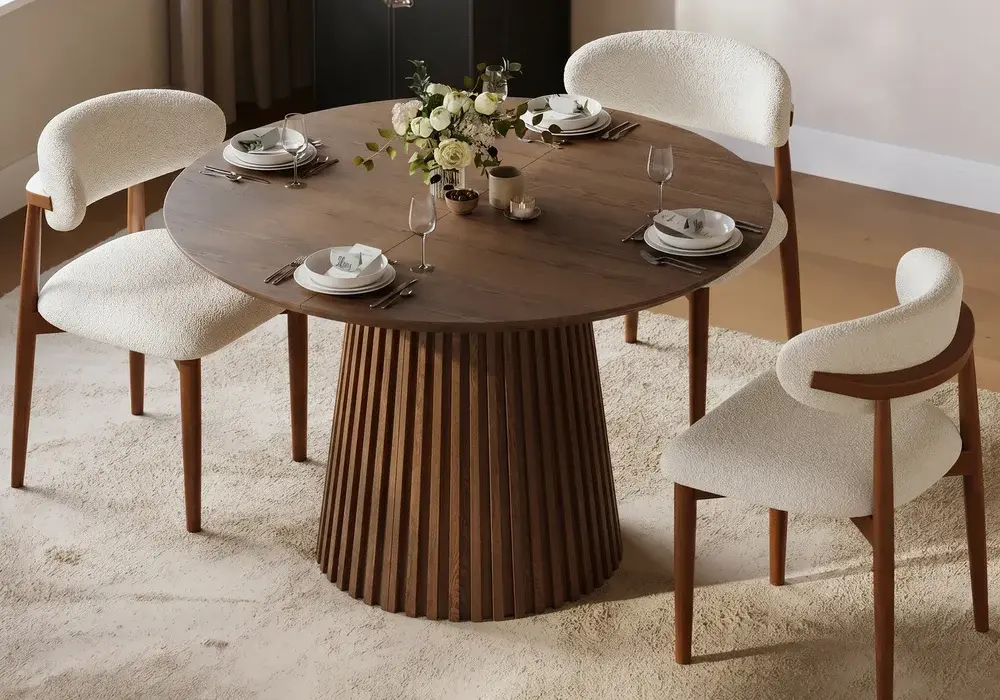
A warm wood top with a sculptural base already carries visual weight. Keep the styling soft and low: a linen runner, a wide ceramic bowl or a short arrangement in neutral tones. In its round configuration, a single centered piece looks best. When the table stretches into an oval, add a second small element so the extended length does not feel bare.
The 53" round sintered stone dining table is a different story. Its listing describes a durable sintered stone top with a sturdy pedestal base and positions it as a four-seater for family meals and small dining areas.
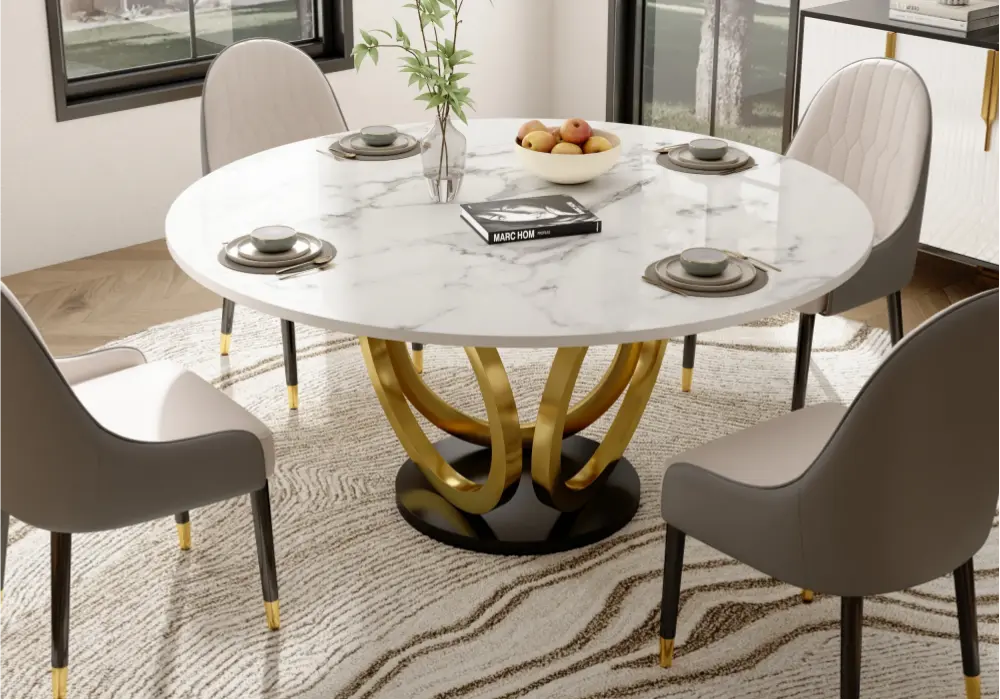
A smooth stone surface is a canvas, so you can introduce texture with woven placemats, a wooden tray or linen napkins. A pedestal base also helps with seating, because there are no legs at the corners to get in the way, so chairs can sit wherever you like around the edge.
Choose a Centerpiece That Suits the Circle
A good centerpiece for a round table is compact, centered and no wider than about a third of the tabletop. That leaves a ring of open space for plates and serving dishes. Strong options include:
- A low bowl or footed dish. Fill it with fruit, pinecones, ornaments or a short floral arrangement.
- A tray with a grouped set. A round or oval tray holding a candle, a small vase and a stack of two books gives you three heights in one lift-off piece.
- A lazy Susan. A rotating plate in the center holds condiments or small serving bowls and makes sharing easy, especially for larger families.
- A tall, slender vase. One branch or a handful of stems in a narrow vase adds height without blocking the view, since guests can look around it.
Whatever you choose, keep an eye on height. A common guideline is to stay under about 12 inches, or to go tall and slim, so conversation across the table is never blocked.
Set the Table in a Circle
Place settings on a round table fan out from the center. Follow a few simple steps:
- Space the settings evenly. Designers suggest leaving about 24 inches of table edge per person. On a smaller round table, that sets a natural limit on how many people sit comfortably.
- Point forks and knives toward the center. Each setting should look like a spoke on a wheel.
- Keep plates a hand's width from the edge. It looks tidy, and it keeps plates from tipping.
- Use round or organic shapes. Round chargers, curved glasses and softly folded napkins echo the table, whereas sharp, geometric pieces can look at odds with it.
If you are short on space, skip the charger and stack plates directly on the table. A smaller footprint per guest leaves more room in the middle.
Choose Chairs That Suit a Round Table
Chairs frame the table, so they belong in the styling plan. Armless or low-arm chairs tuck in fully and keep the circle looking clean, while chairs with wide arms take up more of each 24-inch seat space and can bump into each other. If you mix chair styles, keep the seat height and color family consistent. A round table is forgiving of variety, so a pair of upholstered chairs mixed with wood ones can look collected rather than mismatched. Seat cushions add comfort and color, and wipe-clean fabrics are a practical choice if children use the table.
Layer With a Rug and Lighting
Two elements outside the tabletop make a round table feel anchored.
The rug. A round rug under a round table repeats the shape, while a square rug can work too, especially in a rectangular room. Rugs are commonly recommended to extend at least 24 inches beyond the table edge on every side, so the chair legs stay on the rug even when guests pull back. If you plan to use the table in its extended, oval form, size the rug for the longest length.
The light. A pendant or chandelier centered above the table creates a natural focal point and ties the whole setting together. Many designers hang a pendant so its bottom sits about 30 to 36 inches above the tabletop. A round or globe shape matches the table, and a dimmer lets you move from bright weeknight dinners to candlelit evenings.
Three Looks for a Round Table
Occasion | Base | Centerpiece | Extras |
Everyday | Bare top or two woven placemats | A tray with a small vase and candle | Pendant on a dimmer |
Dinner party | Linen cloth or runner, cloth napkins | Low arrangement under 12 inches or a ring of bud vases | Taper candles, place cards |
Holiday or buffet | Layered cloth, charger plates | Seasonal grouping with varied heights | Candle holders around the edge, lazy Susan for sides |
Seasonal Ideas That Fit the Shape
- Spring: a round wreath laid flat in the center with a candle in the middle, fresh tulips in a low vase and pale linen napkins.
- Summer: a shallow bowl of lemons or peaches, woven mats and glass hurricanes.
- Autumn: a ring of mini pumpkins and dried grasses around a wooden bowl, with rust or olive napkins.
- Winter: an evergreen garland arranged in a circle around a single pillar candle, with brass or mercury-glass votives.
Circular arrangements feel natural on a round table. A wreath, a ring of candles or a circular garland repeats the shape of the table and looks intentional with very little effort.
Handling an Extendable Round Table
An extendable round table gives you flexibility, but the styling has to flex too:
- Round mode: one centerpiece, evenly spaced settings, no runner.
- Oval mode: switch to a long, low arrangement or two matching small ones set at equal distances from the center. A runner now works because the table has a long axis.
- In between: if you leave the table partly extended, treat it as an oval and center the decor on the shape's midpoint rather than the base.
Keep the extra pieces simple. A small set of matching votives or bud vases can be moved between modes, so you do not need a separate setup for each.
Common Mistakes
- A centerpiece that is too wide. It crowds the place settings and leaves no room for dishes.
- A runner on a round table. A straight line cuts the circle. Use a round cloth, placemats or a circular topper instead.
- A rug that is too small. Chairs catch on the edge, and the table looks like it is floating.
- Too many small objects. Round tables look best when a few items are grouped, not scattered.
Frequently Asked Questions
What should I put in the center of a round dining table?
A low bowl, a tray with a small grouped set or a slim vase works well. Keep it compact, no wider than about a third of the tabletop.
Should I use a runner on a round table?
Usually not. A straight runner cuts across the circle. Round tablecloths, placemats or a small round topper under the centerpiece suit the shape better. A runner makes sense only when the table is extended into an oval.
What size rug goes under a round dining table?
Choose a rug that extends at least 24 inches past the table edge on every side, so chairs stay on the rug when pulled out. A round rug repeats the table shape, though a square rug can also work.
How many people can sit at a round dining table?
It depends on the diameter, and the listing for the table you choose is the best guide. As a rule of thumb, plan on about 24 inches of edge per person, and remember that a pedestal base gives more freedom to place chairs.
How tall should a centerpiece be on a round table?
Stay under about 12 inches, or choose a tall, slender piece people can see around. The goal is to keep conversation open across the circle.
How do I decorate a round table for a holiday?
Layer a cloth, charger plates and a seasonal centerpiece with varied heights, then add candles at the edge. Circular arrangements such as wreaths and garlands suit the shape.