

How to Decorate the Wall Behind a TV Stand: Stylish Ideas for a Balanced TV Wall
The wall behind a TV stand is more than a blank backdrop. It can determine how large the television feels, how substantial the media console looks, and whether the entire living room feels intentional or cluttered. The best TV wall designs balance screen size, console proportions, viewing height, storage, lighting, and decoration rather than treating the wall as a separate styling project.
For most living rooms, start by planning the television and TV stand as one visual unit. Then choose a wall treatment, artwork, shelving, or lighting that supports that center rather than competing with it. In a small room, a darker matte wall can visually anchor the screen; in an open-plan room, symmetrical shelves or cabinetry can help define the entertainment zone.
Whether you prefer modern farmhouse, mid-century, coastal, or contemporary interiors, the following ideas can help turn an ordinary TV wall into a functional focal point.
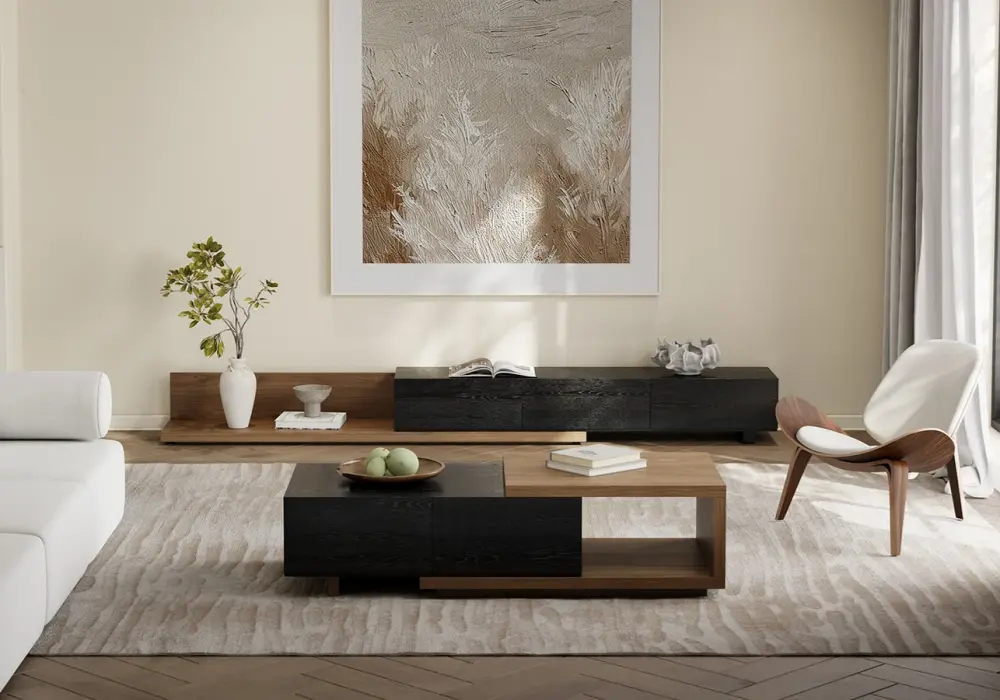
Source Homary
Plan the Wall Layout Behind Your TV Stand
Before choosing artwork or paint, establish the proportions of the TV, media console, wall, and seating area. A beautiful decoration can still look wrong if the television is too high, the console is too narrow, or the artwork is undersized.
Start by measuring the TV stand and the available wall width. As a general styling guideline, the console should usually be at least as wide as the television, with a slightly wider console often creating a more grounded appearance. If the TV is 65 inches wide, for example, a console that is noticeably narrower can make the screen appear oversized.
Next, consider viewing height. The center of the television should generally sit around eye level when seated rather than being positioned as high as possible on the wall. If the TV is mounted above a console, leave enough visual breathing room between the screen and furniture without creating an unusually large gap.
For artwork or decorative elements above the console, a useful starting point is about two-thirds to three-quarters of the console's width. Keep the lower edge of artwork approximately 6–12 inches above the console, adjusting slightly according to the artwork's height and the overall composition.
TV Wall Element | Practical Starting Point |
Artwork width | About ⅔–¾ of console width |
Artwork-to-console gap | 6–12 inches |
Console width | At least as wide as TV is a useful starting point |
Main walkway | About 36 inches where possible |
TV viewing height | Center near seated eye level |
Gallery-wall spacing | Usually 2–4 inches between frames |
Before drilling, use painter's tape to mark the outside dimensions of your artwork, shelves, or wall panels. Step back from the sofa and view the arrangement from the primary seating position. This simple test can reveal whether a composition is too high, too small, or too crowded.
Should the arrangement be symmetrical?
Symmetry works especially well when you want a polished, architectural appearance. For example, matching shelves or cabinets on both sides of a TV console can make an entertainment wall feel built-in.
Asymmetry can feel more relaxed. A large artwork on one side combined with a floor lamp, plant, or smaller shelf on the other creates visual balance without requiring identical objects.
The key is visual weight rather than identical objects. A tall bookcase can balance a wide artwork just as effectively as a matching pair of cabinets.
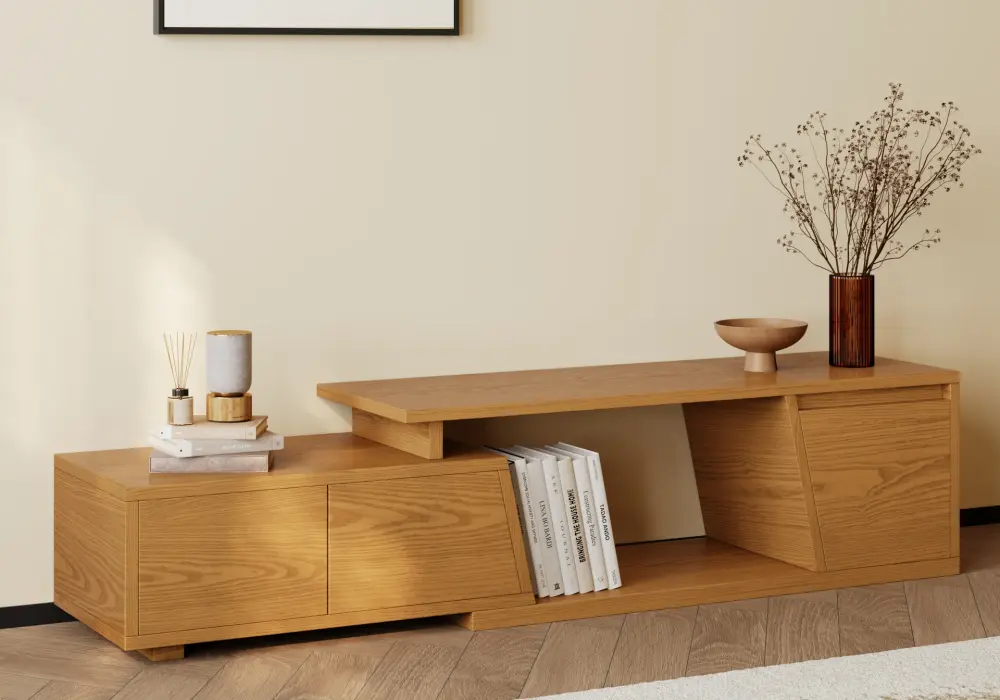
Source Homary
Choose Paint Colors, Finishes, and Wall Treatments That Work Behind a TV
Once the proportions are established, choose a backdrop that supports the screen rather than fighting it.
For many homes, matte or flat paint is preferable to highly reflective finishes behind a television. A glossy wall can reflect windows, lamps, and other light sources toward the viewer or screen. Matte surfaces generally create a quieter background and allow the television to remain the visual focus.
Popular TV wall color directions
Style | Wall Color Direction | Why It Works |
Modern farmhouse | Warm white, greige, muted sage | Softens black electronics |
Mid-century modern | Warm beige, olive, muted brown | Complements walnut and wood |
Contemporary | Charcoal, deep blue-green, warm gray | Creates a strong visual anchor |
Coastal | Soft white, pale blue, sandy beige | Keeps the room light and relaxed |
Minimalist | Warm white or light gray | Reduces visual distraction |
A medium gray or deep blue-green can make a black television visually recede into the wall, particularly when the room receives plenty of natural light. This approach works well when you want the entertainment system to feel integrated rather than like a black rectangle placed on a bright wall.
For a smaller living room, however, an extremely dark wall is not automatically the best solution. Consider the room's natural light, ceiling height, and surrounding furniture before choosing a dramatic color.
Consider architectural wall treatments
If paint feels too simple, vertical or horizontal wall paneling can add architectural character. Vertical slats can emphasize ceiling height, while horizontal paneling can make a wall feel wider.
For a modern farmhouse interior, painted board-and-batten or simple panel molding can frame the TV wall without overwhelming it. Mid-century interiors often work better with natural wood tones, while contemporary rooms can use restrained textured panels or stone-inspired surfaces.
Removable wallpaper can be useful for renters, particularly when you want pattern without committing to permanent construction. Choose a subtle geometric, botanical, or textured design rather than a high-contrast pattern directly behind a large screen.
The goal is not to make every inch of the wall decorative. The television itself already provides a strong visual element, so the background should support the composition.
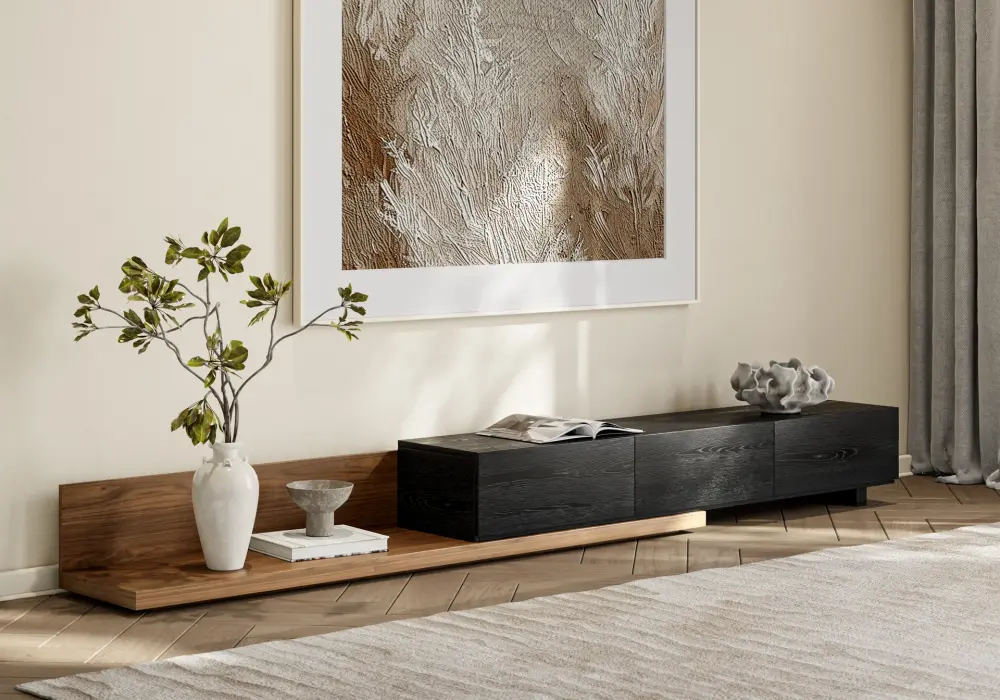
Source Homary
Style Art, Mirrors, and Gallery Walls Above the Console
Artwork is one of the easiest ways to make a TV stand feel like part of the living room rather than a purely functional media station.
The first decision is whether to use one large piece, a pair of pieces, or a gallery wall.
Use one oversized artwork
A single horizontal artwork can create a clean, upscale appearance. As a starting point, choose a piece roughly two-thirds to three-quarters the width of the console.
This works particularly well above a low media console when the TV is wall-mounted or positioned elsewhere in the room. If the television occupies the center of the wall, avoid placing artwork directly behind or immediately beside it unless the composition has been deliberately designed around the screen.
Try a pair of balanced artworks
Two complementary pieces can introduce symmetry without looking overly formal. Keep the gap between frames relatively small—often around 2–4 inches—so they read as one composition.
This approach works well above a long console in a medium or large living room.
Create a gallery wall
A gallery wall can add personality to a neutral TV wall, but it requires more planning. Keep the spacing consistent and establish an imaginary outer boundary before hanging anything.
For example, a gallery arrangement might occupy a roughly 36–48-inch-wide area above a console, with 2–4 inches between individual frames. The exact size should scale with the console and surrounding wall.
A useful rule is to keep the collection visually connected through one common element, such as:
- Similar frame finishes
- A consistent color palette
- Repeated subject matter
- Similar matting
- A shared art style
Use a mirror carefully
A mirror can make a small living room feel more open, but placement matters. Instead of simply hanging a mirror because the wall looks empty, consider what it reflects.
A mirror facing a window can bounce natural light deeper into the room. A mirror reflecting a cluttered shelf or television cables, however, can make the wall feel busier.
For a compact room, a large rounded or organically shaped mirror can soften the hard rectangular forms of a television and console.
Choose decoration according to room scale
Room Situation | Recommended Approach |
Small living room | One large artwork or mirror |
Narrow wall | Vertical artwork or narrow shelf |
Wide console | Oversized horizontal artwork |
Large open-plan room | Gallery wall or layered shelving |
Minimalist room | One statement piece |
Eclectic room | Curated gallery arrangement |
Remember that more decoration does not automatically create a more expensive-looking TV wall. Scale and restraint usually matter more than quantity.
Layer Floating Shelves and DIY Decor for a Balanced Look
Floating shelves can turn a basic TV console into a more complete entertainment wall, especially when the console itself does not provide enough vertical storage.
One effective approach is to place shelves on either side of the television rather than directly above it. This creates vertical framing and allows the screen to remain the central focal point.
For a symmetrical arrangement, matching shelves on both sides can make the wall resemble a custom built-in. For a more relaxed look, vary the shelf lengths or use different decorative objects while maintaining similar visual weight.
How high should floating shelves be?
There is no universal height because the television, ceiling, console, and room proportions all vary. However, the first shelf should not crowd the TV or sit so low that everyday objects interfere with viewing.
Before installation, mark the shelf position with painter's tape. Sit on the main sofa and check the relationship between the screen, shelf, and console from eye level.
Keep shelves visually light
A useful styling formula is to combine different object heights:
Tall object + medium object + small object + open space
For example:
- A small plant
- A stack of books
- A ceramic object
- One framed photograph
Avoid filling every inch of the shelf. Negative space is especially important around a television because the screen already creates visual density.
Budget-friendly DIY alternatives
You do not necessarily need expensive built-ins to create a finished TV wall. A stained wood shelf with simple brackets can provide warmth above a basic console. Thrifted frames, secondhand ceramics, books, baskets, and plants can create a layered look without requiring a complete room makeover.
For seasonal styling, change only a few accessories instead of redesigning the entire wall. Small pumpkins in fall, greenery during the holidays, or lighter ceramics in summer can refresh the space while keeping the primary furniture unchanged.
The same principle applies to the TV stand itself: choose storage based on what your household actually uses, then style the visible areas around it.
Add Lighting and Hide Cords for a Finished TV Wall
Lighting is often the final element that separates a functional TV wall from a thoughtfully designed one.
The best lighting around a television is generally indirect rather than directly aimed at the screen. Wall sconces, concealed LED lighting, or a lamp positioned to the side can create ambient illumination without producing distracting reflections.
Wall sconces
If using sconces beside a television, keep them far enough from the screen's edges that their light does not wash directly across the display. Their height should also relate to the seated viewer and surrounding furniture rather than simply being centered on the wall.
A pair of sconces can reinforce a symmetrical media wall. A single sconce or floor lamp can work better for an asymmetrical arrangement.
LED backlighting
Soft LED lighting behind a wall-mounted television or inside shelving can create depth without adding another large decorative object. Warm white light is generally easier to integrate into a living room than overly cool or colorful lighting.
Avoid placing a bright light source directly in the viewer's line of sight.
Hide the cables before styling the wall
Cable management should be considered during the purchasing and layout stage, not after everything has been installed.
A TV wall may need to accommodate:
- Power cable
- HDMI cables
- Soundbar connection
- Streaming device
- Game console
- Ethernet cable
- Speaker wiring
A media console with rear cable cutouts can make a major difference. If the television is wall-mounted, a surface-mounted cable raceway can conceal wires without opening the drywall and may be suitable for some rental situations.
For permanent in-wall wiring, follow local electrical requirements and consult a qualified electrician when necessary. Do not assume that hiding a power cable inside the wall is equivalent to routing a low-voltage HDMI cable.
Think of the TV wall as an entertainment center
The best TV wall design combines aesthetics with everyday usability.
A console should provide enough space for the equipment you actually use, while drawers and cabinets can hide remotes, controllers, DVDs, game accessories, and other visual clutter. If you use a soundbar, check that the console's layout does not block its audio output.
This is where choosing the right TV stand becomes part of the decorating decision. A wide media console with closed storage can create a cleaner appearance than multiple small furniture pieces scattered around the television.
Likewise, a floating media console can make a compact room feel more open by exposing more floor area underneath.
Make the TV Wall the Living Room's Visual Anchor
A successful TV wall does not require an expensive built-in or a wall covered with decoration. It requires a clear hierarchy.
Start with the television and console, because they are the functional center. Confirm that the console is appropriately sized, the viewing height is comfortable, and storage meets your equipment needs.
Then select one major visual treatment:
- Paint
- Paneling
- Large artwork
- Mirror
- Gallery wall
- Shelving
- Architectural treatment
Finally, add lighting and accessories only where they improve the composition.
For a modern living room, this might mean a walnut media console, a deep neutral matte wall, minimal artwork, and warm indirect lighting. A modern farmhouse room could combine a light-colored console with simple panel molding, neutral artwork, and woven accessories. A coastal room may benefit from pale walls, natural wood, soft blue accents, and a large organic mirror.
The objective is not to make the TV disappear completely. Instead, integrate the television into a larger living-room composition so the entertainment area feels intentional, balanced, and comfortable.
Quick TV Wall Planning Checklist
Before you drill, paint, or purchase new furniture, check:
- Is the TV appropriately sized for the viewing distance?
- Is the console at least as wide as the TV?
- Does the console provide enough storage for your equipment?
- Is the TV positioned at a comfortable viewing height?
- Is artwork approximately ⅔–¾ the console width?
- Is there roughly 6–12 inches between the console and artwork?
- Will shelves interfere with the screen or soundbar?
- Are cables routed before final styling?
- Will lighting create screen glare?
- Does the wall treatment complement the rest of the room?
A few minutes with painter's tape and a measuring tape can prevent an expensive decorating mistake.
FAQ
What is the best wall color behind a TV stand in a small living room?
A medium neutral such as warm gray, greige, muted blue-green, or another low-reflective color can work well. Matte finishes are generally preferable because they reduce reflections from windows and lamps. The best choice ultimately depends on the room's natural light and surrounding furniture.
How far above a TV stand should I hang art or floating shelves?
A practical starting point is 6–12 inches above the console for artwork, although the exact distance depends on the artwork's height and the overall composition. For shelves, first check the relationship to the television and sit on the main sofa to make sure the arrangement does not feel crowded.
Should the decor behind a TV be symmetrical or asymmetrical?
Symmetrical arrangements tend to look more formal and architectural, while asymmetrical layouts feel more relaxed and collected. Use symmetry when you want a balanced built-in appearance; choose asymmetry when the room already has varied furniture or you prefer a less rigid aesthetic.
What are renter-friendly ways to decorate the wall behind a TV without damaging it?
Removable wallpaper, lightweight framed artwork, adhesive-compatible accessories, and surface-mounted cable covers can provide visual impact without major construction. Always check the manufacturer's weight and wall-surface requirements before using adhesive mounting products.
How do I hide TV, soundbar, and console cords on a plain drywall wall?
Start by choosing a media console with rear cable openings and position your equipment close to those openings. Surface-mounted cable raceways can conceal wires without cutting into drywall. For permanent in-wall wiring, use an appropriate professional installation method and follow local electrical requirements.
What type of lighting works best behind or beside a TV without causing glare?
Indirect, warm lighting generally works better than a bright fixture aimed toward the screen. Wall sconces positioned beside the television, concealed LED lighting, and lamps placed away from the screen's direct reflection path can provide ambient illumination while minimizing glare.
How can I create a modern farmhouse TV wall on a budget?
Start with a simple neutral matte wall and a functional wood-tone media console. Add inexpensive board-and-batten-style trim, one large neutral artwork, woven accessories, and warm lighting. Keep the number of decorative objects limited so the television and console remain the visual center of the room.