

Decorate a round dining room table with a compact centerpiece, a clear perimeter for place settings, and a small palette that relates to the room. When styling dining tables, begin with the way the table is used: daily meals need an arrangement that stays useful, while occasional entertaining can accommodate a fuller setting. Keep the center low enough for conversation and make sure the display looks good from every seat.
A circular top naturally draws attention toward its center. That makes one well-chosen grouping more effective than several unrelated objects spread across the surface. The aim is to give the table a focus without using the space diners need.
Start with the plates, glasses, and serving pieces you normally use. Once those have a comfortable place, add decoration to the area that remains. This order produces a table that works for dinner instead of one that must be completely dismantled before every meal.
Table of Contents
How to Decorate a Round Dining Room Table: Start With the Basics
Measure the open center
Set out the normal number of places and pull the chairs into their occupied positions. Include glasses, utensils, and any dishes that stay on the table. Then look at the open area in the middle.
As a starting point, keep the centerpiece's footprint to roughly one-quarter to one-third of the table's diameter: about 305 mm on a 1194 mm table, and about 203 mm on a 991 mm table. Cut a paper circle to that size and lay it in the center. If it pushes glasses outward or leaves no room for a shared bowl, trim it down.
Check sightlines from every seat
Sit at each regular place and look toward the opposite seat. You should be able to see the person across from you without leaning. If you have to look around the arrangement, lower it or cut back the stems and foliage. Keep the total height under 305 mm.
If an arrangement is taller than that, designate a sideboard or shelf where it moves during meals. For evening atmosphere, a flameless candle is a safe accent among flowers and linens. One or two small lights are enough.
Round Dining Table Centerpiece Ideas
A low vase, shallow bowl, compact plant, or small group on a tray can provide the main focus. Choose one, not all of them.
Flowers
Use a broad, low arrangement with five to seven stems. Rotate it as you work so that no seat faces an unfinished side. Remove stems that spread into the place-setting area.
Bowls
Let the vessel do the decorating. A textured ceramic bowl needs only a few pieces of fruit or a loose handful of branches. An empty sculptural bowl also works if its form is interesting enough.
Trays
A tray groups several small objects into one centerpiece. Try a short bud vase, a small candleholder, and one stack of two books, and stop there. Keep the tray around 254 mm to 356 mm across on a 1194 mm table.
Pick a mood
Desired mood | Centerpiece idea | Supporting details |
Quiet and natural | Low ceramic bowl or a few short branches | Simple mats, neutral napkins, visible tabletop |
Light and contemporary | Clear or pale vessel with a few stems | Unpatterned tableware and one accent color |
Warm evening setting | Compact centerpiece with a small flameless light | Soft textile texture and plain glasses |
Colorful family meals | One bright bowl or vase | Repeat the color in napkins rather than adding ornaments |
Occasional hosting | Low arrangement sized to the place settings | Serving space planned before decorative extras |
Tie the table to the room
Repeat a tone from the room, such as a picture frame, cabinet, or pendant light. It doesn't need to match exactly. One shared color is enough to make the table feel part of the space. If an object doesn't support the mood or serve a practical purpose, remove it.
Round Table Decor Ideas by Table Size
1194 mm round table (seats 4)
The Aura 1194 mm round sintered-stone dining table has a matte-travertine-look top and a fluted pedestal base. The surface pattern and base already bring visual detail, so the styling should stay quiet.
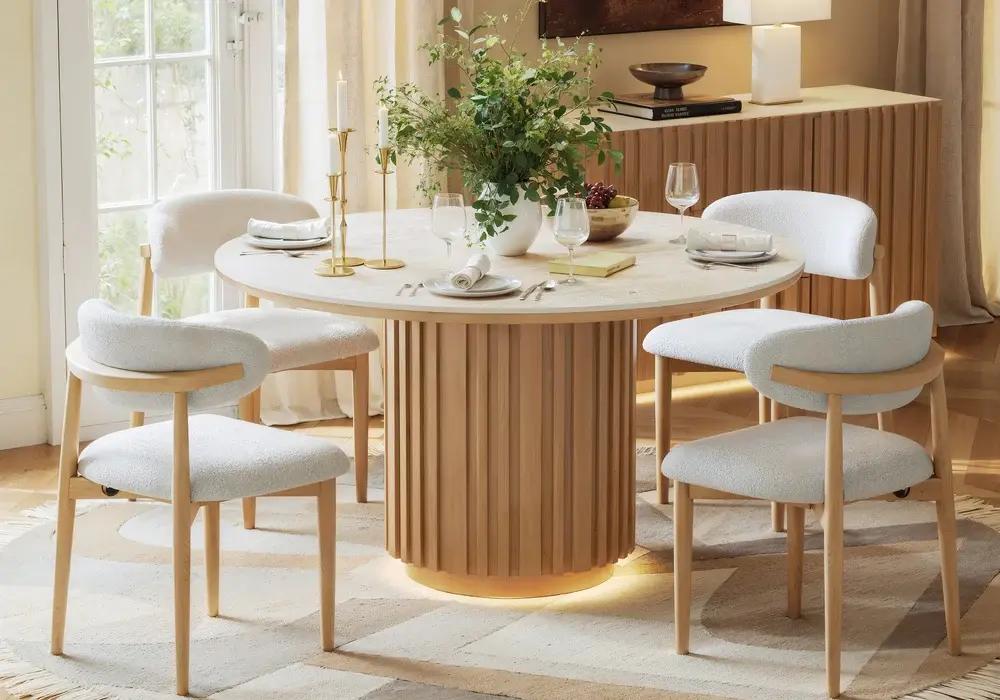
- Centerpiece: a cream ceramic bowl, about 305 mm wide and 102 mm tall, filled with three or four pears or a handful of dried seed pods.
- Placemats: 356 mm round woven jute mats, one per seat, with the edge about 25 mm from the table rim.
- Glassware: clear, straight-sided tumblers and stemless wine glasses so nothing competes with the stone.
- Napkins: oatmeal linen, folded in thirds and laid under the fork.
- Evening accent: one small flameless candle set beside the bowl.
The repeated pale and natural tones connect with the travertine look, while the woven texture adds warmth against the smooth top.
991 mm round table (seats 2)
On a compact table, one low vessel is enough. The 991 mm round sintered-stone dining table in a matte-travertine finish seats two comfortably and leaves a small but workable center.
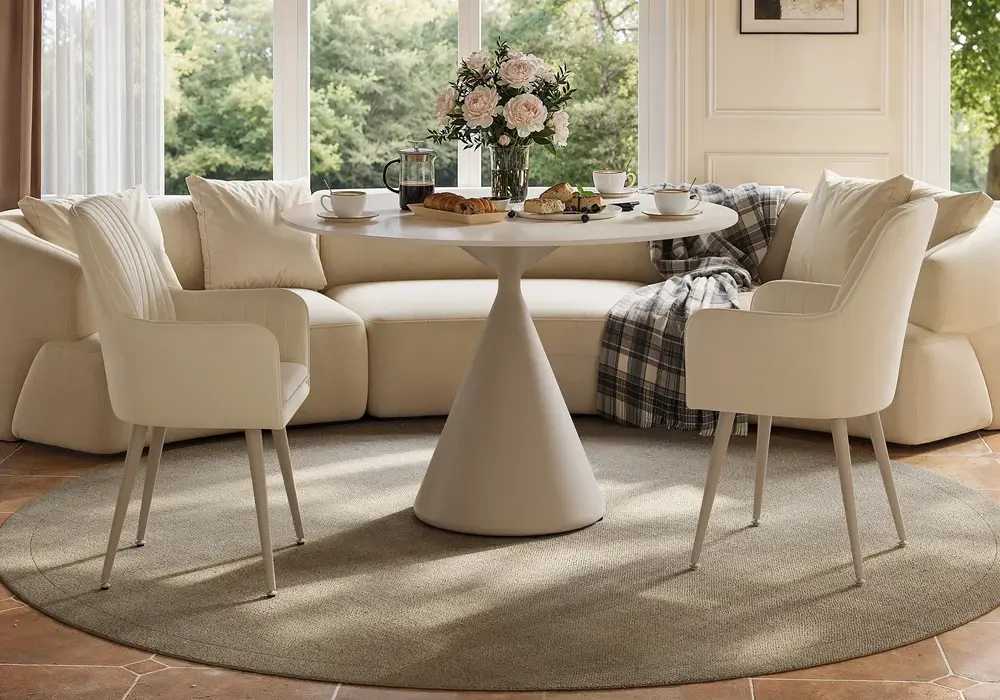
- Centerpiece: a matte black or charcoal ceramic vase about 152 mm tall, holding three to five short stems such as eucalyptus, ranunculus, or dried grasses, with the whole arrangement staying under 254 mm.
- Placemats: two 279 mm round rattan mats, set opposite each other.
- Napkins: terracotta or rust, one color only, for a single warm accent against the pale top.
- Glassware: two clear stemless glasses.
The dark vase defines the center against the light surface, and the single napkin color keeps the table looking tidy. Avoid shrinking every object until the center becomes a cluster of tiny ornaments: one modest vase with a clear shape looks better than several miniatures. Keep salt, pepper, and condiments in a kitchen drawer or on a nearby sideboard, and bring them out only for the meal.
Extendable round table (seats 4 to 6)
The gray extendable dining table changes shape when it opens, so it needs a decor plan for each configuration.
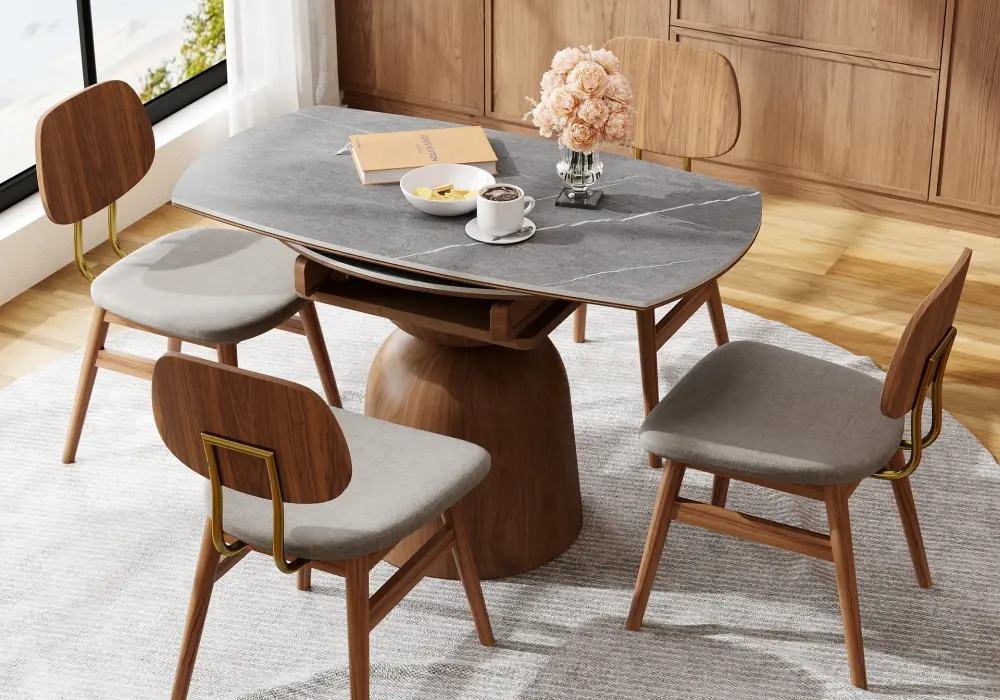
Everyday round configuration (seats 4)
- Centerpiece: a white or sage-green ceramic bowl, about 254 mm wide, with a few stems of olive branch or eucalyptus.
- Palette: gray table, white tableware, and sage-green napkins.
- Placemats: four 330 mm round linen mats in light gray or white.
Extended configuration (seats 6)
- Centerpiece: move to a longer low grouping on an oval tray about 508 mm long, with the bowl in the middle flanked by two small brass or glass candleholders.
- Palette: keep the sage-green napkins and add brass accents to warm the gray top.
- Serving space: put one shared dish on each side of the tray so people can reach it without stretching across.
Switching between the two: lift the centerpiece off before you open the table, and rest it on the sideboard until the new top is in place. Don't leave objects on the seam while the sections move. Keep the extra napkins, mats, and candleholders in one box so the guest setup takes a couple of minutes.
Place Settings, Runners, and Tablecloths for a Round Table
Choose a limited set of materials, such as woven texture, simple ceramics, and clear glass, and repeat them around the table so the circle feels coherent.
Placemats and napkins
Round or softly shaped mats suit a round table. On a 991 mm top, choose mats 279 mm to 305 mm across; on a 1194 mm top, 330 mm to 381 mm works well. Individual mats are simpler than a runner on a small table. A bare surface also works if the table's care instructions say it is safe for everyday use.
Napkins are the easiest way to add color without adding objects. Fold them simply or use one style of ring. If the top has strong veining or pattern, leave at least half of it visible and let the rest stay calm.
Runners
A runner adds a straight line across a round table, which breaks the circular composition. If you like the look, choose one about 305 mm wide and let the ends hang 152 mm to 203 mm past the edge. A short central square of fabric gives similar texture with less visual weight.
Tablecloths
A tablecloth turns the surface into a single block of color. Choose a drop of 254 mm to 305 mm for everyday use so it clears chair arms and doesn't bunch at the seat. Use a heat-resistant trivet under hot dishes and a coaster under glasses, since a decorative cloth won't protect the table beneath. Pick a textile you will actually launder: save delicate fabrics for special dinners and use cotton or linen blends for daily meals.
Keep Your Round Dining Table Easy to Reset
Give the centerpiece a home
Choose one stable spot, such as a sideboard or console, for the centerpiece when you need the full table for homework, work, or a big meal.
Return only what belongs
After meals, put back only the items in the daily arrangement. Clear away mail and unrelated items so the center doesn't become a drop zone.
Refresh in small steps
Change the stems, swap the napkin color, or borrow a bowl from another room. Keep the same structure and avoid buying a whole new set for every season.
Frequently Asked Questions
What is the easiest centerpiece for a round dining table?
One low vase or shallow bowl, about one-quarter to one-third the table's diameter and under 305 mm tall. Lay out the place settings first, then check it from every seat.
Does the centerpiece have to be round?
No. A round form echoes the table, while a softly elongated object adds contrast. What matters is the usable space, sightlines, and how it looks from all sides.
Can I use a runner on a round dining table?
Yes. Choose one about 305 mm wide and test where the ends fall relative to the chairs and base. Placemats, a central square of fabric, or a bare tabletop work just as well.
How do I decorate a small round table without crowding it?
Use one compact object, about 152 mm to 203 mm wide, and a single accent color. Keep condiments elsewhere and set the table first so the decor fills only the space that's left.
Should I change the centerpiece when the table extends?
Yes. Move the original piece to a tray and extend the grouping with one or two small accents, such as candleholders. Clear the table before you open it.