

A kitchen island has to work hard. It may be a food-prep station in the morning, a homework desk in the afternoon, and a gathering spot when friends come over. That makes decorating it different from styling a console table or coffee table. The goal is not to fill every inch, but to create a focal point while keeping the island comfortable and practical to use.
The best kitchen island decor starts with function. Once you establish clear work and walking zones, you can add a layered centerpiece, coordinate colors and textures, and use pendant lighting and bar stools to complete the look. Whether you have a large open-plan island or a compact kitchen peninsula, a few well-chosen pieces can make the whole kitchen feel more finished.
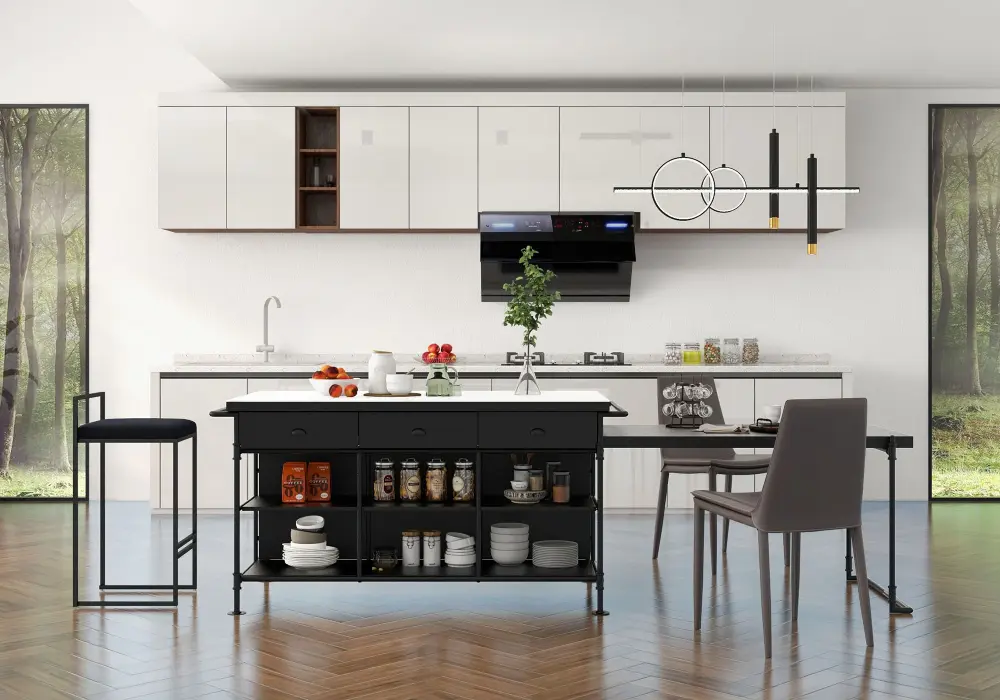
Extendable Faux Marble Kitchen Islands from Homary
Table of Contents
Start by Planning Kitchen Island Clearance and Decor Zones
Before choosing a vase or decorative tray, consider what happens around your island every day. In an open kitchen, several activities often overlap: cooking, serving, eating, entertaining, and moving between the kitchen and adjacent rooms.
A beautifully styled island is not successful if someone has to move a vase every time they prepare dinner.
As a general planning guideline, allow around 914–1067 mm of clearance around areas used for walking and working. The exact amount depends on the layout, appliances, cabinetry, and number of people using the kitchen, so manufacturer and building requirements should always take priority.
Keep appliance zones clear
If your island contains a sink, cooktop, microwave, dishwasher, or other built-in appliance, treat the surrounding area as a functional zone first and a decorating zone second.
Near a sink, choose materials that can handle occasional splashes, such as glazed ceramic, stone, glass, or washable containers. Avoid placing paper goods, delicate textiles, or untreated wood directly beside the faucet.
Around a cooktop, leave the immediate cooking area clear. Decorative candles, dried foliage, and other flammable or heat-sensitive items should not be positioned where they can be exposed to heat or grease.
A microwave also needs unobstructed access to its door and ventilation. Instead of decorating directly around it, create a visual arrangement farther along the island where there is enough countertop space.
Use the lower shelf as a second decorating zone
If your island has an open shelf underneath, you do not have to put everything on the countertop. The lower level is ideal for decorative storage.
Consider:
- Woven baskets for kitchen linens
- A stack of attractive cookbooks
- Wooden serving boards
- Ceramic serving bowls
- A small collection of pitchers
- Everyday items stored in matching containers
This is particularly useful for a small kitchen island. Moving storage and decorative pieces to the lower shelf leaves more countertop space available for cooking and eating.
Scale the decor to the island
A small island needs restraint. Rather than placing five or six tiny accessories on the countertop, choose one compact tray with two well-scaled objects.
For a long island, you have more flexibility, but that does not mean the entire surface needs decoration. Leaving some areas intentionally empty makes the island feel larger and keeps its primary purpose visible.
Build a Kitchen Island Centerpiece With Height and Negative Space
Once you have established the functional zones, create one main visual focal point. One of the easiest ways to do this is with a tray vignette.
A tray provides a visual boundary around several objects, making the arrangement feel intentional rather than randomly placed. It also allows you to move the entire display when the island is needed for food preparation.
Follow a simple low-to-high arrangement
Start with the tray as the lowest layer. Then add objects at different heights rather than placing everything at the same level.
A simple arrangement might include:
Low: tray or shallow board Medium: ceramic bowl, cookbook stack, or small container High: vase, branches, lamp, or tall vessel
This creates a gentle visual progression that is easier to look at than a collection of objects with identical heights.
For example, place a rectangular wooden tray slightly off-center. Add a low ceramic bowl filled with lemons on one side and a tall ceramic vase with branches on the other. The different heights create balance while leaving part of the tray visible.
Use odd numbers without forcing the rule
Three objects often create a natural-looking composition, but there is no need to follow the rule mechanically.
A small island might look best with only:
- A tray
- A bowl
- A small vase
A larger island could support a longer arrangement with a vase, bowl, and stack of cookbooks.
The important factor is visual balance, not the exact number of objects.
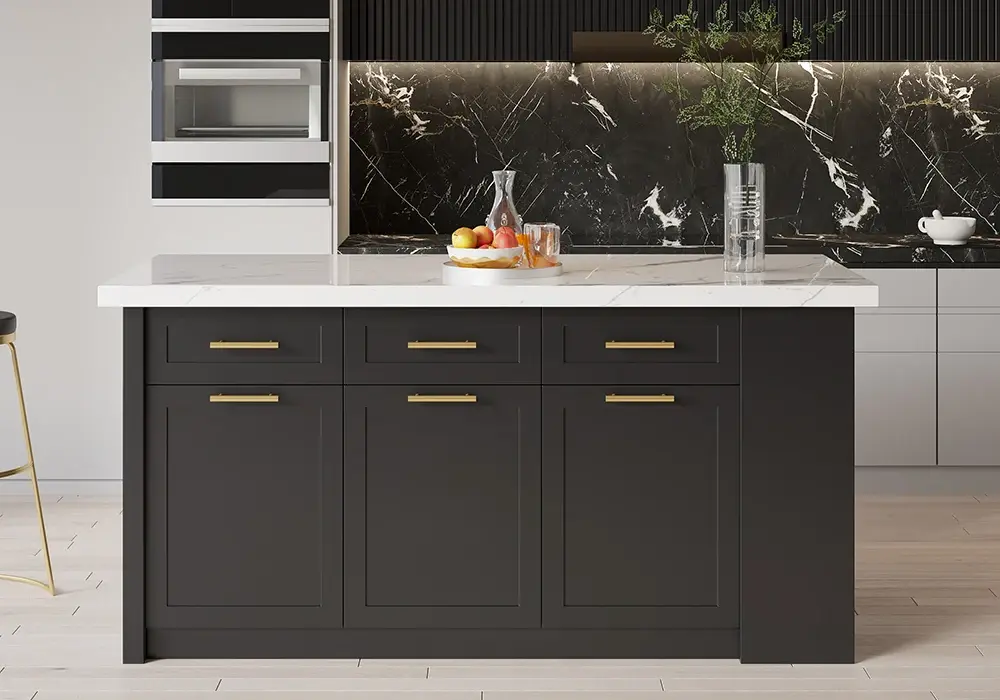
Wood Kitchen Island from Homary
Leave intentional empty space
Negative space is especially important on a kitchen island because it prevents the surface from becoming visually and physically crowded.
As a practical starting point, try to keep roughly one-third or more of the countertop visually open, particularly if the island is used for meal preparation.
If your centerpiece is spreading across the entire island, remove one or two pieces before adding anything else.
Mix useful items with decorative pieces
Some of the best kitchen island accessories are things you already use.
A bowl of lemons can add color while providing fruit for the kitchen. A wooden serving board can be displayed vertically and pulled down when needed. A stack of cookbooks can add height and personality. A small herb pot can bring greenery into the room while providing fresh ingredients.
This approach makes the island feel naturally styled rather than staged.
Match Kitchen Island Decor to Your Cabinets, Countertop, and Hardware
The easiest way to make kitchen island decor feel cohesive is to borrow colors and materials already present in the room.
Look at the island base, cabinet doors, countertop, backsplash, flooring, hardware, and nearby furniture. Choose two or three colors from this existing palette and repeat them in your accessories.
You are not trying to match everything exactly. Instead, you want the decorative pieces to look as though they belong in the same room.
Choose colors based on your kitchen style
Kitchen Style | Complementary Colors | Suitable Materials |
White Shaker | Warm white, beige, sage, natural wood | Ceramic, wood, linen |
Dark wood | Cream, brown, muted green, brass | Stone, wood, metal |
Gray-blue island | White, sand, muted blue | Ceramic, rattan, light wood |
Navy island | Cream, tan, soft gray | Brass, ceramic, wood |
Modern flat-panel | Black, white, gray, one accent color | Glass, metal, stone |
Farmhouse | Warm white, green, tan | Wood, ceramic, woven fibers |
Coastal | White, sand, pale blue | Rattan, linen, light wood |
Rustic | Brown, cream, earthy greens | Reclaimed wood, stone, iron |
For example, a white Shaker kitchen can feel warmer with natural wood and creamy ceramic pieces. A navy island can be softened with a cream stone bowl and woven basket. A modern black-and-white kitchen may benefit from a restrained combination of black metal, white ceramic, and natural wood.
Add contrast through texture
If your kitchen has a neutral color palette, texture becomes even more important.
Combine smooth and rough surfaces to create visual depth:
- Glossy ceramic + unfinished wood
- Woven rattan + smooth stone
- Matte pottery + brushed metal
- Linen + glass
- Marble or quartz + natural wood
You do not need all of these materials at once. Two or three contrasting textures are enough to prevent a simple arrangement from looking flat.
Repeat hardware finishes carefully
If your kitchen has brass cabinet pulls, for example, a small brass detail in the centerpiece can connect the island decor with the cabinetry.
The same principle works with black, chrome, bronze, or brushed nickel finishes. A small repeated detail is usually more sophisticated than adding multiple unrelated metals.
Use Pendant Lights and Bar Stools to Frame the Kitchen Island
The countertop is only one part of the island's visual composition. Look up and around the island, and you will see two major elements that influence its overall appearance: pendant lights and seating.
Treat these elements as part of the same design rather than choosing them independently.
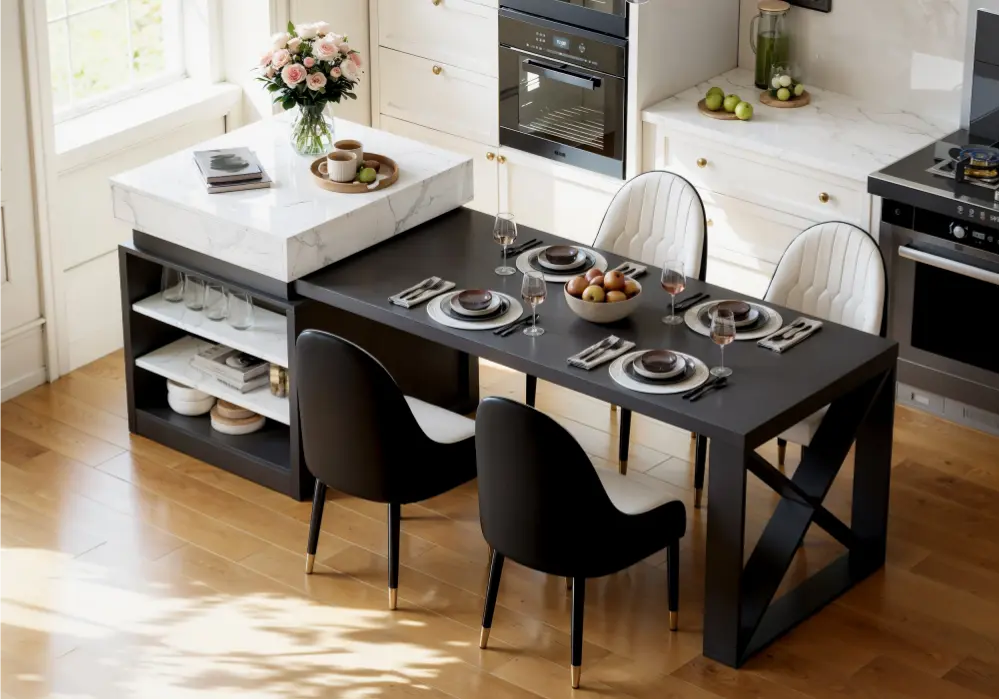
Extendable White & Black Kitchen Island from Homary
Choose pendant lights according to island size
The number and size of pendant lights should relate to the island's dimensions.
A compact island may need one well-proportioned pendant, while a longer island can often support two or three smaller fixtures. Oversized pendants can overwhelm a narrow island, while tiny fixtures can disappear above a large surface.
When arranging multiple pendants, keep the spacing consistent and center them over the island's working or seating area.
As a general starting point, the bottom of a pendant is often positioned around 762–914 mm above the countertop. Ceiling height, pendant size, sightlines, and personal preference can affect the final position.
Consider lighting temperature as part of the decor
Lighting color can change how your kitchen island decor looks at night.
A warm or soft-white light can make wood, cream ceramics, and natural textures feel inviting. Brighter neutral lighting can be useful when the island is primarily used as a preparation area.
Choose a lighting setup that works for both everyday tasks and entertaining rather than focusing only on the fixture's appearance.
Select bar stools by height, width, and style
Start by measuring the actual island height. Counter-height islands generally require counter-height stools, while taller bar-height surfaces need taller seating.
For comfortable spacing, allow approximately 610–762 mm of width per person, depending on the stool design. Stools with wide seats or arms require more room than slim backless models.
Also consider the space beneath the island. A generous countertop overhang creates better knee and legroom, while cabinetry or supports can limit where people can sit comfortably.
If you have wood, tile, or another easily scratched floor, choose stools with smooth feet or protective glides.
Make stools and pendants work together
If the stools have a strong visual presence, choose pendant lights that complement rather than compete with them.
For example, black metal stools can pair naturally with black-framed pendants. Natural wood stools can work with woven shades or warm metal fixtures. Upholstered stools introduce another texture, so the centerpiece can remain relatively simple.
The goal is to create a visual triangle between the countertop decor, pendant lights, and seating.
Refresh Kitchen Island Decor by Season Instead of Starting Over
Seasonal decorating does not have to mean buying a new set of accessories four times a year.
The easiest system is to create a neutral foundation that stays in place and change a few small elements as the seasons shift.
Spring: add flowers and lighter textures
In late spring, replace darker or heavier accents with fresh flowers, green foliage, pale ceramics, and light linen.
You can use inexpensive grocery-store flowers or cut branches from the garden rather than investing in elaborate arrangements.
Summer: use citrus and fresh herbs
Summer is an ideal time for edible decor. A bowl of lemons, oranges, or limes can provide a strong color accent without introducing another decorative object.
Small pots of basil, rosemary, mint, or thyme can also add greenery and practical value.
Fall: introduce pumpkins and warm wood
For autumn, bring in small pumpkins, warm-toned ceramics, wooden bowls, dried branches, and textured napkins.
Instead of covering the island with seasonal decorations, replace one or two items in your existing centerpiece.
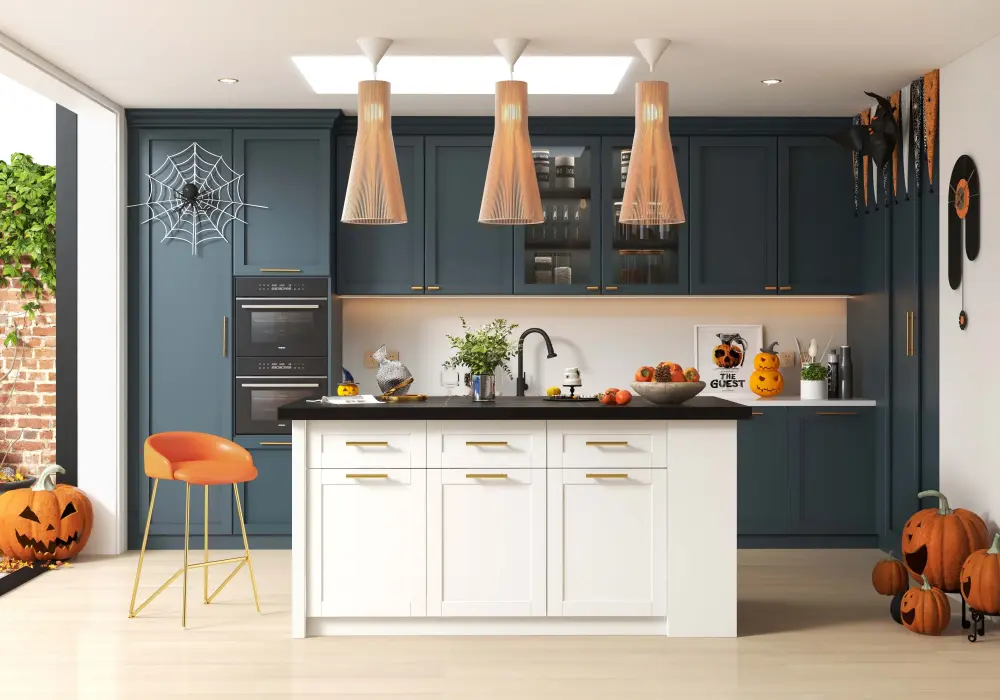
Modern Style Laminate Kitchen Islands from Homary
Winter: layer greenery, candles, and festive pieces
From Thanksgiving through Christmas and into winter, evergreen branches, candles, pinecones, and seasonal serving pieces can quickly change the mood of the kitchen.
A simple evergreen arrangement in your everyday vase may be all you need.
Seasonal Base | What to Change |
Wooden tray | Keep all year |
Ceramic bowl | Change fruit or seasonal contents |
Neutral vase | Change flowers or branches |
Woven basket | Keep all year |
Candlesticks | Change candles or greenery |
Store seasonal accessories in one place
Keep seasonal pieces together in labelled storage bins. Prioritize items that can work for more than one occasion.
For example, neutral ceramic pumpkins can work throughout autumn, while evergreen branches can be used for both Thanksgiving and Christmas arrangements.
A smaller collection of reusable accessories is easier to store and often looks more cohesive than buying new themed decorations every year.
FAQ About Decorating a Kitchen Island
How do I decorate a kitchen island without making it look cluttered?
Use one main focal point instead of spreading accessories across the entire countertop. A tray with two or three objects at different heights can create a polished arrangement while keeping the rest of the surface open. Remove anything that interferes with food preparation or everyday movement.
How do I choose the right size centerpiece and tray for my kitchen island?
Match the size of the arrangement to the island. A small island generally needs a compact, shallow tray and one or two accessories. A long island can support a larger centerpiece or two coordinated arrangements. The centerpiece should never consume so much space that the island becomes difficult to use.
How can I style a small or narrow kitchen island without blocking workspace?
Keep the countertop arrangement compact and vertical. A shallow tray, small bowl, and one taller vase can provide enough visual interest without taking up much space. Use open shelving underneath the island for baskets, cookbooks, and decorative serving pieces.
How do I decorate around a sink or built-in microwave on my kitchen island?
Keep decor outside appliance access, ventilation, heat, and splash zones. Choose washable and durable materials near the sink, and avoid placing delicate or flammable objects near cooking appliances. If space is limited, move decorative items toward the seating end or use the lower shelf for storage.
What colors and textures should I use to match my kitchen cabinets and island base?
Start with two or three colors already found in the kitchen. Then add texture with materials such as ceramic, wood, stone, rattan, linen, or metal. Repeating existing colors and finishes will generally create a more cohesive result than introducing many unrelated accent colors.
What height and spacing should bar stools and pendant lights have around a kitchen island?
Allow roughly 610–762 mm of width per seated person, depending on the stool design. Match the stool height to the countertop height. Pendant lights are commonly positioned about 762–914 mm above the countertop, although ceiling height, fixture dimensions, and sightlines should be considered before final installation.
How do I change my kitchen island decor seasonally without buying all-new pieces?
Keep a neutral foundation such as a wooden tray, ceramic bowl, and versatile vase. Change only the contents: flowers in spring, citrus and herbs in summer, pumpkins and warm wood in fall, and evergreen branches or festive accessories in winter. This keeps seasonal decorating affordable, flexible, and easy to store.