

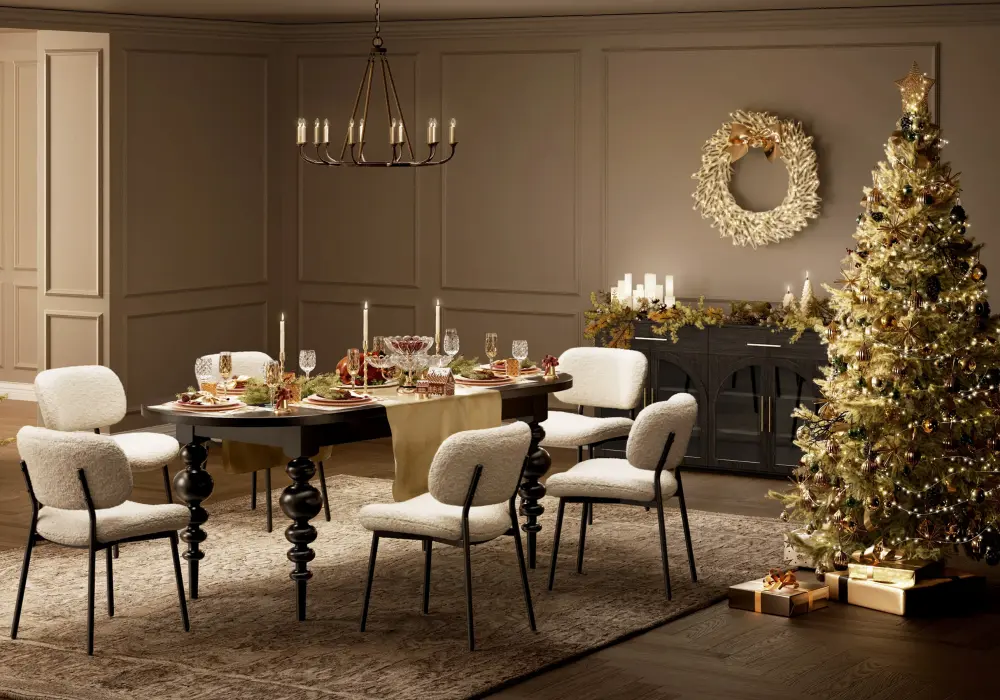
Decorate a Christmas tree by checking its position and lights first, adding ribbon or larger decorative elements next, and finishing with ornaments and the base. Coordinate the tree with the surrounding home decor rather than treating it as a separate color scheme. Working in layers makes gaps easier to see and adjustments easier to make. The exact order can vary with your tree and decorations, but complete the electrical and stability checks before investing time in the finishing details.
In This Guide
Choose the position before choosing the decorations
Look at the tree from the doorway and from the seats people actually use. A position that photographs well may interrupt a walking route or make the room difficult to use. Check the footprint of the stand and the lowest branches, not just the height of the tree. Include space for opening nearby doors and using adjacent furniture.
NIST's holiday fire guidance recommends keeping a tree at least 3 feet from heat sources and keeping exits clear. Follow the tree and light manufacturers' instructions as well. An extension cord should not become a trip hazard across the room, and decorative objects should not cover a heater or interfere with equipment. A small tabletop tree or a few keepsakes can instead go on nearby side tables, as long as they stay stable and away from heat.
Set up and stabilize the tree before unpacking all the ornaments. For an artificial tree, assemble the sections according to its instructions and shape the branches before judging fullness. For a cut tree, use an appropriate water-holding stand and maintain the water level. The tree's appearance should be built around those practical requirements.
Build a color and texture plan you can repeat
Choose a small set of colors that works with the room. You could use green with warm metallic accents, red with cream, or a restrained combination that echoes the sofa and wood finishes. There is no requirement to replace decorations simply because they do not belong to a named trend.
Sort your existing ornaments into groups before hanging them. Separate larger pieces, smaller accents, and personal keepsakes. This makes it easier to distribute visual weight instead of placing every favorite item in the same area. Set aside anything damaged or unsuitable for your household.
Vary texture within the palette. A matte ornament, a reflective surface, and a simple textile detail can produce variety without adding more colors. Leave some branch tips visible so the tree retains its shape. A heavily decorated tree still benefits from places where the eye can rest. Placing the tree near mirrors can also reflect the lights and add depth, which helps a compact tree feel fuller.
Add lights and inspect the overall effect
Check light strings before placing them on the tree. NIST advises using lights labeled by a recognized testing laboratory and avoiding damaged bulbs, strings, or connections. Follow the manufacturer's limits for connecting sets. Do not assume every string has the same electrical rating or permitted use.
For an unlit tree, distribute the lights with enough depth that the effect is not confined to the outermost branch tips. Work in manageable sections and step back periodically. Follow the tree's construction rather than pulling a cable tightly across gaps. Keep the plug and any controls accessible.
With a pre-lit tree, check the existing lighting before adding anything. You may not need another set. View the tree with the room lighting both on and off, since a balanced daytime arrangement can look different in the evening. Adjust obvious dark areas without exceeding the equipment's instructions.
NIST recommends turning tree lights off before leaving home or going to bed. Build that routine into the setup. A convenient control is useful only when it is suitable for the equipment and used according to its instructions. Never use lit candles as tree decorations.
Use ribbon to guide the eye through the branches
Ribbon is easier to arrange when you choose its role first. It might form loose vertical paths, short loops, or a few larger bows. Try one treatment on a small section before committing to the whole tree. A controlled pattern usually looks more coherent than several unrelated ribbon techniques.
For a soft cascading effect, create gentle changes in direction rather than a straight strip from top to bottom. Tuck the ribbon into suitable branches without forcing them out of shape. Keep the visible sections relaxed, and check the result from across the room. The aim is a visual rhythm, not exact repetition.
For short loops, make a few sample pieces and test their scale against the ornaments. Large loops can overwhelm a compact tree, while very small ones may disappear. Secure decorations only in ways appropriate to the tree and keep loose ribbon away from pets that may chew or swallow it.
Ribbon does not need to circle every part of the tree. If ornaments already provide strong color and movement, a few bows may be enough. Stop when the ribbon supports the arrangement rather than becoming another layer that hides all the others.
Place ornaments from larger forms to personal details
Distribute larger ornaments first so you can judge their effect on the overall shape. Check the balance between the upper, middle, and lower areas. Place an ornament where the branch can support it, and avoid assuming that a delicate outer tip can hold the same weight as a sturdier inner branch.
Add smaller ornaments to connect the larger ones. Move around the tree if several sides are visible. If the back is against a wall, concentrate your effort on the views people actually see while still maintaining a stable, complete arrangement. You do not need identical density on every branch.
Place meaningful keepsakes where they can be appreciated without being crowded. A small group of personal ornaments can be more effective than scattering them where they are difficult to notice. In a household with children or pets, consider the consequences of a dropped or reachable piece before selecting its position.
Step away before adding the final layer. Take a photograph if it helps you see uneven distribution, but also judge the tree in person. Remove an element if the arrangement feels too dense. Editing can improve the tree more than filling every remaining opening.
Finish the base and adapt the method to smaller trees
Keep the stand accessible for the tasks it requires. A cut tree needs water checks, and any cover should allow you to perform them easily. Arrange gifts without covering cords or blocking routes around the room. Do not create a decorative base that makes the tree harder to maintain. A flat-weave area rug underneath can define the tree corner and protect the floor, as long as cords stay clear and the stand remains stable.
For a tabletop tree, scale down both the ornaments and the number of materials. Choose a stable surface away from its edge and allow enough room for the base. A small tree can feel complete with one light treatment and a handful of coordinated ornaments.
In homes with pets, the ASPCA advises securing the tree, keeping tree water inaccessible, and avoiding tinsel. Keep batteries, wires, and breakable decorations out of reach. A smaller tree does not automatically remove those risks, so adapt the arrangement to your pet's behavior.
Frequently Asked Questions
Should lights or ribbons go on the tree first? Check and place the lights first in most arrangements. This keeps the electrical setup accessible and lets you judge illumination before adding ribbon. Follow the tree's instructions if its construction requires a different approach.
How much ribbon should I use? Use enough to establish the treatment you want without hiding the ornaments or the tree shape. Test one section first. Tree size, ribbon width, and the chosen technique affect the result, so a universal quantity is not very useful.
How do I decorate a real Christmas tree? Begin with a stable, appropriate stand and a position away from heat and exits. Maintain its water according to care guidance. Then add suitable lights and decorations without interfering with watering or the stand's stability.
What can go under the tree besides presents? Keep the area simple if gifts are not part of the display. A suitable stand cover may be enough. Preserve access to water and electrical connections, and avoid adding loose pieces that create tripping or pet hazards.
How do I make a tabletop tree look finished? Use a limited palette and decorations scaled to the tree. Give the base a stable position and leave clear space around it. A consistent arrangement is more important than matching the number of layers used on a full-size tree.
Finish by checking the view, walking routes, and everyday maintenance. Explore Homary's home decor collection for surrounding accents that suit the room, while keeping the tree itself coordinated, stable, and easy to enjoy.