

Choosing a dining table is less about finding the most attractive design and more about finding the right balance between size, seating, circulation, comfort, material, and everyday use. A table that looks perfect in a showroom can feel oversized in a small dining room, while a compact table may become frustrating when your family hosts Thanksgiving or weekend dinners.
The right choice should fit both your room and your lifestyle. Before comparing finishes or table shapes, determine how much space you actually have, how many people need to sit comfortably, and whether your dining area needs to accommodate occasional guests.
This guide explains how to choose a dining table with those practical decisions in the right order.
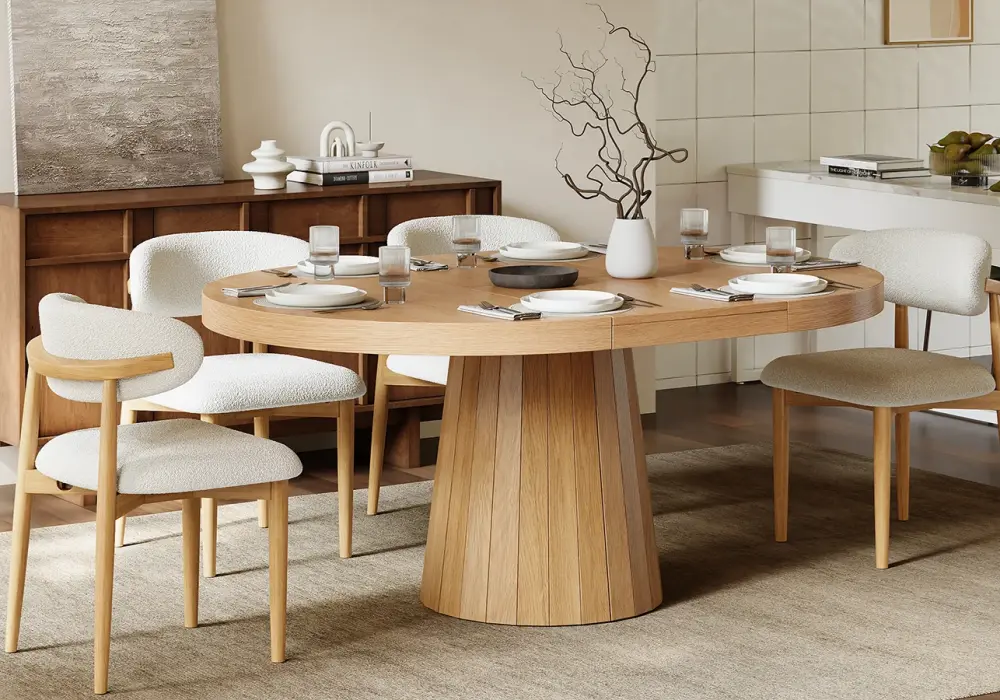
Source Hormary
Measure Your Dining Room for Clearance, Traffic Flow, and Table Fit
The first step in choosing a dining table is measuring the usable dining area, not simply the overall room dimensions.
Measure the distance between walls, but also mark doorways, windows, kitchen islands, sliding doors, radiators, built-in cabinets, and sideboards. In an open-plan home, the dining area may share circulation space with the kitchen or living room, so the table cannot be planned independently from the rest of the floor plan.
A good starting point is to leave approximately 36 inches of clearance around a dining table and chairs where people need to walk or pull out chairs. A less-trafficked side beside a wall or sideboard may sometimes work with around 30 inches, but more space is preferable when the area is used frequently.
Remember that the chair—not the tabletop—is what determines the real footprint.
If a dining chair is approximately 20–24 inches deep, pulling it away from the table can consume another 18–24 inches of floor space. This is why simply comparing the tabletop dimensions with your room size can produce an inaccurate layout.
Dining area | Recommended clearance |
Main walkway around table | About 36 in. |
Lower-traffic side | About 30 in. minimum |
Chair pull-out area | About 36 in. or more |
Table to kitchen island | Preferably 36 in.+ |
Table near frequently used doorway | 36–42 in.+ |
For an open-plan dining room, identify the primary walking routes first. For example, if people regularly walk from the kitchen to the patio through the dining area, do not position the table so chairs interrupt that route.
Sliding doors deserve special attention because their opening area can overlap with the dining zone. Likewise, if a kitchen island sits beside the table, leave enough space for someone to open a cabinet, sit down, and walk behind the chair without creating a bottleneck.
A simple way to test your proposed table size is to use painter's tape to mark the tabletop on the floor. Add another outline showing where the chairs will sit when pulled out. Then physically walk around the space, open the nearby doors, and pull out each imaginary chair.
If the layout feels tight with tape on the floor, it will feel even tighter once the table, chairs, rug, and lighting are installed.
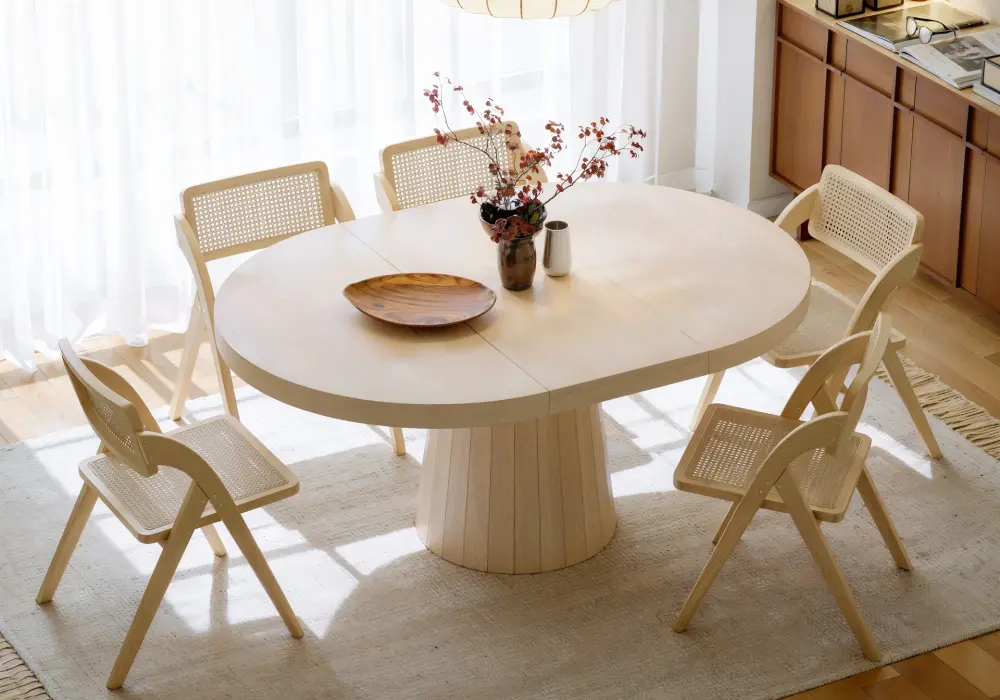
Source Homary
Match Table Shape, Seating Capacity, and Fixed vs. Extendable Options
Once you know the maximum footprint, choose a shape based on both the room and the number of people you actually seat.
A useful starting point for rectangular tables is approximately 24 inches of table width per person. This provides enough personal space for comfortable everyday dining, although the exact capacity depends on the table design, leg placement, and chair width.
Table shape | Best suited for | Typical advantage |
Rectangular | Medium/large or narrow rooms | Efficient seating capacity |
Oval | Narrow or transitional spaces | Softer corners, similar capacity |
Round | Small square rooms | Easier conversation |
Square | Compact square dining areas | Balanced proportions |
Extendable | Flexible households | Everyday + entertaining capacity |
Rectangular and Oval Tables
Rectangular tables are usually the easiest choice for a conventional dining room because they use a narrow footprint efficiently while providing substantial seating.
For a narrow dining room, an oval table can provide a similar seating capacity while eliminating sharp corners. This can make circulation feel easier, particularly where a table is positioned near a walkway.
Round and Square Tables
Round tables are particularly effective in smaller square rooms. Because there are no corners, people can move around the table more naturally, and everyone can maintain visual contact during conversation.
Square tables can also work well in compact, symmetrical dining areas, particularly for four people.
Fixed vs. Extendable Dining Tables
The biggest question is often not shape but whether the table should expand.
A fixed table is simpler and generally has fewer moving components. It makes sense when the household consistently needs the same number of seats.
An extendable dining table is better suited to households that have a smaller everyday dining group but occasionally host additional guests.
Common mechanisms include:
- Single-leaf tables: Add one extension for moderate additional seating.
- Double-leaf tables: Provide greater flexibility for larger gatherings.
- Butterfly-leaf tables: Store the extension inside the table, making them convenient when separate leaf storage is limited.
An extendable table can therefore provide a practical compromise: a compact footprint on ordinary days and additional seating during holidays or dinner parties.
However, do not forget the extension leaves themselves. If the table requires separate leaves, determine where you will store them when they are not installed. A dining room may have enough space for a 72-inch table but no convenient storage location for two large extension leaves.
The best table size is therefore based on everyday occupancy + occasional hosting needs, rather than choosing the largest table that can physically fit.
Compare Materials, Durability, and Daily Finish Maintenance
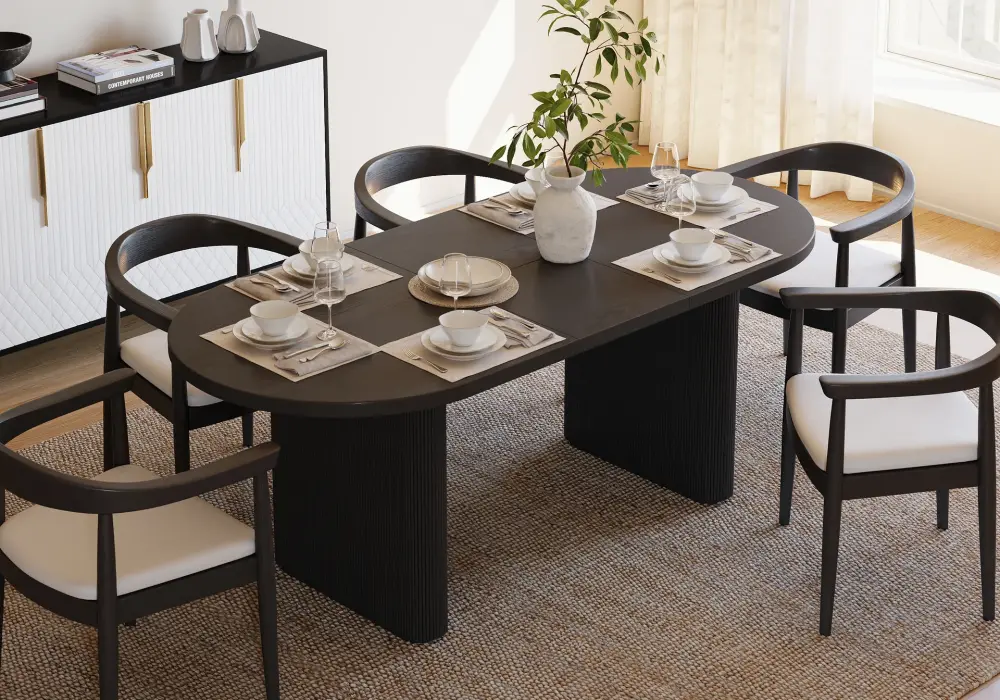
Source Homary
Material affects more than appearance. It determines how the dining table responds to scratches, spills, heat, moisture, and years of everyday use.
Solid Wood
Oak, walnut, maple, and ash are popular choices because they provide natural grain and can often be refinished when the surface eventually becomes worn.
Oak is particularly practical for busy households because of its hardness and pronounced grain, which can make minor marks less visually obvious. Walnut offers a richer appearance but is somewhat softer and can show scratches more readily.
Solid wood can also respond to changes in humidity. Use appropriate coasters, placemats, and manufacturer-recommended cleaning products rather than saturating the surface with water.
Wood Veneer
A quality wood veneer table can provide the appearance of real wood while using a stable engineered substrate underneath. This can reduce some of the movement associated with a large solid-wood panel.
Veneer is not automatically inferior to solid wood. The quality of the veneer, substrate, edge construction, and protective finish matters more than the label alone.
MDF and Particleboard
MDF and particleboard can be cost-effective choices, particularly for contemporary dining tables with painted, laminated, or engineered surfaces.
Their biggest weakness is usually moisture exposure. If water penetrates an unprotected edge or damaged surface, swelling can occur. For households with young children or frequent spills, inspect the table's surface and edge treatment carefully.
Stone, Glass, Metal, and Laminate
Stone and engineered stone create a substantial, contemporary appearance and can be highly resistant to everyday wear, although natural stone may require sealing depending on the material.
Glass creates a visually lightweight effect, which can be useful in small dining rooms, but fingerprints, smudges, and visible scratches may require more frequent cleaning.
Metal tables can be extremely durable when properly finished, while laminate surfaces are often practical for busy families because they are relatively easy to wipe clean.
Material | Durability | Spill resistance | Maintenance | Best for |
Solid oak | High | High with proper finish | Moderate | Busy families |
Walnut | High | High with finish | Moderate | Sophisticated interiors |
Wood veneer | Moderate–high | Good | Low–moderate | Modern dining rooms |
MDF/particleboard | Moderate | Depends on finish | Low | Budget-conscious buyers |
Stone/engineered stone | High | High | Moderate | Contemporary spaces |
Glass | Moderate | High | Frequent cleaning | Small modern rooms |
Laminate | High | High | Low | Everyday family dining |
For any material, avoid assuming that "water-resistant" means completely waterproof. Clean spills promptly, use heat protection for hot cookware, and follow the manufacturer's care instructions rather than applying furniture oils or waxes indiscriminately.
Evaluate Table Height, Base Clearance, and Legroom Standards
A dining table can have the correct length and still feel uncomfortable if its height or base design does not work with the chairs.
Most standard dining tables are approximately 28–30 inches high, with around 30 inches being a common target. Counter-height tables are typically around 36 inches, while bar-height tables are often approximately 40–42 inches.
The relationship between the tabletop and chair matters more than either dimension individually.
A chair should provide enough space for your thighs and knees without the underside of the tabletop or apron pressing against your legs. This becomes particularly important with tables featuring thick aprons, central supports, or unusual bases.
Table type | Approximate height |
Standard dining | 28–30 in. |
Counter height | About 36 in. |
Bar height | About 40–42 in. |
Base design also affects seating flexibility.
A traditional four-leg table can provide excellent stability but may interfere with chairs at the corners. A central pedestal can create more open legroom around the perimeter, making it easier to add an extra chair.
However, a pedestal should not be judged only by how much floor space it occupies. Check whether the base interferes with feet or knees and whether chairs with arms can slide comfortably beneath the tabletop.
If you already own dining chairs, measure their seat height and arm height before ordering the table. Armchairs that fit visually beside a table may not physically slide underneath it.
Coordinate Style, Budget, and Delivery/Assembly with Your Existing Room
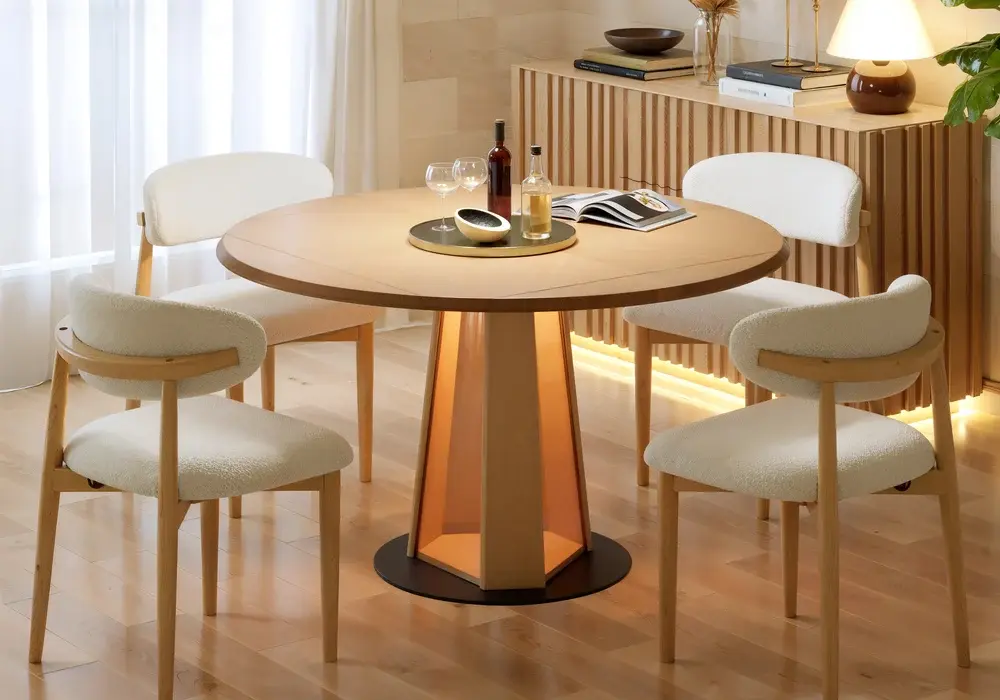
Source Homary
After determining size, shape, material, and height, consider how the table will integrate with the rest of the dining room.
The easiest approach is to coordinate the table with the room's existing visual temperature and proportions, rather than trying to match every piece exactly.
For example, a warm oak floor can pair naturally with a walnut or medium-tone wood table, while a modern neutral interior may work better with a lighter oak, stone top, or black metal base.
The dining table does not need to match the sideboard or dining chairs perfectly. Mixing materials can actually make the room feel more intentional. What matters is maintaining a connection through color, finish, shape, or scale.
How Much Should You Budget?
Dining table prices in the U.S. vary substantially depending on material, construction, dimensions, and brand. As a broad purchasing framework:
Table category | Typical U.S. price range* |
Budget engineered/laminate | $200–$600 |
Quality veneer or mid-range solid wood | $600–$1,500 |
Premium solid wood | $1,500–$3,000+ |
Stone/engineered stone | $1,000–$4,000+ |
*These are broad planning ranges rather than fixed market prices; custom construction and designer pieces can be considerably more expensive.
Also account for delivery, white-glove service, assembly, and potential stair or room-access fees. A large solid-wood or stone table can be difficult to move through narrow hallways, elevators, or staircases.
Before ordering, measure not only the dining room but also the delivery route. Check the front door, hallway width, stairwell, elevator, and the final doorway into the dining area.
Finally, consider the lighting above the table. A common planning guideline is to position the bottom of a pendant or chandelier approximately 30–36 inches above the tabletop. For proportionality, a dining light often works well when its width is roughly one-half to three-quarters of the table's width, although the exact size depends on the fixture design and room.
A table is therefore a complete purchase decision—not simply a tabletop. Size, chairs, lighting, rug, delivery access, and budget all need to work together.
Turn Your Dining Table Search into a Practical Buying Checklist
Before placing an order, use the following checklist:
- Measure the room: Record the usable length and width, doorways, islands, sideboards, and traffic routes.
- Calculate the real footprint: Include chairs when pulled away from the table, not just the tabletop dimensions.
- Choose everyday seating first: Determine how many people normally eat together, then decide how many additional seats you occasionally need.
- Select the shape: Rectangular and oval tables generally suit narrow rooms, while round and square tables can work efficiently in compact square spaces.
- Compare materials: Consider scratches, heat, spills, moisture, children, pets, and the amount of maintenance you are willing to perform.
- Check legroom: Confirm table height, chair height, apron depth, leg placement, and whether armchairs fit underneath.
- Calculate the complete budget: Include delivery, assembly, lighting, chairs, and any necessary accessories.
Most importantly, avoid buying based on a product photo alone. Mark the tabletop dimensions on your floor, test the circulation, and verify the delivery path before committing to a large piece.
A dining table should fit your home before it fits your style.
FAQ
What size dining table fits a 10 by 12 foot dining room?
A 10 × 12-foot room provides 120 square feet, but the ideal table size depends on doors, windows, furniture, and circulation. A table around 60–72 inches long can work in many layouts, provided approximately 36 inches of clearance is maintained around the table and chairs where people need to walk.
How much clearance do you need around a dining table and chairs?
A good general target is 36 inches around the table and chairs for comfortable movement and chair pull-out. In a low-traffic area, around 30 inches may sometimes work, but high-traffic routes should ideally have more space.
What is the standard dining table height and recommended knee clearance?
Most standard dining tables are approximately 28–30 inches high. The exact knee clearance depends on the tabletop thickness, apron, base design, and chair dimensions. When buying a table, check the space beneath the tabletop rather than relying only on the overall height.
Which dining table shape is best for a small dining room or apartment?
A round or square table can work particularly well in a compact, square dining area because there are fewer corners interrupting circulation. For a narrow apartment dining area, an oval or compact rectangular table may make better use of the available length.
What is the most durable and family-friendly dining table material?
For many busy households, finished solid oak, quality laminate, and durable engineered surfaces offer a practical combination of durability and easy maintenance. The protective finish matters almost as much as the underlying material because it determines how the surface handles everyday spills and wear.
Should I choose a fixed or extendable dining table for occasional hosting?
An extendable dining table is usually the better choice if your household needs a compact everyday table but regularly hosts additional guests. A fixed table is preferable when the number of diners rarely changes and simplicity is more important than flexibility.
How much should I budget for a quality dining table in the U.S.?
A realistic starting range for a quality mid-range dining table is often around $600–$1,500, while premium solid wood and stone can cost $1,500–$4,000 or more. Always consider the complete cost, including delivery and assembly, rather than comparing tabletop prices alone.