

How high should a TV stand be? While most TV consoles are around 18 to 30 inches high, there is no universal answer. The right height depends on your sofa, seated eye level, TV size, viewing distance and whether you use a soundbar. In most living rooms, the center of the TV should sit at or slightly below eye level when you are seated. This guide explains how to calculate the ideal TV stand height, choose the right console for different screen sizes, and adjust the setup for bedrooms, fireplaces and reclined seating.
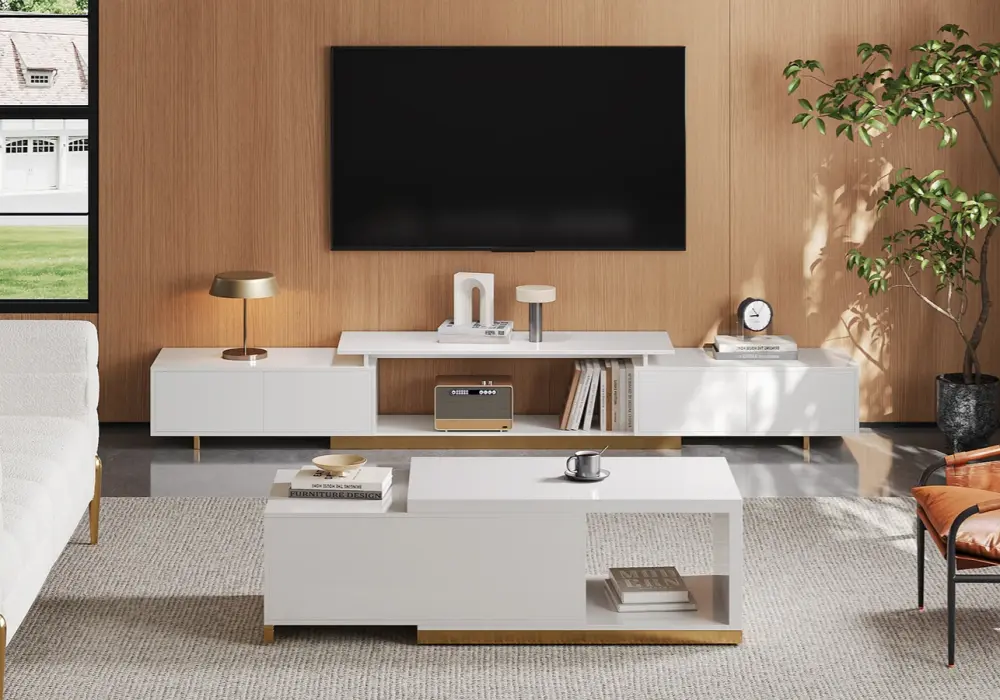
Homary Pick
Table of Contents
The Ideal TV Stand Height for Comfortable Viewing
For most living rooms, a TV stand between 18 and 30 inches works well, with approximately 20–25 inches being a practical range for many modern setups.
However, the better way to determine TV stand height is to start with your seated eye level, not a standard furniture measurement.
When you sit naturally on your sofa, the center of the TV should generally be at eye level or slightly below it. This creates a relaxed viewing angle and avoids making you tilt your head upward during a movie, sports game or long gaming session.
Why TV size changes the ideal console height
A larger TV does not necessarily need a taller TV stand. In fact, large TVs often look and feel better on lower-profile consoles.
A 55-inch TV is roughly 27 inches tall, while a 75-inch TV is around 37 inches tall. If both screens have the same center height, the larger screen naturally extends farther toward the floor.
That is why a 75- or 85-inch TV placed on a 28-inch console can end up too high, even though the furniture itself is a common height.
How to Calculate TV Stand Height
The easiest way to find your ideal TV stand height is to measure your actual viewing position.
Measure your sofa and seated eye level
Start by measuring from the floor to the top of your sofa cushion. A typical sofa seat is approximately 18–20 inches high, but your furniture may be different.
Next, sit in your normal viewing position. Keep your back against the sofa and look straight ahead naturally. Have someone mark the wall at eye level, then measure from the floor to that mark.
For example:
Seated eye level = 38 inches
This gives you a starting point for the center of your TV.
Find the screen-center height
For a typical living room, position the screen center at approximately your eye level or 1–2 inches below it.
If your seated eye level is 38 inches, you might target a screen center around 36–38 inches.
Use the TV stand height formula
Measure the actual height of your TV screen, then use:
TV stand height = desired screen-center height − half of TV screen height
For example, if your 65-inch TV is approximately 32 inches tall and you want its center at 37 inches:
37 − 16 = 21 inches
A TV stand around 21 inches high would therefore be a useful starting point.
Remember to check the height of the TV's feet or tabletop stand. Different TV models can create different gaps between the console and the bottom of the screen.
TV Stand Height by Screen Size
TV size is useful for estimating the right console height, but your eye level should always have the final say.
TV Size | Approx. Screen Height | Suggested Stand Height | Typical Screen Center |
55-inch | 27 in | 24–28 in | 37–42 in |
65-inch | 32 in | 20–25 in | 36–41 in |
75-inch | 37 in | 18–23 in | 36–42 in |
85-inch | 42 in | 15–21 in | 36–42 in |
These are general ranges rather than fixed requirements.
55-inch TV
A 24–28-inch TV stand can work well with a 55-inch TV in many living rooms. Because the screen is relatively compact, a slightly taller console can still keep the screen center within a comfortable range.
65-inch TV
For a 65-inch TV, consider a 20–25-inch console. Low-profile furniture is especially effective if the TV is the main visual feature of the room.
75-inch TV
A 75-inch screen usually benefits from a lower 18–23-inch TV stand. Its larger vertical dimensions mean that a traditional 28- or 30-inch cabinet may place the screen center too high.
85-inch TV
An 85-inch TV often looks best with a 15–21-inch low-profile console. Since the screen itself is roughly 42 inches tall, keeping the furniture low helps prevent the upper portion of the display from sitting too high.
For large-screen setups, an extendable TV stand can also be useful because it lets the furniture width better match the screen.
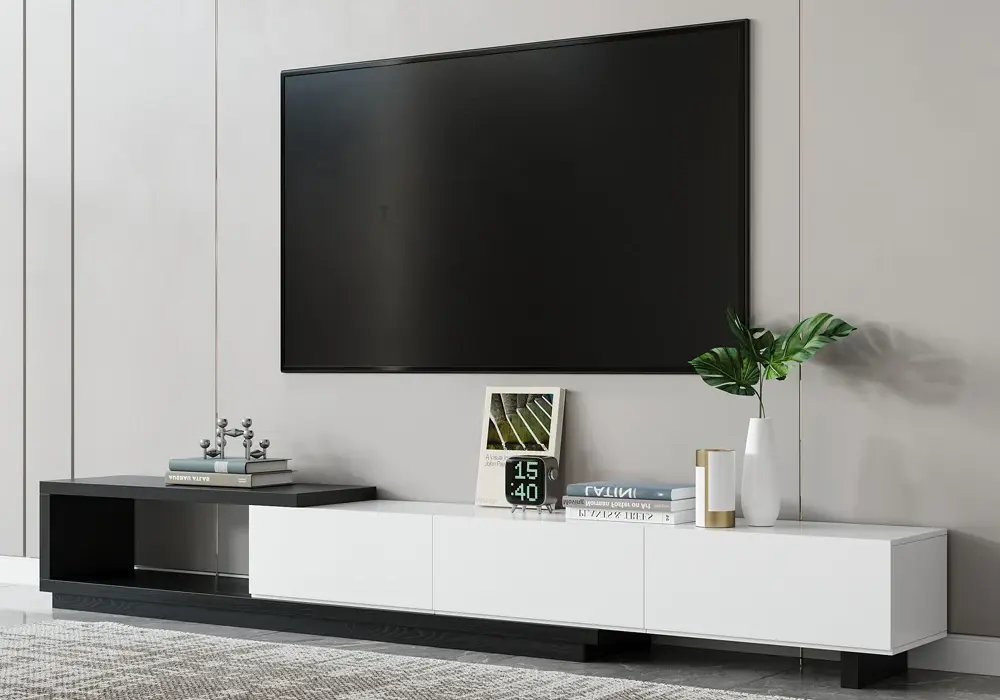
For example, Homary's Quoint Extendable TV Stand expands from 71 to 100 inches and includes three drawers, making it suitable when you want a wide console beneath a large TV without committing to one fixed length.
Homary Pick
Viewing Distance and Screen Angle
TV height should be considered together with viewing distance and posture.
Keep the vertical viewing angle comfortable
For general home viewing, keeping the vertical viewing angle around 15 degrees or less is a useful guideline. A screen that is too high forces your eyes and neck upward, especially when you are sitting close to a large display.
For most people, a slightly downward gaze is more comfortable than looking upward.
Use screen height to estimate viewing distance
A simple rule of thumb is to sit approximately three times the screen height away from the TV.
TV Size | Approx. Screen Height | Approx. 3× Viewing Distance |
55-inch | 27 in | 6.75 ft |
65-inch | 32 in | 8 ft |
75-inch | 37 in | 9.25 ft |
85-inch | 42 in | 10.5 ft |
This is only a starting point. Resolution, content and personal preference can all change the ideal distance.
Reclined seating needs a slightly different approach
A deep sofa, recliner or lounge chair changes your natural viewing angle. When you lean back, your head moves backward and your gaze may shift upward.
In this situation, the screen center can be slightly higher than your upright seated eye level. Test the position while sitting exactly as you normally watch TV rather than measuring only from an upright posture.
The goal is still to avoid an exaggerated upward viewing angle.
TV-to-Console Clearance for Soundbars and Equipment
The right TV stand height also needs to leave enough room for your audio equipment.
Leave 2–6 inches between the TV and console
A 2–6-inch gap between the top of the console and the bottom of the TV is a useful starting range. If you use a soundbar or center speaker, measure that equipment before finalizing the TV position.
A soundbar that is several inches tall may require a larger gap to prevent it from covering the bottom of the screen.
For wall-mounted TVs, calculate the entire setup as one system:
Console height + soundbar height + clearance + TV bottom edge
This prevents the common problem of mounting the TV at the right height only to discover that the soundbar blocks part of the display.
Check console depth and ventilation
Height is only one part of choosing a TV stand. A typical media console may be around 15–20 inches deep, but the correct depth depends on your TV feet and equipment.
Before buying, check:
- TV stand or foot depth
- Receiver and game-console dimensions
- Cable space behind the console
- Wall outlet location
- Ventilation requirements
- Weight capacity
For large TVs and extensive equipment, an extendable console can also make it easier to match furniture width to the room.
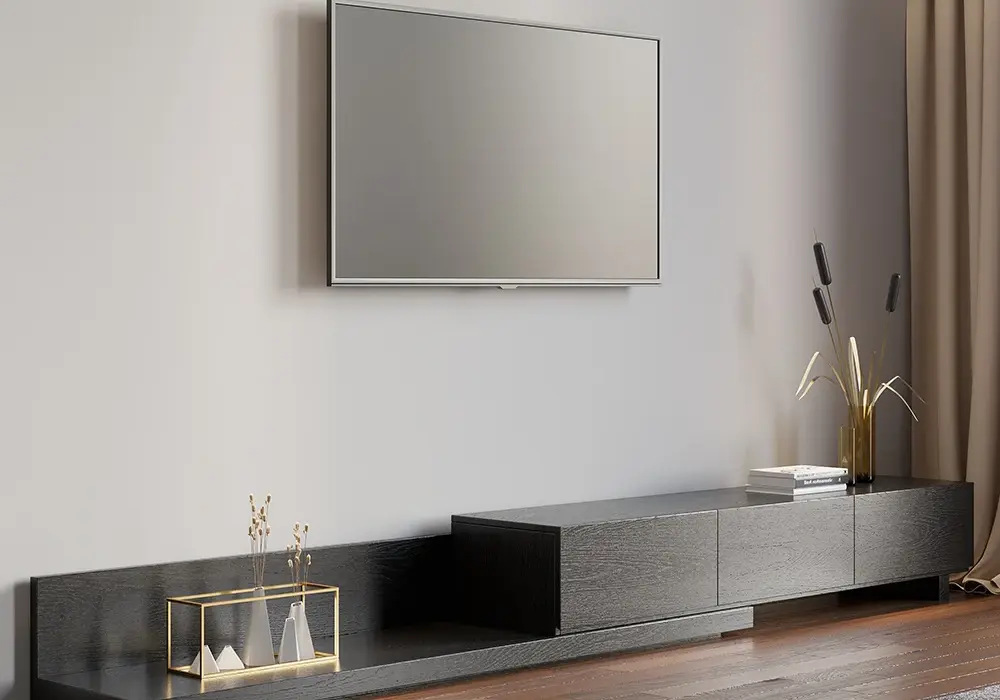
Homary's Extendable Floor TV Stand is designed to expand for larger TV setups and offers three drawers for media accessories. Its listed configurations extend from 84 to 110 inches, making it an option for wide entertainment walls.
Homary Pick
TV Height for Bedrooms, Fireplaces and Small Spaces
The best TV height changes depending on where and how you watch.
Bedroom TV height
Bedroom TVs are commonly installed higher than living-room TVs because viewers often watch while reclining or lying down.
A 42–50-inch screen-center height can be a useful starting point, but mattress height and your normal sleeping position matter more than a fixed number.
Lie in bed, find your natural eye level, and adjust the TV from there.
TVs above fireplaces
A fireplace mantel can force a TV much higher than the ideal living-room viewing position.
Before installing a TV above a fireplace, check the fireplace manufacturer's heat-clearance requirements and consider whether the resulting viewing angle will be comfortable.
If the TV would be significantly above eye level, another wall may provide a better viewing experience.
Floating consoles and compact rooms
A floating TV stand can work particularly well in small spaces. It keeps the floor visible and creates a cleaner appearance while providing storage for media equipment.
An extendable design is another useful solution when room dimensions or TV sizes change.
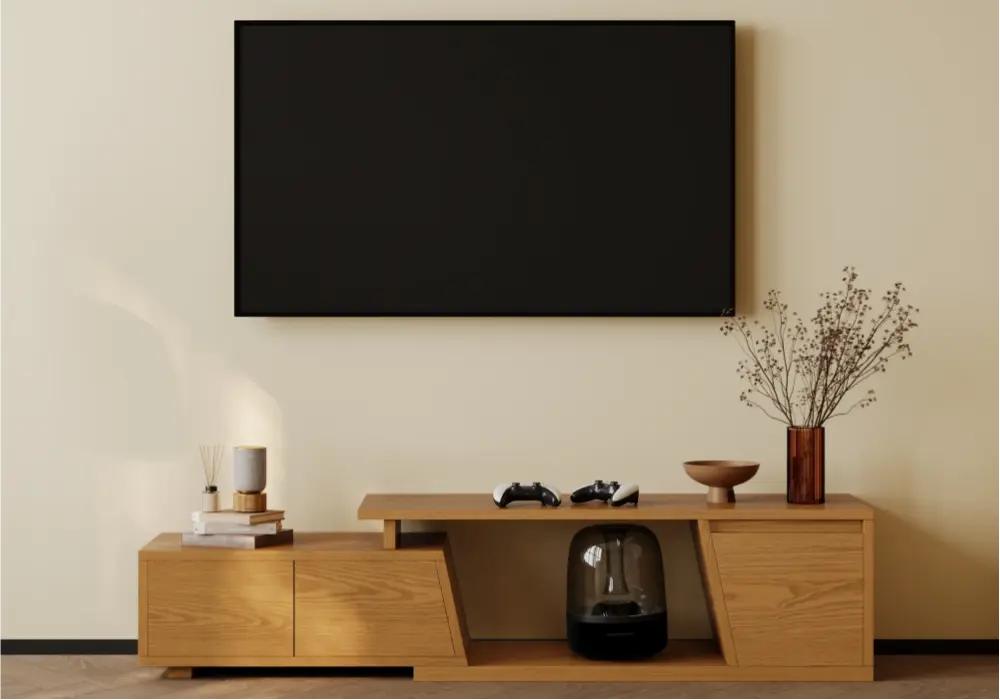
For a smaller entertainment area, the Fero Natural Extendable TV Stand expands from 47 to 71 inches and has three drawers for organizing remotes, cables and other everyday items. Its compact starting size makes it particularly practical when you do not want a large fixed-width console.
Homary Pick
Accessibility and children's spaces
For wheelchair users or households with significantly different seating heights, base the TV position on the primary viewer's seated eye level. An adjustable wall mount can provide more flexibility.
In children's rooms and gaming spaces, secure freestanding TVs with appropriate anti-tip hardware or use a properly installed wall mount.
Choosing a TV Stand That Fits Your Space
Once you know your ideal TV height, choosing the furniture becomes much easier.
Use this order:
- Measure sofa seat height.
- Measure seated eye level.
- Choose the desired screen-center height.
- Measure the TV's actual screen height.
- Calculate the console height.
- Check TV feet and soundbar clearance.
- Confirm console depth and equipment ventilation.
- Choose a console width that suits the TV and room.
The last step is where extendable furniture can be particularly useful. Instead of choosing a console that is permanently oversized or undersized, an expandable design can adapt to different wall widths and screen sizes.
Most importantly, do not choose a TV stand solely because its advertised height is considered "standard." A 21-inch console can be perfect in one living room and too high in another.
FAQ
What is the standard height for a TV stand?
Most TV stands are approximately 18–30 inches high, but the ideal height depends on your seated eye level and TV dimensions. For many modern large-screen TVs, a lower console around 20–25 inches may be more comfortable.
How do I calculate the ideal TV stand height?
Measure your seated eye level, choose the desired screen-center height, and subtract half the TV's actual screen height.
TV stand height = screen-center height − half of TV screen height.
Then account for the TV feet and any soundbar.
Should the TV center be exactly at eye level?
Not necessarily. In a living room, placing the center of the screen at or slightly below seated eye level is often comfortable. Reclined seating may require a somewhat higher position.
How much space should be between a TV and console?
A 2–6-inch gap is a useful general starting point. If you have a soundbar, measure its height and increase the gap as necessary.
What is the ideal TV stand height for a bedroom?
A bedroom TV is usually higher than a living-room TV because of the reclining viewing position. A screen center around 42–50 inches from the floor can be a starting point, but your bed height should determine the final position.
How high should a TV be above a fireplace?
There is no universal height. Check the fireplace's heat-clearance requirements first, then consider whether the TV can remain within a comfortable viewing angle. A different wall may be preferable if the mantel forces the TV too high.
Does a reclined sofa change TV height?
Yes. Reclining can shift your natural line of sight upward, so you may prefer the screen center slightly higher than your normal upright eye level. Test the position in your actual viewing posture before installation.