

Choosing the right coffee table is about more than style. The distance between the coffee table and couch affects comfort, movement, room balance, and everyday usability. A table that sits too close can restrict legroom and make it hard to stand. One that sits too far away can make reaching for a drink, book, or remote inconvenient.
So, how far should a coffee table be from a couch? For most living rooms, 356 to 457 mm (36 to 46 cm) is a practical range, with 406 to 457 mm being a strong starting point. However, the ideal spacing is not one fixed number. Sofa depth, cushion softness, seating posture, traffic flow, and household needs can all change the answer.
This guide explains the ideal coffee table distance from a couch, how to match table height to sofa seat height, how much walking space to leave, and how to choose the right table size and shape.
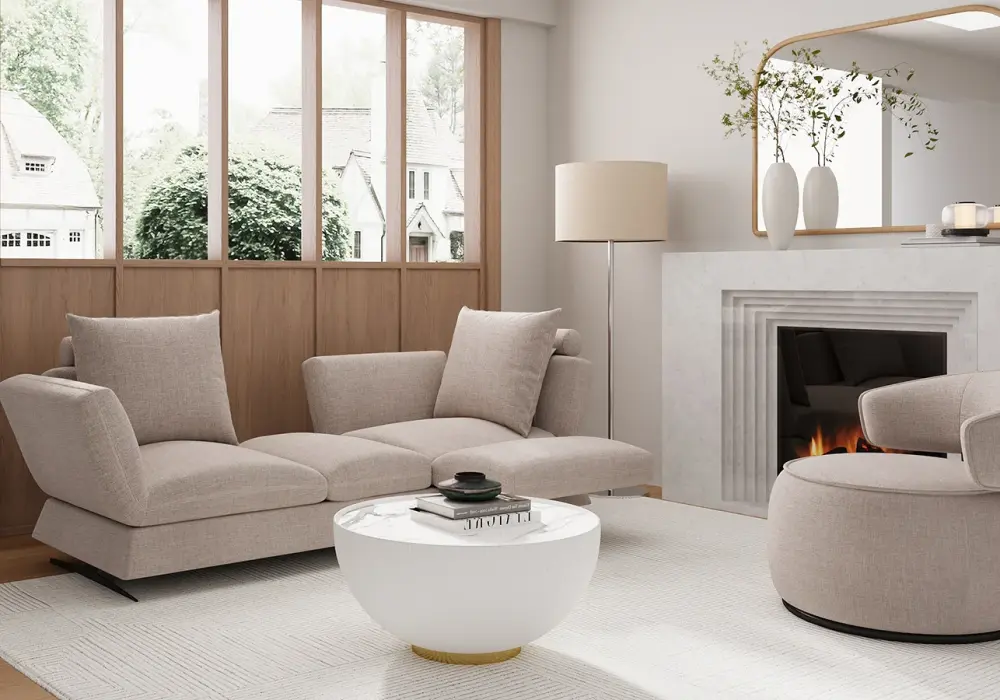
Round Beige Sintered Stone Leather Drum Coffee Table
Table of Contents
How Far Should a Coffee Table Be From a Couch?
The standard recommendation for coffee table-to-couch distance is about 356 to 457 mm. This range generally provides enough room for your legs while keeping the tabletop within easy reach.
What Is the Ideal Distance Between a Sofa and Coffee Table?
For a typical sofa, 406 to 457 mm is a reliable starting point. It creates a comfortable buffer without making the seating area feel disconnected.
The frequently cited “457 mm rule” should be treated as a guideline rather than a universal requirement. A shallow sofa with firm cushions can work well at 356 to 406 mm, while a deep lounge sofa may feel more comfortable at 457 to 508 mm.
How Sofa Depth Changes Coffee Table Spacing
Sofa depth is one of the most overlooked factors when planning coffee table placement.
A shallow sofa encourages a more upright sitting position, so a shorter gap can keep essentials within easy reach. A deep sofa with soft cushions allows people to sit farther back, which can make a slightly larger gap more comfortable.
Your body proportions matter as well. Taller users may prefer additional knee and legroom, while smaller users may find a 356- to 406 mm gap easier for reaching.
How to Measure the Right Coffee Table Distance
The easiest way to find the ideal distance is to test the layout in your actual room.
Measure from the front edge of the sofa cushion to the nearest edge of the coffee table. Mark several options, such as 356, 406, 457, and 508 mm, with painter’s tape.
Then sit on the couch in your normal position and test whether you can comfortably reach the tabletop. Try reaching for a mug, placing down a book, and standing up without bumping your knees.
A cardboard template cut to the size of your proposed table can also help you test the layout before purchasing furniture.
Sofa and seating style | Recommended coffee table gap |
Shallow sofa with firm cushions | 356–406 mm (36–41 cm) |
Standard sofa | 406–457 mm (41–46 cm) |
Deep sofa or soft lounge cushions | 457–508 mm (46–51 cm) |
Tall users or relaxed seating | 457–559 mm (46–56 cm), if circulation allows |
What Is the Ideal Coffee Table Height Compared With a Sofa?
Coffee table height is just as important as the distance between the table and sofa. A well-matched height makes it easier to reach drinks and snacks while keeping the seating arrangement visually balanced.
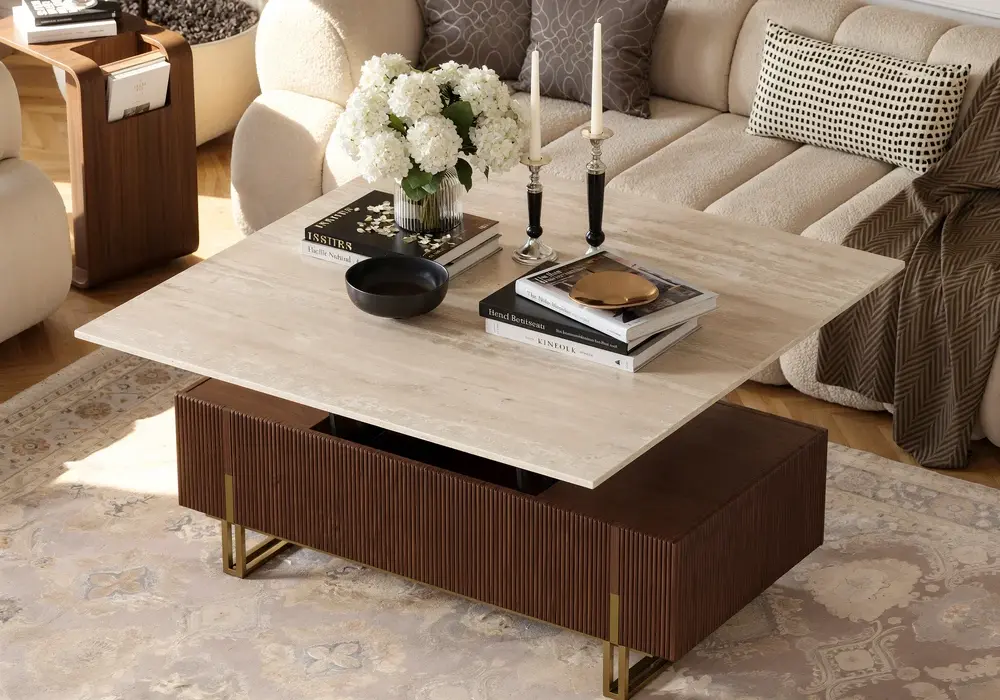
Walnut Fluted Lift-Top Coffee Table
How Much Lower Should a Coffee Table Be Than a Couch?
For most living rooms, the coffee table surface should be about 25 to 51 mm lower than the sofa seat.
For example, if your sofa seat is 457 mm high, a coffee table measuring 406 to 457 mm high can create a comfortable pairing.
A table that is more than about 51 to 76 mm higher than the sofa seat can feel awkward because the tabletop may dominate the seating area and interfere with comfortable leg extension.
How to Measure Sofa Seat Height
Measure from the floor to the top of the cushion where you actually sit. Do not measure from the floor to the sofa frame or the highest point of a loose back cushion.
When comparing tables, check the actual usable tabletop height rather than relying only on the overall product dimensions.
Coffee Table Height for Low Sofas and Recliners
Low-profile modern sofas typically pair well with lower coffee tables because a tall table can overpower the proportions of the room.
Recliners require a different approach. Because the back and footrest move, you may need additional clearance behind and beside the chair. The coffee table should never interfere with the reclining mechanism, even when that means increasing the distance slightly.
How Much Space Should You Leave Around a Coffee Table?
Comfortable traffic flow is essential when arranging a living room. The sofa-to-table gap alone does not determine whether the room will feel spacious or cramped.
Minimum Walking Clearance in a Living Room
For a main walkway, 762 to 914 mm of clear space is a useful target. A secondary route can sometimes work with approximately 610 mm, although wider circulation usually feels more comfortable.
The actual requirement depends on how often the route is used and whether multiple people need to pass each other.
Coffee Table Clearance Near Doorways
Coffee tables placed near entrances require more careful planning than tables positioned in the center of a seating area.
Consider adding roughly 152 to 305 mm of additional clearance near a doorway or active entrance route. For example, if 406 mm works comfortably between the sofa and table in the center of the room, 559 to 711 mm may be more practical when the same area also functions as a passage.
How Door Swings and Stairways Affect Coffee Table Placement
Always check the full swing of nearby doors. An inward-opening door should not collide with the table or create a narrow pinch point.
The same principle applies to stairs and multi-directional traffic paths. Mark the movement zones on the floor before finalizing your furniture placement.
How Much Space Should Be Between a Coffee Table and TV?
Leave enough room around the table for people to access the media console, walk across the room, or clean the area without squeezing between furniture.
The goal is to keep the seating zone connected while preserving a clear route to other parts of the room.
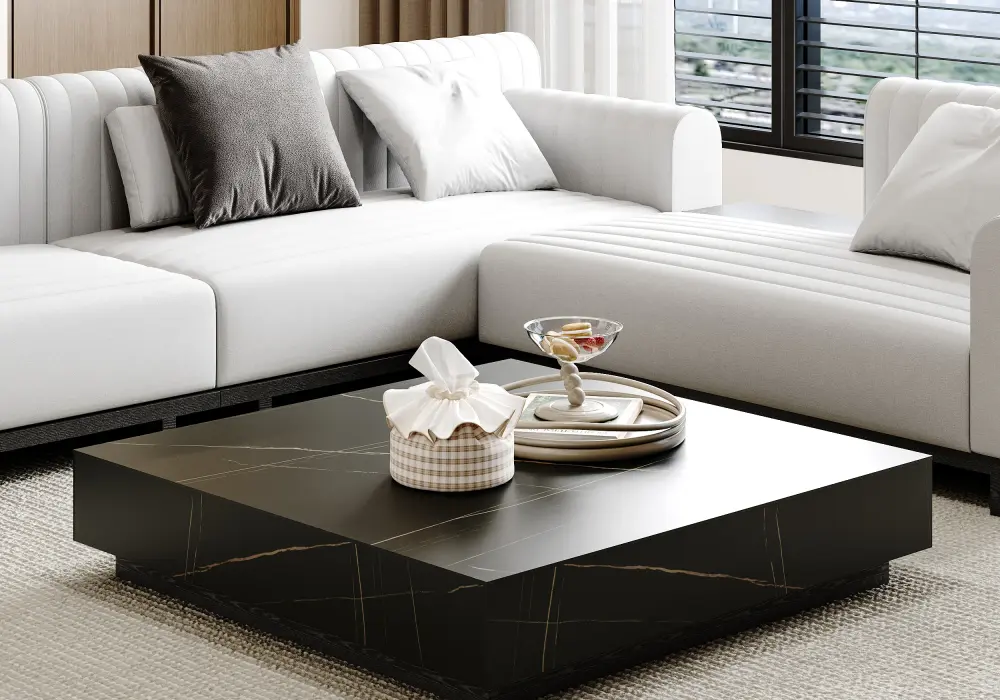
Square Sintered Stone Block Coffee Table
What Size and Shape Coffee Table Works Best With a Sofa?
Once the spacing is correct, the next consideration is proportion. A coffee table should feel large enough to anchor the seating arrangement without overwhelming the room.
How Long Should a Coffee Table Be Compared With a Sofa?
A useful rule is to choose a coffee table that is approximately two-thirds to three-quarters the length of the sofa.
For example, a 2134 mm sofa can typically pair with a coffee table around 1422 to 1600 mm long. A 1829 mm sofa can work well with a table around 1219 to 1372 mm long.
Sofa length | Suggested coffee table length | Suitable shapes |
1524–1829 mm | 1016–1372 mm | Round, oval, compact rectangle |
1829–2134 mm | 1219–1600 mm | Rectangle, oval |
2134–2438 mm | 1422–1829 mm | Rectangle, oval, large round |
2438+ mm | 1626–2032+ mm | Long rectangle, oversized oval |
When Should You Choose a Round Coffee Table?
Round coffee tables are useful when you want softer visual lines or easier circulation around the furniture.
A 1016- to 1219 mm round coffee table can work particularly well in a compact seating area. Without sharp corners, it can also be easier to navigate around in a home with young children.
Is an Oval Coffee Table Better for Narrow Rooms?
An oval table combines many of the advantages of rectangular and round designs. Its longer surface can complement a sofa, while its curved ends make it easier to walk around.
This makes oval tables especially useful in narrow living rooms where every inch of circulation space matters.
What Coffee Table Shape Works Best With a Sectional?
For an L-shaped sectional, round, oval, and compact square tables can all work well.
Round tables create a central focal point and allow movement around the perimeter. Square tables can efficiently fill the space inside a large sectional, while a narrow oval or rectangle may be better when the room has a restricted passage.
Coffee Table Placement for Small Living Rooms and Sectionals
Small living rooms require a different strategy. Instead of maximizing table size, prioritize comfortable reach and clear traffic flow.
How to Place a Coffee Table in a Small Living Room
Start by establishing the main walking path. Once that route is protected, position the coffee table within comfortable reach of the sofa.
Slim tables, nesting tables, oval designs, and lift-top pieces can provide useful surface area without consuming excessive floor space.
A table does not always have to sit perfectly centered. Shifting it slightly can make room for a doorway, accent chair, or hallway while maintaining an overall sense of balance.
How to Position a Coffee Table With a Sectional Sofa
Measure the available space inside the sectional from both directions rather than measuring only one side.
The table should be accessible from the primary seating positions without blocking the open side of the sectional. In a particularly compact room, a smaller round table may offer better circulation than a large rectangular one.
Can an Ottoman Replace a Coffee Table?
An ottoman can function as a footrest, extra seat, and casual tabletop when paired with a tray.
It is especially useful in homes where comfort is the priority. However, an upholstered ottoman usually provides less stable support for drinks and may visually fill more space than a slim coffee table.
How to Measure Coffee Table Placement Before You Buy
Taking a few minutes to test the layout can prevent an expensive furniture mistake.
Best Tools for Measuring a Living Room
A standard tape measure is enough for most rooms. A laser distance meter can speed up larger layouts, while furniture-planning apps are useful for checking proportions.
For the most realistic test, use painter’s tape or a cardboard template to reproduce the exact footprint of the coffee table on the floor.
How to Test a Coffee Table Layout
Mark the proposed table dimensions and position. Then test the room in real-life situations.
Sit on every commonly used seat. Reach toward the tabletop. Stand up. Walk from the entry to the sofa. Open nearby doors. Pull out chairs or ottomans. Test the full reclining range of any recliner.
A layout that looks perfect on a floor plan may feel very different once people actually move through it.

Round Rotating Tray Coffee Table
Coffee Table Safety Tips for Homes With Kids and Pets
In family homes, safety should be considered alongside aesthetics.
Choose Rounded Corners for High-Traffic Areas
Round and oval tables eliminate exposed sharp corners. Tables with softened edges can also reduce the impact of accidental bumps.
Choose a Stable, Heavy Base
A lightweight table can shift or tip when bumped or climbed on. Look for a stable base and keep the tabletop free from objects that could fall easily.
Use Non-Slip Pads and Grippers
Soft felt or rubber furniture pads can help prevent unwanted sliding on hard flooring. On rugs, suitable non-slip grippers can improve stability and keep the table positioned correctly.
Consider Easy-Care Upholstery for Ottomans
For upholstered ottomans, removable and washable covers can make maintenance easier in homes with children and pets. Durable, easy-clean materials are often more practical than delicate fabrics.
Coffee Table and Couch Spacing: Quick Measurements to Remember
For most living rooms, start with 406 to 457 mm between the couch and coffee table. Adjust to roughly 356 to 508 mm based on sofa depth, cushion softness, and seating posture.
Keep the tabletop approximately 25 to 51 mm below the sofa seat when practical, and aim for 762 to 914 mm of clear space on major walking routes.
The most reliable method is to measure the furniture, mark several possible positions on the floor, and test the room by sitting, reaching, standing, and walking through the space.
Frequently Asked Questions About Coffee Table Spacing
How far should a coffee table be from a couch for comfortable reach?
A distance of 356 to 457 mm works well for most sofas, with 406 to 457 mm being a practical starting point. Deep sofas or relaxed seating may need 457 to 508 mm.
What is the ideal coffee table height compared to sofa seat height?
The coffee table is generally most comfortable when the tabletop is 25 to 51 mm lower than the sofa seat.
How much walking space should I leave between a coffee table and a sofa or doorway?
Aim for about 762 to 914 mm for a main walkway. Near an active doorway, consider leaving an additional 152 to 305 mm of clearance.
Which coffee table shape works best with a sectional sofa in a small living room?
Round and oval tables are often useful in compact rooms because they allow easier movement around the seating area. A slim rectangular table can also work when the room is long and narrow.
How do I position a coffee table on a rug to keep proportions balanced?
Keep the coffee table visually connected to the seating group. A common arrangement places the table fully on the rug while the sofa's front legs also sit on the rug. Leave a consistent border around the furniture group rather than crowding the rug edges.
Are ottomans a safer or better alternative to coffee tables for homes with kids and pets?
An upholstered ottoman can be a practical alternative because it has softer edges and can double as a footrest or extra seat. Add a firm tray when you need a stable surface for drinks and accessories.