

A reclining sofa needs more space than a standard sofa because its back and footrest move when you recline. The right wall clearance depends on the mechanism, recline path, sofa dimensions, and room layout—not simply the sofa's overall depth.
As a general planning range, a standard reclining sofa may need about 18–24 inches (457–610 mm) of space behind it, while a wall-hugger or zero-wall recliner may require only around 4–6 inches (102–152 mm). Power reclining sofas can fall between these ranges depending on their mechanism. The footrest also needs additional open space in front of the sofa when fully extended.
The best approach is therefore to measure the entire movement path before purchasing. This is especially important when upgrading from a conventional sofa to a power reclining sofa, sectional recliner, or multi-seat home-theater configuration.
Reclining Sofa Type | Typical Planning Clearance Behind Sofa | Main Space to Check |
Standard manual recliner | 18–24 in. (457–610 mm) | Backrest travel + footrest |
Standard power recliner | About 8–18+ in. (203–457+ mm) | Mechanism + cord + backrest |
Wall-hugger recliner | About 4–6 in. (102–152 mm) | Manufacturer-specified rear clearance |
Zero-wall model | Minimal, model-specific | Full recline footprint |
Reclining sectional | Varies by configuration | Every reclining seat + corners |
These are planning ranges, not universal specifications. Always use the manufacturer's required clearance for the exact model you are considering.
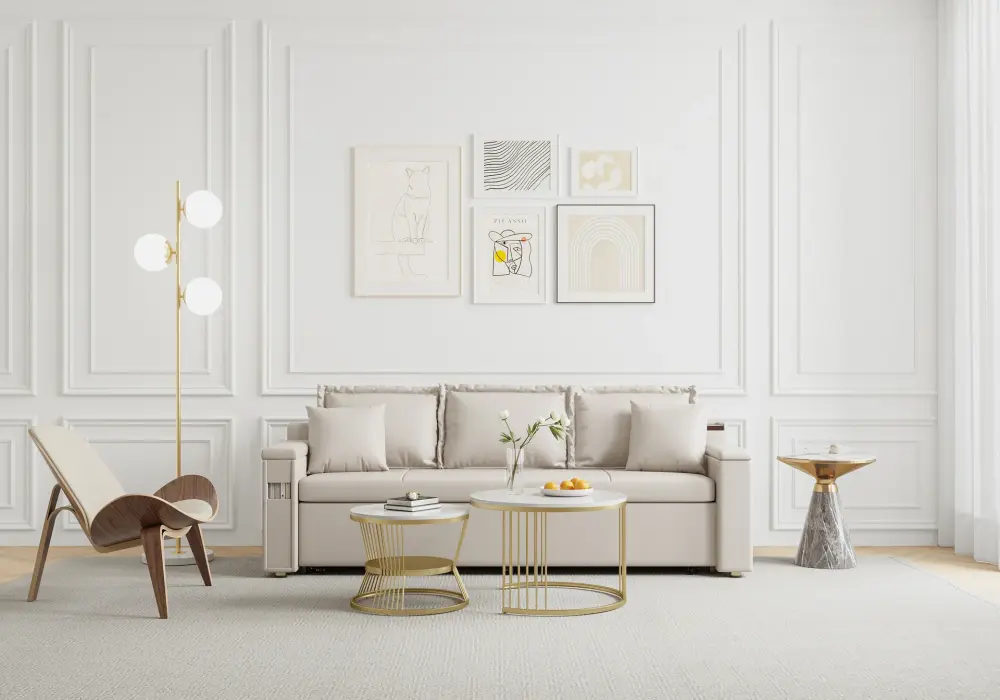
Exact Wall Clearance for Manual, Power, and Wall-Hugger Reclining Sofas
The most important distinction when deciding how far a reclining sofa should be from the wall is how the backrest moves.
A conventional recliner usually moves its back backward as the footrest rises. If the sofa sits too close to the wall, the top of the backrest can strike the wall, trim, artwork, or window treatment.
Standard manual reclining sofas: plan for 18–24 inches (457–610 mm)
For a traditional manual reclining sofa, 18–24 inches (457–610 mm) of rear clearance is a practical starting range. Larger recliners with deeper reclining angles may need more.
This clearance should be measured from the furthest rear point of the sofa in its upright position to the wall, not simply from the seat cushion. The backrest needs enough room to travel through its entire reclining arc.
A manual recliner also needs clear space in front. Once the footrest opens, its usable footprint becomes substantially deeper than the sofa's upright dimensions.
Power reclining sofas: check the mechanism and electrical path
Power recliners do not automatically require more wall clearance than manual models. Some use mechanisms that allow the backrest to travel backward, while others are designed as wall-hugger or zero-wall systems.
For a conventional power reclining sofa, planning for roughly 8–18 inches (203–457 mm) or more behind the sofa may be reasonable, but the manufacturer's specifications should take priority.
The electrical system adds another consideration: the power cord and plug need to remain free from crushing or sharp bends as the mechanism operates.
Wall-hugger and zero-wall recliners: approximately 4–6 inches (102–152 mm) or model-specific
A wall-hugger recliner is designed so that the seat moves forward as it reclines, allowing the back to remain relatively close to the wall.
Many wall-hugger designs can work with approximately 4–6 inches (102–152 mm) of rear clearance, while true zero-wall mechanisms may require even less. However, “zero wall” does not mean that every part of the sofa can touch the wall.
The safest purchasing rule is simple:
Treat the manufacturer's specified rear clearance as the minimum, not an optional recommendation.
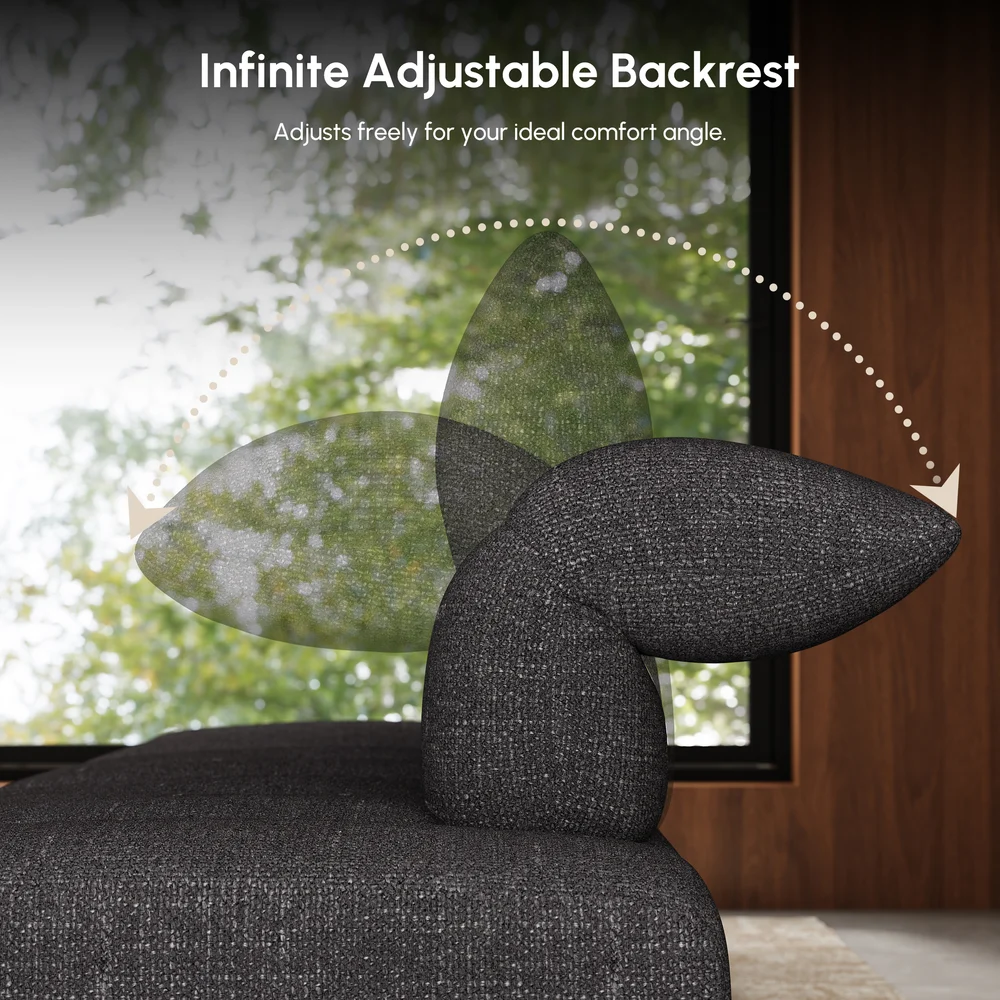
Source Homary
The front clearance matters just as much as the rear clearance. A sofa may technically fit against a wall but still become unusable if the footrest extends into a coffee table, rug edge, or main walkway.
Step-by-Step Measuring Guide for Full Recline and Footrest Extension
Measuring a reclining sofa should be treated as mapping a movement path, not measuring a rectangle.
Before ordering, gather the sofa's upright depth, fully reclined depth, rear clearance requirement, and footrest extension from its specifications. Then compare those numbers with your actual room.
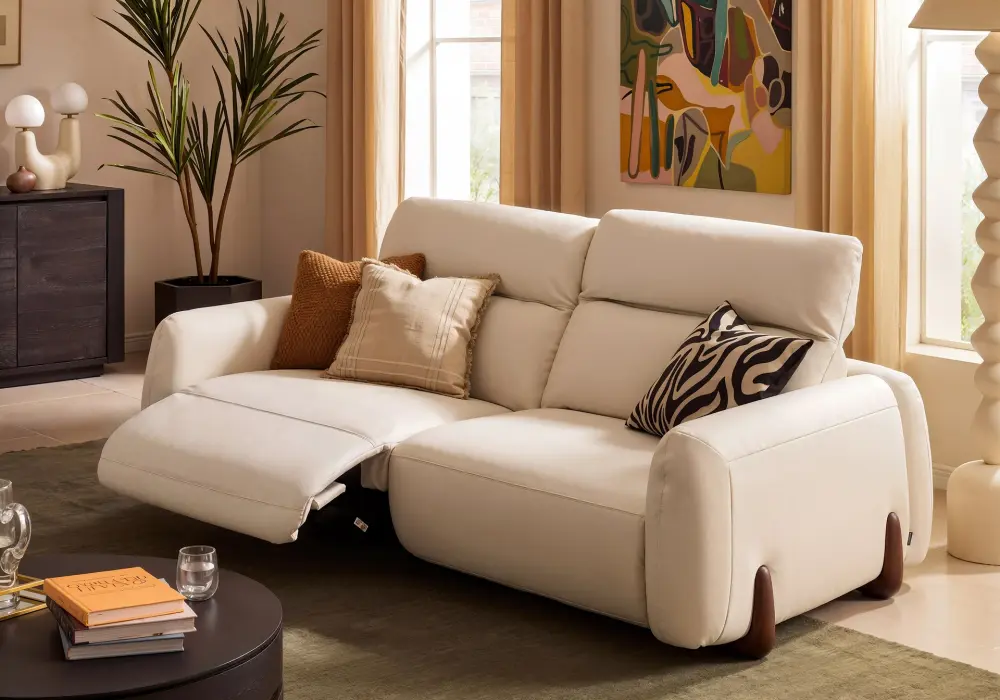
Source Homary
Step 1: Measure the wall-to-sofa starting position
Measure from the wall—including baseboard or trim—to the intended rear edge of the sofa.
For example, if the sofa requires 20 inches (508 mm) of clearance and your baseboard projects 0.5 inch (13 mm) from the wall, account for that projection rather than measuring only from the flat wall surface.
Step 2: Find the sofa's maximum reclined depth
The manufacturer's fully reclined depth is more useful than the upright depth.
For example:
- Upright sofa depth: 40 inches (1016 mm)
- Fully reclined depth: 65 inches (1651 mm)
- Rear wall clearance: 20 inches (508 mm)
The sofa therefore occupies significantly more of the room when reclined.
Step 3: Mark the movement path with painter's tape
If you do not have a physical sample, use painter's tape on the floor.
Mark:
- The wall line.
- The sofa's upright footprint.
- The rear clearance.
- The fully reclined front edge.
- The footrest's maximum projection.
- The surrounding walkway.
This creates a simple full-scale floor plan without moving heavy furniture.
Step 4: Check the footrest independently
The footrest is often the overlooked part of the calculation.
A reclining sofa can have sufficient rear clearance but still block a coffee table or walkway once the footrest is extended.
If the fully reclined sofa reaches 65 inches (1651 mm) from its rear starting point to its front edge, do not assume that a 30-inch (762 mm)-wide coffee table positioned directly in front will remain accessible.
Step 5: Test the entire arc, not just the endpoints
If possible, check the sofa at three positions:
Upright → Partially reclined → Fully reclined
Look for contact with:
- Walls
- Baseboards
- Window trim
- Side tables
- Floor lamps
- Coffee tables
- Rugs
- Electrical cords
This is particularly important for a power reclining sofa, because users may operate the mechanism frequently rather than only occasionally.
A simple planning example
Imagine a 3-seat reclining sofa with:
- 40-inch (1016 mm) upright depth
- 20-inch (508 mm) required rear clearance
- 65-inch (1651 mm) fully reclined depth
- 36-inch (914 mm) coffee-table clearance
The sofa should not simply be placed 20 inches (508 mm) from the wall and assumed to fit. You need enough total room depth to accommodate:
20" (508 mm) rear clearance + 65" (1651 mm) reclined footprint + usable front clearance
That produces a planning depth of approximately 121 inches (3073 mm), or just over 10 feet (3048 mm), before considering additional circulation around the sides.
The exact numbers vary by model, but the principle is universal: measure the sofa in its largest operating position.
Room Layout and Placement: Corner, Angled, and Floating Recliner Solutions
A reclining sofa does not have to sit flat against a wall. In larger living rooms, floating or angled placement can create a more comfortable and intentional layout.
Corner placement
A reclining sofa placed near a corner needs clearance behind both the back and the reclining sides if one or more seats operate independently.
Do not push the side of a reclining seat tightly against a wall simply because the rear clearance looks sufficient. The armrest, mechanism, or neighboring furniture may interfere with movement.
For corner layouts, leave enough room for the reclining seat to open fully and maintain a usable walkway around the sofa.
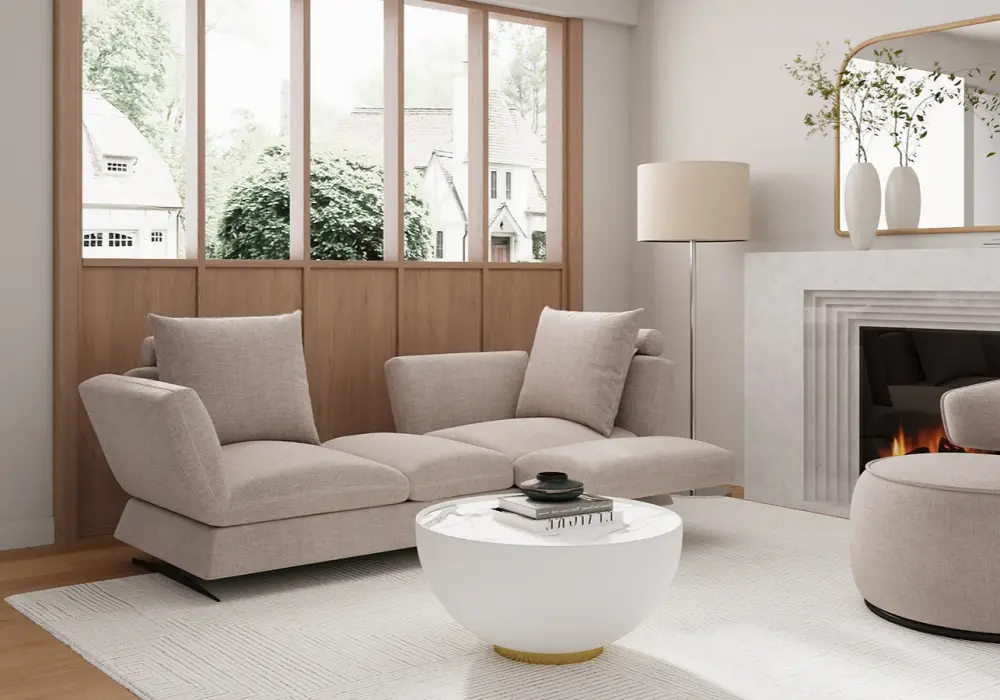
Source Homary
Angled placement
Angling a reclining sofa 15–30 degrees away from a wall can create a more dynamic conversation area, but it also creates a triangular space behind the sofa.
That space can work well for:
- A slim floor lamp
- A plant
- A narrow console
- Decorative lighting
- A small side table
The important point is that the closest point of the sofa's rear movement path still needs to satisfy the manufacturer's clearance.
Floating placement
Floating a reclining sofa in the middle of the room is often the best solution for a large open-plan living room.
It allows you to create a genuine outdoor-lounge-inspired indoor living room feel, with the sofa defining the main conversation zone rather than simply lining a wall.
For a floating configuration, think in terms of circulation:
Layout Element | Practical Planning Range |
Main walkway | 36–42 in. (914–1067 mm) |
Comfortable passage | 36+ in. (914+ mm) |
Tight secondary passage | About 30 in. (762 mm) |
Sofa-to-coffee-table zone | About 14–18 in. (356–457 mm) |
Reclining sofa front clearance | Model-specific; often substantially more than a standard sofa |
A reclining sofa should also be positioned so that the fully extended footrest does not occupy a primary walkway.
For a two-seat or three-seat reclining sofa, the center console can become part of the layout. If it includes cup holders, USB ports, or storage, you may not need a large side table between the sofa and another seating group.
For home-theater layouts, keep the rows sufficiently separated so that one person's footrest does not interfere with the row in front.
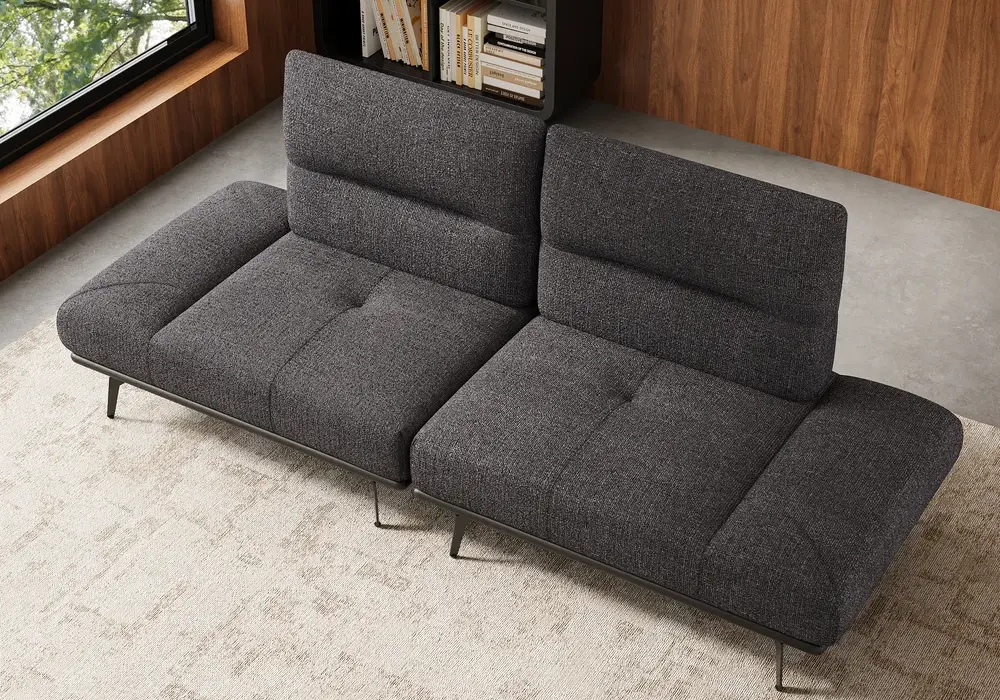
Source Homary
Power Recliner Electrical Clearance, Outlet Placement, and Wall Protection
Power reclining sofas introduce another layer of planning because the mechanism and electrical connection need to work together.
The outlet should ideally be positioned so the cord does not become trapped behind a moving frame. Avoid routing the cable directly underneath moving components or through a location where the reclining mechanism can pinch it.
A practical setup is to place the outlet behind or beside the sofa while keeping enough slack for the mechanism's movement. The exact cord path depends on the model.
Wall protection is another reason not to treat the clearance measurement as purely cosmetic. Repeated movement can create scuffs if the backrest approaches a painted wall or baseboard.
Depending on the manufacturer's design, a small amount of protection may include:
- A soft wall bumper
- Felt or padded protection
- A discreet wall protector
- A suitable baseboard guard
However, do not add thick padding that changes the required mechanism clearance unless the manufacturer permits it.
For wall-hugger power recliners, the reduced rear clearance is one of their major advantages in compact rooms. But the same rule applies: the phrase “wall hugger” does not replace the model's actual specifications.
Delivery and Setup Clearance Checklist for Reclining Sofas
Buying the right reclining sofa is only half the space-planning process. A large sectional or reclining sofa must also physically reach its final position.
Before delivery
Measure:
- Front door width and height
- Interior doorways
- Hallway width
- Narrow corners
- Stairway width
- Elevator dimensions
- Ceiling height at difficult turns
- Sofa package dimensions
- Individual sofa-module dimensions
Also measure the maximum height and depth of the packaged pieces, not only the assembled sofa.
During delivery
Check whether the sofa can:
- Enter through the main doorway.
- Clear the door frame.
- Turn through the first hallway.
- Pass narrow corners.
- Clear stair railings.
- Fit inside an elevator if necessary.
- Reach the intended room without damaging walls.
For modular reclining sectionals, individual pieces can make delivery easier because the modules may be transported separately and assembled inside the room.
After placement
Before pushing the sofa into its final position:
- Confirm rear clearance.
- Check both sides of each reclining seat.
- Extend every footrest fully.
- Test every reclining position.
- Check power cords.
- Confirm the main walkway remains open.
- Make sure rugs do not interfere with moving footrests.
For example, if a living room is 12 feet (3658 mm) deep and the sofa requires 20 inches (508 mm) behind it plus approximately 65 inches (1651 mm) when fully reclined, the remaining floor area must still accommodate the coffee table and circulation space. A room can fit the sofa dimensionally while still feeling too cramped operationally.
A Simple Reclining Sofa Clearance Checklist
Before purchasing, save these measurements in your phone or shopping notes:
Wall
- ☐ Wall-to-sofa clearance
- ☐ Baseboard projection
- ☐ Window/door interference
Sofa
- ☐ Upright width
- ☐ Upright depth
- ☐ Fully reclined depth
- ☐ Seat-by-seat reclining range
- ☐ Weight and mechanism requirements
Front
- ☐ Footrest projection
- ☐ Coffee-table clearance
- ☐ Main walkway
- ☐ Rug position
Electrical
- ☐ Outlet location
- ☐ Cord path
- ☐ No pinch points
- ☐ Power source accessible
Delivery
- ☐ Door width
- ☐ Hallway width
- ☐ Corner clearance
- ☐ Elevator/stair dimensions
- ☐ Package dimensions
The simplest rule is: measure once for the sofa, once for the full recline, and once for the delivery route. That turns a potentially frustrating furniture purchase into a predictable room-planning decision.
Upgrade Your Living Room With the Right Reclining Configuration
A reclining sofa is more than a larger version of a standard sofa. The right configuration can turn an ordinary living room into a dedicated relaxation zone, home theater, or flexible family space.
Before choosing between a manual recliner, power reclining sofa, wall-hugger, or modular reclining sectional, record your available wall clearance, full recline depth, walkway width, and electrical locations. Then compare those measurements against the specifications of the models you are considering.
If you are shopping online, keep this checklist beside you and confirm the upright dimensions, fully reclined dimensions, rear clearance, and weight requirements before ordering. A few minutes of planning can help prevent wall damage, blocked walkways, and a sofa that technically fits but cannot recline comfortably.
FAQ
How many inches (mm) of clearance should you leave between a reclining sofa and the wall?
A standard reclining sofa commonly needs about 18–24 inches (457–610 mm) of clearance behind it, while some power and wall-hugger models need substantially less. Always follow the manufacturer's specified minimum because the required space depends on the reclining mechanism and backrest movement.
What is the clearance difference between a wall-hugger recliner and a standard recliner?
A standard recliner may require roughly 18–24 inches (457–610 mm), whereas a wall-hugger model may operate with approximately 4–6 inches (102–152 mm) behind it. Some zero-wall designs require even less, but the exact specification varies by model.
How do you measure the full recline path of a reclining sofa, including the footrest?
Measure the sofa's upright position, required rear clearance, and fully reclined depth. Then use painter's tape to mark the entire footprint on the floor, including the furthest point reached by the footrest. Check the path in upright, partially reclined, and fully reclined positions.
Do power recliners need extra space behind them for the motor and power cord?
Not necessarily. Power recliners can use different mechanisms, so some require substantial rear clearance while wall-hugger models need much less. The important considerations are the manufacturer's rear-clearance specification and ensuring that the power cord cannot be pinched by the moving mechanism.
Can you place a reclining sofa in a corner or at an angle without hitting the wall?
Yes, but you need to check the movement path of every reclining seat. Corner and angled placements can change the clearance needed around the back and sides. Tape the fully extended footprint on the floor before finalizing the layout.
What can you put behind a reclining sofa to protect the wall from scrapes and scuffs?
A suitable soft wall bumper, felt protection, or discreet wall guard can help protect a wall where the sofa's movement comes close to it. However, protection should not reduce the mechanism's required clearance or interfere with reclining.
Which doorway and hallway clearances should you check before a reclining sofa delivery?
Measure the front door, interior doorways, hallway width, tight corners, stairways, elevator dimensions, and ceiling clearance at difficult turns. Also compare these measurements with the packaged dimensions, because a reclining sofa may be substantially larger when boxed than individual modular pieces.