

The best expandable dining room table for a small space fits your everyday meals when closed and still leaves enough room for chairs when open. Start by deciding how many people you seat most days and where guests will sit when you host. Then shortlist dining tables by their two footprints, how the extension opens, and where the extra chairs and leaves will live. A room may fit a table at full length on paper while leaving no comfortable place for the person sitting at the end.
Table of Contents
Measure closed, open, and in motion
Measure the room from the fronts of the furniture you will keep, such as a sideboard or kitchen island. Mark door swings and the route you take while carrying plates. Use a different tape color for the closed and open tabletops. In a long, narrow space, check which end extends and whether there is room to move the table if opening it changes where it needs to sit.
As an initial check, allow about 36 inches from the tabletop to an obstacle where you want room to pull out a regular chair. Give the busiest path more space where people need to walk behind diners. Bring in your actual chairs as soon as possible. A compact chair might slide under a table that is awkward to approach with a deeper chair. The opening into the room also changes when you add an end seat.
For a sample layout, take a clear area 144 inches long and 108 inches wide. A centered 60-by-36-inch table leaves 42 inches at each end and 36 inches on the sides. The same table stretched to 72 inches leaves 36 inches at each end. At 84 inches it leaves 30. If you host often and traffic crosses an end, the 72-inch option may be easier to arrange than the longer table. Try shifting the table or seating guests along the sides to see what makes the room usable.
The third footprint is the conversion itself. Ask how the legs or tabletop move and where you stand while opening it. Check whether you need to pull two halves apart from opposite sides, lift a leaf, or clear the full arc of a hinged section. You may need room to convert the table before guests arrive, even if it can sit closer to the wall once open.
Pick a mechanism you can use on an ordinary day
A separate center leaf is useful if you want a simple closed table and have a place to put the leaf. Store it as directed, away from a position where it will get knocked by chairs or other furniture. Record the assembled orientation so you know where the finished edges join. If the leaf is heavy or bulky, check whether someone will usually be around to help.
A built-in folding leaf can simplify storage. Review the opening sequence and see if the leaf sits under the top or needs a separate support. Check knee clearance around the folded parts, especially if you use tall chairs or chairs with thicker seat pads. Ask whether the table locks in both the compact and extended positions.
A drop-leaf design makes sense where the table can live along a wall or in a small nook. Check the depth of the usable top with one leaf up, and confirm where the visible brackets or gate legs land. Curtains, radiators, and outlets can complicate the placement even when the furniture outline fits.
A sideboard table is another option when storage matters on days you rarely use the dining area. Decide which cabinet openings you need while the table is extended. If the unit holds your everyday dishes, test whether someone can open it with the nearest chair occupied. Check where the pulled-out top and legs go so the arrangement uses the open floor instead of a busy path.
Set the seat count using real chairs
For an early sketch, give each adult approximately 24 inches of table edge. Include space for glasses and flatware, using whatever you normally serve. Large chairs may need wider intervals. On a round or oval table, an arc can feel roomy at the edge while the chair legs compete near the base. Mark each chair on your floor plan and check the table's supports before adding another place setting.
A bench is useful when you can tuck it in or use it elsewhere between meals. Measure from the inside face of the legs, and include any apron near the top of the bench. Decide how the person in the middle will get up when the room is full. If a bench is against a wall, it may be easier to put the more mobile guests on that side and leave the open chairs for people who want to come and go.
For chairs brought in only for parties, use the same test for height and spacing as you use for everyday chairs. Folding chairs vary in seat height and footprint. Put the spare chairs beside the table before assuming you can fit them at the two heads. A radiator or a table leg can take up the space you planned for someone's feet.
Compare three compact-to-expanded designs
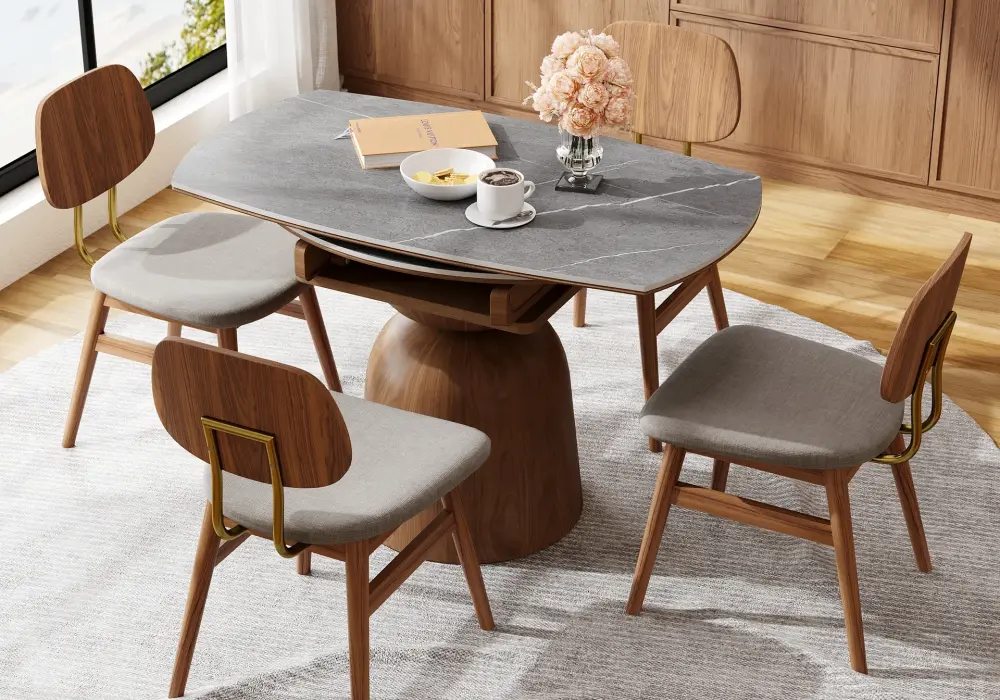
The 47-inch gray round extendable dining table gives you a round layout for everyday dining and is listed for four to six. It suits a room where people approach from several directions. When it opens, position the extended axis along the longest usable span and check whether the new seating positions keep a route to the kitchen clear.
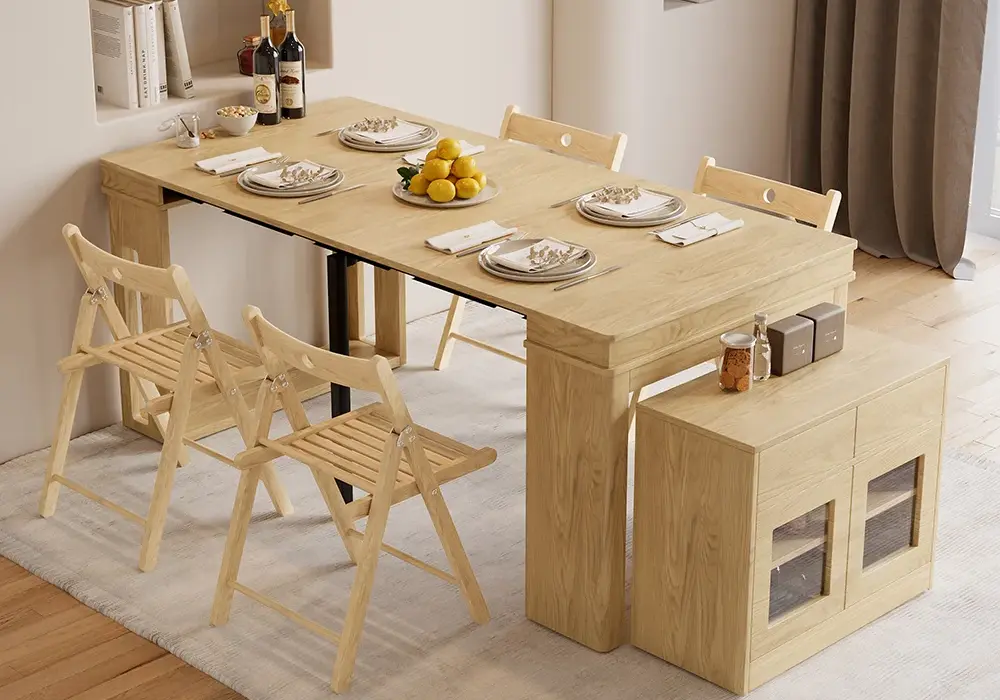
The extendable dining table with natural-finish sideboard storage is designed to work in sideboard mode and in two- and four-person dining arrangements. In a studio or an open kitchen, draw the cabinet as a permanent piece first. Test how the table faces into the room during meals and where you will put the chairs when it folds back into storage use.
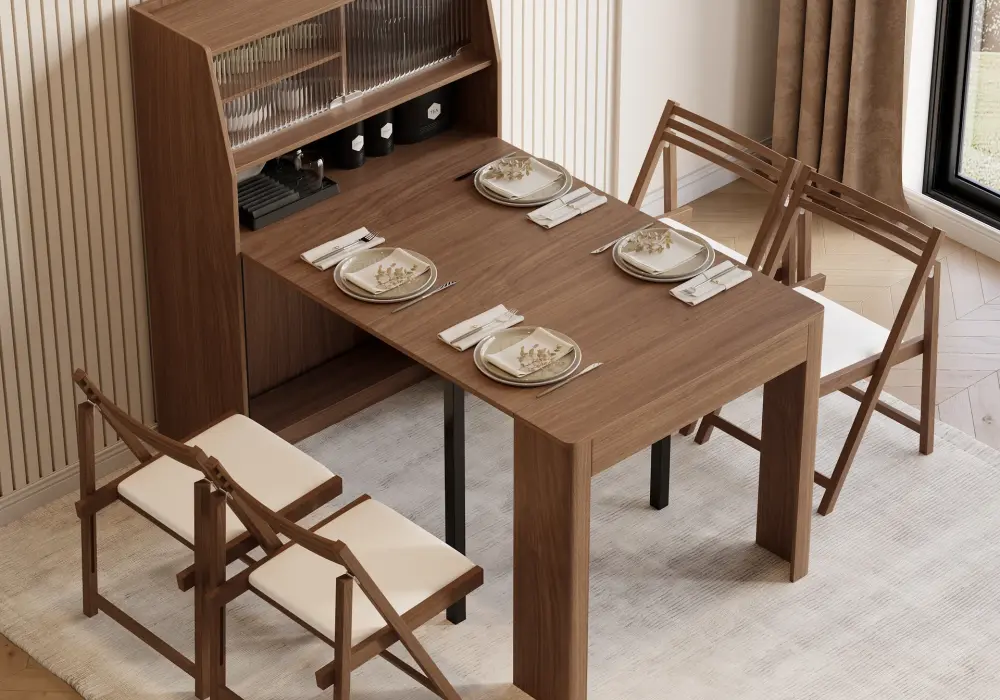
The 71-inch farmhouse extendable dining table with walnut-finish sideboard offers storage and several configurations. Its current product details describe seating up to five. Compare it with the smaller sideboard setup by mapping the full room during dinner, including any seats you plan to use at the sides. Ask whether the exact configuration gives each person independent legroom.
Keep the room usable between gatherings
Decide what stays on the table when it is closed. If it doubles as a desk, plan where your laptop and accessories will go when you expand it for dinner. If you keep a vase on top, see whether you can lift it easily with one hand and where you can set it during conversion. A clear spot nearby makes the transformation more likely to happen.
Plan storage for guest chairs before ordering them. Check a closet, secondary room, or the space beneath a console with real dimensions. If chairs need to stack, confirm the maker's stacking instructions. A table that opens easily saves less space when two extra chairs are always parked in the main path.
Practice the open and closed arrangement with someone else in the room. Run through how you would make the change before a meal, pull a chair out, walk past someone seated, and put the furniture away again. Keep the arrangement that feels simple enough for the number of times you expect to use it.
Check whether the expanded table is balanced in the room
Some tables grow symmetrically and others extend away from a fixed cabinet or leg. Place painter's tape at the center of each footprint and compare those marks with the pendant or window. If the expanded table moves the center away from the light, try moving a floor lamp or using a pair of portable lights from a nearby surface. Check where the ends land relative to doorways and chairs. A center shift can be worth planning for even when the open table fits, because the preferred chair positions may change between the two layouts.
Frequently Asked Questions
Are round extendable tables good for small apartments?
They can work well in a roughly square nook or where traffic passes around the corners. Check the open shape and the direction it extends. An elongated top may move a chair into a doorway even if the closed round footprint is easy to walk around.
How much bigger should an extendable table get?
Calculate the number of additional places you really need and find where those people would sit. Additional length can add side seating or let the existing chairs spread out. Added inches count only where the supports and room layout leave the space usable.
Should I get a sideboard table or a conventional leaf table?
A sideboard table can save floor space if you use the room for several purposes during the week. A leaf table may feel simpler when you dine there every day and only need to expand it occasionally. Compare the number of steps it takes to convert each.
Can I leave an expandable table open all the time?
Many designs offer a usable extended configuration. Read the model instructions for how the leaves lock and where their supports go. Recheck the daily walkway, since a route that works during a party can feel tight when it is used every morning.
Can an extendable table go against a wall?
Yes, if there is room for the chair access and opening sequence. On a sideboard design the wall can be a natural position. On other designs you may need to pull the table out before extending it, so mark that temporary position on the floor too.