

When every square foot matters, a dining table can quickly become one of the hardest pieces of furniture to fit into a home. A table that feels perfectly comfortable in a spacious dining room may block a kitchen walkway, crowd an apartment living area, or leave little room for working from home. That is where a drop leaf dining table for small spaces can make a real difference.
With folding leaves that can be lowered when they are not needed, this versatile table can shift from a compact everyday surface to a larger dining area in seconds. The right design can support meals, remote work, homework, and entertaining without permanently taking over the room. In this guide, we will cover five essentials: how to measure for the right size, where to place the table, what to look for when buying, how different mechanisms work, and which chairs and finishes make a small dining space feel more open.
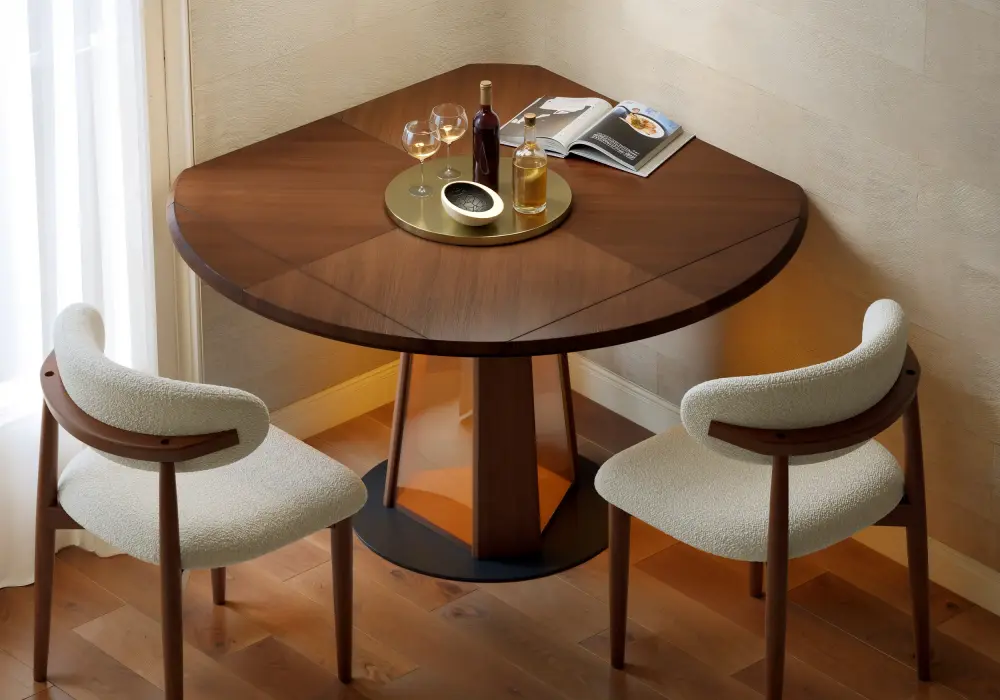
Extendable Walnut Wood Dining Table
Table of Contents
How to Choose the Right Drop Leaf Table Size for Small Spaces
Choosing the right size starts with the room around the table, not just the tabletop itself. In a compact home, a table may technically fit but still make the room difficult to use if there is not enough clearance for chairs, doors, drawers, or everyday foot traffic.
Measure Your Available Floor Space First
Start by measuring the full area where the table may sit. Note the distance to walls, kitchen cabinets, sofas, appliances, and other furniture. Then measure the main walkway.
As a practical rule, aim to preserve roughly 762–914 mm of clear walking space in frequently used paths. Around the dining side of the table, more room is helpful because chairs need to slide back when someone sits down.
Compare the Table's Closed and Open Dimensions
For many compact drop leaf tables, a closed footprint may be around 762 × 762 mm, while opening one or both leaves can bring the tabletop closer to 762 × 1524 mm. These are common reference dimensions rather than fixed standards, so always check the manufacturer's exact measurements before ordering.
A useful way to think about sizing is to measure the table in two states:
Closed position: This is the footprint you will live with most of the time. Make sure it does not block the main route through the room.
Open position: This shows how much space you need for everyday dining, guests, or special occasions. Measure outward from the table edge and include the space required for chairs.
Plan Enough Seating Width for Adults and Children
Seat width matters as well. A typical adult dining place setting works comfortably with about 457–508 mm of table width per person, while children generally need around 356–406 mm. Actual comfort also depends on chair arms, table legs, and how much elbow room your household prefers.
Household Use | Approximate Seating Space per Person | Space-Saving Tip |
Adult | 457–508 mm | Choose armless chairs that tuck under |
Child | 356–406 mm | Use narrower chairs or benches |
Four adults | About 1829–2032 mm total around the seating edge | Consider opening both leaves only when needed |
Consider Table Height and Everyday Comfort
Do not forget the vertical dimensions. A standard dining table is generally around 711–762 mm high, but compact homes may benefit from counter-height or adjustable designs when the table must perform more than one function.
The most important question is not simply, “Will it fit?” Instead, ask: Can I open it, sit down, stand up, and walk around it comfortably? Measuring both the closed and expanded configurations will prevent one of the most common small-space furniture mistakes: buying a table that fits perfectly until it is time to actually use it.
Where to Put a Drop Leaf Table: Space-Saving Placement, Safety, and Multi-Use Ideas
Once you know the dimensions, placement becomes the next major decision. In a small apartment or compact kitchen, the best location is often the one that allows the table to disappear visually and physically when it is not in use.
Use Wall Placement to Save Valuable Floor Space
Placing one side close to a wall can work particularly well. You can keep one leaf down for a narrow daily setup and raise the second leaf when guests arrive. This creates a flexible arrangement without requiring the entire table to sit in the middle of the room.
A drop leaf table can also function almost like a semi-built-in workstation. During the day, keep one leaf raised as a desk for a laptop or paperwork. At dinner, clear the surface and open the opposite leaf for two to four diners. In a studio apartment, this dual-purpose layout can eliminate the need for a separate desk.
Protect Doorways, Cabinets, and Main Walkways
Wall placement does require some care. If one leaf opens toward a wall, make sure the leaf has enough room to move fully and that the table hardware does not scrape paint or trim. A slim gap can also make cleaning easier and prevent the table from constantly rubbing against the wall.
For homes with narrow pathways, consider positioning the table at the edge of the main circulation zone, rather than directly in the center. A rectangular or square top can work especially well against a straight wall, while a round or softly curved version may reduce the visual feeling of sharp corners in a tight room.
Turn a Small Dining Table Into a Multi-Use Workstation
The table can also become a surprisingly useful family station. Fold it down after dinner and use it as a compact homework area, a craft table, a puzzle station, or a children's activity surface. Some adjustable designs can even be raised toward counter or bar height, creating an alternative standing workspace.
This flexibility is particularly useful in apartments where one room may serve several purposes throughout the day. Instead of dedicating separate floor space to a dining table, desk, and activity table, a single adaptable piece can perform several roles.
Choose Child- and Pet-Friendly Folding Features
Safety becomes more important when a folding table is used frequently. For homes with children or pets, check that the leaf supports lock securely into place and that hinges cannot pinch small fingers. Rounded corners can reduce the risk of bumps in narrow rooms, while removable edge guards can provide additional protection without permanently changing the furniture.
For pet-friendly homes, avoid leaving a loose leaf partially supported or extended in an unstable position. Check the table's locking mechanism after opening it, especially if the tabletop is carrying dishes, laptops, or other weight. A stable folding system should feel firm in both the open and closed configurations.
Maximize the Space Under the Table
One more small-space tip: treat the floor area underneath the table as storage potential. Choose chairs that slide fully underneath and avoid pedestal or leg designs that unnecessarily interfere with chair placement. In a compact room, a few extra inches of tuck-under space can make a noticeable difference.
Drop Leaf Table Buying Guide: Price Tiers, Assembly, and Renter-Friendly Picks
Drop leaf tables come in a broad range of prices, and the difference is often visible in the hardware, materials, finish quality, and ease of conversion. Instead of focusing only on the tabletop appearance, evaluate what happens when you fold and unfold the table repeatedly.
Compare Entry-Level, Mid-Range, and Premium Tables
Entry-level models often use engineered wood, laminate, or mixed materials and are designed primarily for affordability. Mid-range options may feature stronger hinges, more substantial leaf supports, better finishes, and improved stability. Higher-end or vintage-inspired tables can use solid hardwood, traditional joinery, upgraded hardware, or furniture-quality finishes that make the table suitable as a long-term piece rather than a temporary space saver.
Price Tier | Typical Features | What to Check |
Entry-level | Engineered wood, basic hardware, simple finish | Stability and hinge quality |
Mid-range | Better hardware, stronger supports, improved finishes | Smooth leaf operation and edge durability |
Premium / Vintage | Solid wood, upgraded joinery, furniture-grade finish | Weight, restoration condition, long-term maintenance |
Check Assembly Requirements Before You Buy
Assembly is another consideration, especially in a small apartment where there may be little space to unpack and build furniture. Basic models may require only a screwdriver or hex key and can often be assembled by one person. Larger solid-wood tables or designs with multiple folding sections may be easier with two people, particularly when aligning legs, brackets, or heavy leaves.
Before purchasing, check whether the table arrives fully assembled, partially assembled, or completely flat-packed. A clear assembly guide and straightforward hardware can make a significant difference when floor space is limited.
Review the Return Policy and Warranty
Also inspect the return policy. A table may fit according to its listed dimensions but still feel too bulky once chairs and open leaves are accounted for. A straightforward return process can be valuable when shopping for compact furniture online.
Pay attention to warranty coverage as well, especially for folding hardware. Look for information about the tabletop finish, structural components, hinges, and support brackets. A clearly stated warranty can provide useful insight into what the manufacturer expects from the product over time.
Look for Renter-Friendly Features
Renters should pay special attention to installation requirements. A freestanding drop leaf table is often preferable to a wall-mounted dining surface when drilling is not allowed. Look for designs that can sit securely against a wall without being permanently attached and that can be moved when the room layout changes.
Other renter-friendly features include removable protective pads, non-marking feet, detachable storage components, and lightweight construction. These details can help prevent damage to floors and walls while making the table easier to move between rooms or apartments.
Prioritize Mobility in Small Apartments
For small urban homes, mobility is often more useful than maximum weight. A table that one person can reposition easily may be more practical than a heavier, bulkier design with slightly more solid construction. The goal is not simply to buy the strongest table possible; it is to find the right balance of durability, footprint, and everyday convenience.
Drop Leaf Table Mechanisms Explained: Which Type Lasts the Longest?
The folding mechanism is the hidden feature that determines how a drop leaf table behaves over time. Different mechanisms suit different users, and there is no single design that is automatically the longest-lasting in every situation.
Gateleg Drop Leaf Mechanisms
Gateleg tables use hinged legs that swing outward to support one or both leaves. They are popular because the structure can remain relatively compact when folded while offering substantial support when opened. Their main consideration is the quality of the leg hinges and how securely the legs lock into position.
Butterfly Leaf Mechanisms
Butterfly mechanisms store a folding leaf inside the tabletop, allowing it to open in a central section. This creates a relatively neat appearance and can be convenient in homes where the table is expanded frequently. More moving parts, however, mean more points that may require adjustment over time.
Folding Hinge Mechanisms
Folding-hinge designs use hinges to allow leaves to drop vertically when not in use. They are mechanically straightforward and can be especially useful for compact tables that sit against a wall. Inspect the hinge construction and make sure the leaf remains stable without excessive movement.
Leaf-Support Bracket Systems
Leaf-support brackets use hinged arms or brackets beneath the tabletop to hold the leaf in its raised position. Quality brackets can provide strong support while keeping the mechanism visually simple.
Mechanism | Main Advantage | Maintenance Focus |
Gateleg | Excellent space saving with strong open support | Check leg hinges and locks |
Butterfly | Convenient integrated storage | Inspect folding joints and alignment |
Folding hinge | Simple compact operation | Keep hinges clean and properly tightened |
Leaf-support brackets | Direct, sturdy leaf support | Check brackets for looseness or bending |
Compare Stainless Steel, Galvanized, and Alloy Hardware
Hardware material matters, but construction quality matters just as much. Stainless steel generally offers strong corrosion resistance, while galvanized steel provides a protective coating that can help resist rust. Alloy hardware can also be durable when properly engineered.
For daily-use furniture, look beyond the label and inspect hinge thickness, screw attachment points, alignment, and whether the support system feels solid under normal pressure.
Maintain the Folding Mechanism for Long-Term Use
Periodic maintenance is simple: keep the moving parts clean, tighten loose screws when necessary, and avoid forcing a leaf past its intended range. A well-designed mechanism that is treated gently can provide many years of regular use.
Chairs and Finishes That Fit a Small Dining Space
The table may be the centerpiece, but chairs determine how much space the dining area actually occupies. In small rooms, look for armless chairs, folding chairs, stackable chairs, or designs that slide completely under the tabletop.
Choose Chairs That Tuck Fully Under the Table
A chair with a low-profile back can visually reduce clutter, while a narrower seat can improve circulation around the table. Benches can also be useful along a wall because they can tuck away farther than individual chairs and can seat multiple people when needed.
When the table is closed, try to keep the chairs as fully tucked in as possible. This is one reason compact tables with simple leg layouts can outperform larger designs with bulky apron rails or decorative supports.
Select Finishes That Make Small Rooms Feel Larger
The tabletop finish also influences how large the room feels. Light wood tones, pale finishes, and reflective surfaces can help a compact dining zone feel brighter, while darker finishes may create a stronger visual focal point.
Solid wood can add warmth, veneer can provide a refined appearance with less visual weight, and metal accents can create a cleaner modern look.
Match the Table Finish to the Room's Natural Light
The best choice is usually the finish that works with your room's existing light and color palette rather than the finish that simply looks best in a showroom. In a small space, visual consistency can make the entire dining area feel more intentional and less crowded.
FAQ
How do I measure my small dining area to make sure a drop leaf table fits both open and closed?
Measure the available floor area first, including the distance from walls, cabinets, appliances, and other furniture. Then record both the table's closed dimensions and its fully opened dimensions. Allow enough clearance for chairs to slide out and for people to walk around the table comfortably. Do not measure only the tabletop; include the legs, supports, and chair clearance in your planning.
Can a drop leaf table comfortably seat four adults, and what dimensions should I look for?
Yes, many drop leaf tables can seat four adults when fully opened, but the exact comfort level depends on table shape, leg placement, and chair width. As a general guide, plan for around 457–508 mm of tabletop width per adult. A table that expands to approximately 762 × 1524 mm may work for four people in a compact arrangement, provided the design offers adequate legroom and seating clearance.
What's the best way to place a drop leaf table in a small kitchen or apartment?
For many small rooms, placing the table against a wall or at the edge of a circulation path is an efficient choice. Keep one leaf down for everyday use and open it when you need more seating. Before settling on a location, make sure the raised leaf does not obstruct a doorway, appliance, cabinet, or main walkway.
Are drop leaf tables a good choice for renters or small apartments that don't allow wall fixtures?
They can be an excellent option because many drop leaf tables are freestanding and do not require drilling or permanent installation. Look for lightweight or movable models, non-marking feet, and a design that can safely stand close to a wall without being mounted. Always confirm the manufacturer's installation requirements before buying.
What are the main types of drop leaf mechanisms, and which is most durable for daily use?
The most common mechanisms include gateleg, butterfly, folding-hinge, and leaf-support bracket designs. Durability depends on the quality of the hardware, joints, materials, and manufacturing rather than the mechanism name alone. For daily use, prioritize strong hinge construction, secure locking supports, precise alignment, and hardware that does not loosen easily.
What's the difference between a drop leaf table and an extendable table, and when should I choose one over the other?
A drop leaf table typically expands by raising hinged sections attached to the sides of the tabletop, allowing the overall footprint to shrink substantially when those leaves are lowered. An extendable table usually increases in size by pulling apart the main tabletop and inserting or deploying additional leaves.
For very small rooms where everyday floor space is the priority, a drop leaf design can be especially practical because the closed footprint can be much smaller. An extendable table may be preferable when you want a more traditional full-size dining table and only occasionally need extra seating.