

You do not need a coffee table simply because there is a sofa in the room. Choose one when a shared central surface, accessible storage, or a particular activity would improve daily use. When exploring coffee tables, compare that benefit with the floor space the piece occupies. Side tables, another suitable surface, or an open center can be better choices when circulation, play, exercise, or reclining takes priority.
A coffee table can make a seating group feel complete, but visual convention is only one reason to own furniture. The more useful question is what happens without it. If drinks have no convenient place to go, the room needs a solution. If the center stays clear and nobody misses a surface there, you may already have a workable arrangement.
Make the decision through a short trial rather than guessing from a photograph. Observe the room's activities, identify the missing function, and choose the smallest practical way to provide it.
Table of Contents
Notice What People Do in the Middle of the Room
Think through an ordinary week. The room might be used for television, conversation, reading, games, pet space, or children's activities. Some of those routines benefit from a central surface; others benefit from uninterrupted floor area.
Watch where objects land. A mug repeatedly placed on the floor suggests that a reachable surface is missing, but it does not prove the surface belongs in the center. A small table beside the regular seat might solve the problem more directly.
Look at shared activities separately. A group game or a spread of snacks may work better on one central surface than on several individual tables. Decide how often that happens and whether another room already accommodates it comfortably.
Record only recurring needs. Furnishing the living room around an imagined hosting routine can consume useful space for an activity you rarely do. Start with the way the household lives now, while leaving reasonable flexibility for change.
Test the Room Without a Central Table
If you already have a table, move it out of the way for a few days (ask a second person to help with a heavy one).
Observe the open area over several normal days. Notice whether routes improve, people use the floor more comfortably, or the seating feels disconnected. Keep other changes modest so you can understand what the table's absence actually changes.
Write down the inconveniences as well as the benefits. Perhaps everyone enjoys the clearer route but misses a place for shared snacks. Or the room feels open while remotes begin collecting on the sofa. Those observations point toward the function that needs a replacement.
If you are furnishing from scratch, begin with tape markings on the floor and the side surfaces you already have. The purpose is to evaluate the layout and reach, not create a makeshift permanent table.
Decide Whether You Need Shared or Individual Surfaces
A central table serves a group. Side tables serve particular seats. Neither arrangement is inherently better, but they solve different problems and distribute the room's floor space differently.
For a couple using opposite ends of a sofa, two reachable side surfaces may be more convenient than leaning toward the center. For a conversation group sharing a plate of snacks, a central table may simplify the arrangement.
Check every regular seat. A table that serves one person well may be beyond another's comfortable reach. If someone repeatedly places a drink elsewhere, the furniture plan may need an additional surface or a different position.
Keep the complete footprint in mind. Several small tables can collectively occupy more floor area than one modest central piece, especially when they spread into routes. Compare the actual layouts rather than assuming smaller individual items always save space.
Consider a Coffee Table When Storage Is the Missing Function
A table with storage can make sense when items need to remain near the seating but do not belong permanently on display. Identify those items first, then compare the storage against other available furniture.
Our pick for this job is the Grovyn fluted lift-top coffee table with two drawers. The two drawers and the hidden storage under the lift-top give remotes, throws, controllers and magazines a home right beside the sofa, while the fluted, light-toned finish keeps the table looking like furniture rather than a storage box.
Best for: households where small everyday items keep piling up on the sofa arm or the floor.
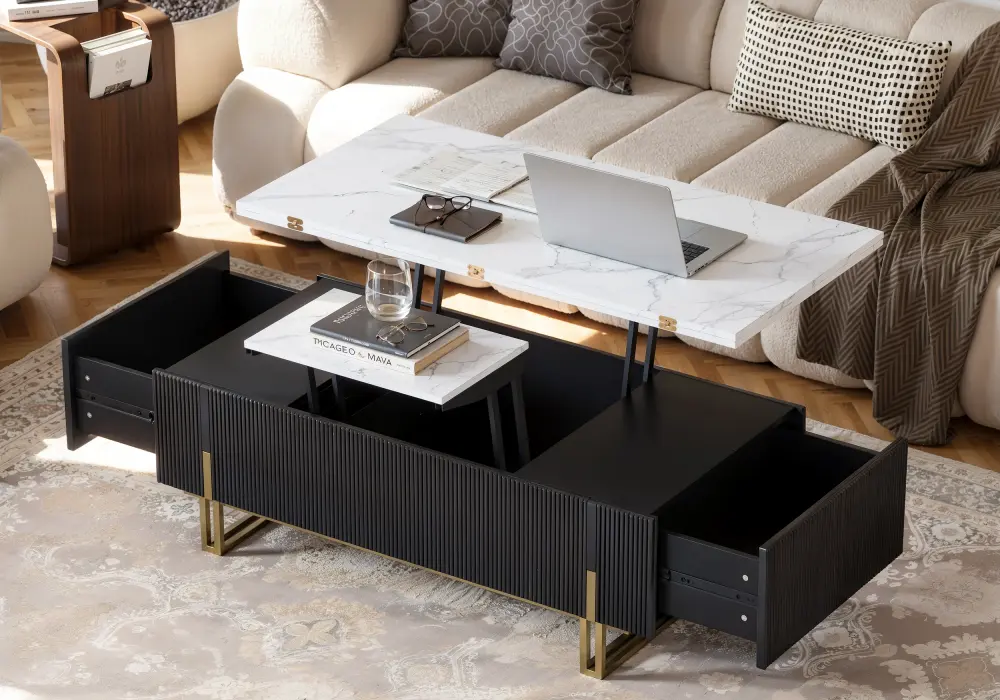
If the drawers become the permanent home for belongings that are currently scattered, it earns its place. If nearby cabinets already hold everything conveniently, skip the extra storage and save the floor space.
Compare access as well as capacity. A compartment used daily should be easy to reach without moving several objects or another chair. Storage that is awkward to use can leave the same belongings scattered on top, despite having more room inside.
A Simple Fixed Table May Be Enough
You do not need a transforming design when a consistent shared surface is the main requirement. A fixed table can support ordinary drinks, reading material, or conversation without introducing a setup routine for another mode.
For that, we like the oval travertine-top coffee table. At 43 by 20 by 15 inches, its long, slim top runs along a sofa without pushing deep into the walkway, and the beige stone-look top with double supports brings a calm, Japandi feel to the room.
Best for: long seating areas where you want one steady shared surface and an easy path around it.
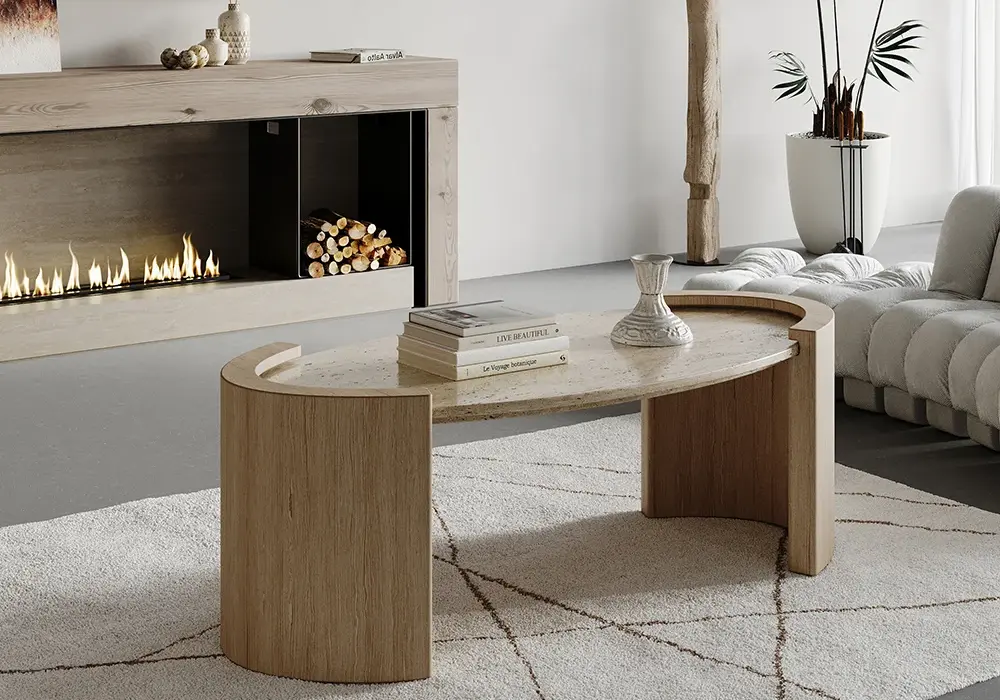
The 20-inch depth is the point of this table: it keeps a central surface within reach of the sofa while leaving the room's main routes open. Mark the full footprint on the floor to see how people approach the seats.
A hard, stone-look top suits a table that will hold drinks and meals every day. The value of a central surface includes how easily it can be kept ready for the next activity.
Test a Smaller Center Before Rejecting the Idea Entirely
Sometimes the issue is an oversized table rather than the presence of any table. A smaller piece can preserve a shared surface while returning space to circulation or another activity.
For tight rooms, the Aura round coffee table with a sintered-stone top is the one we would start with. At 28 inches across and 18 inches high, it is close enough to reach from nearby seats, and the round top and slatted ash-wood base keep the center soft and light.
Best for: compact living rooms that still want a shared surface in the middle.
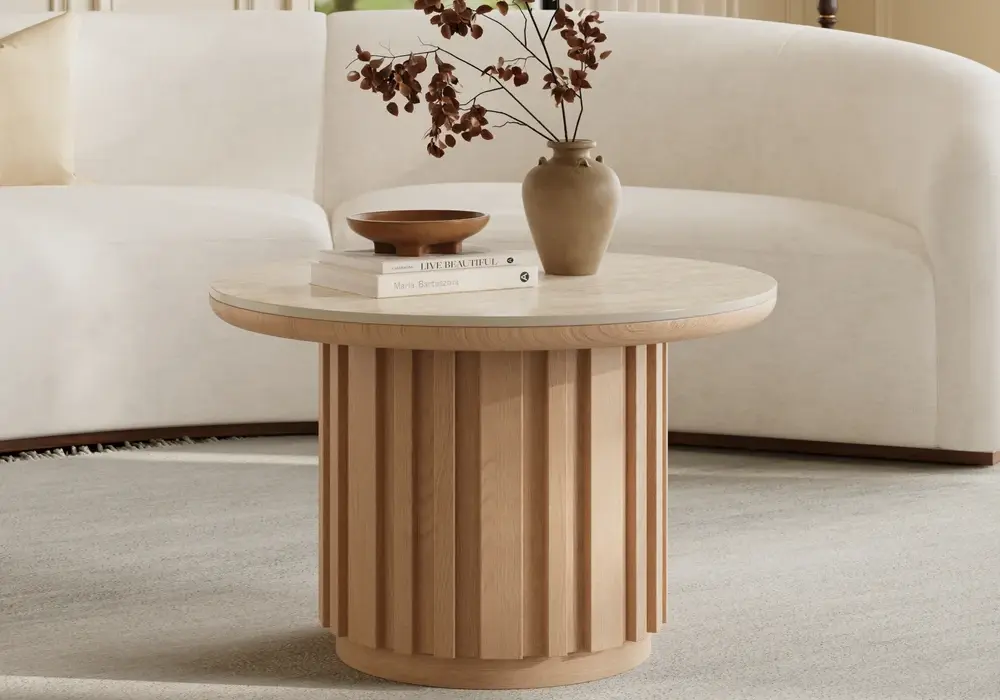
A round top gives you a softer approach around the furniture, though its base and diameter still occupy space. Compare it with a small rectangular outline and with an open-center arrangement; in a tight room, the round shape usually wins.
Avoid buying a very small table only to preserve a conventional appearance. If it is too distant for drinks and too small for the shared activity you want, it may become decoration that still needs to be walked around. The piece should perform a job proportional to the space it uses.
Compare the Alternatives Honestly
Arrangement | When it may suit the room | What to test |
One central coffee table | Shared snacks, games, or a common surface | Reach, circulation, and the complete footprint |
Side tables near regular seats | Individual drinks, books, and reading routines | Access from every frequently used seat |
A suitable movable surface | Occasional rather than continuous use | Ease of moving and a real storage location |
An upholstered ottoman | A separately needed upholstered piece | Intended use and whether another surface is still required |
An open center | Floor activities, clearer routes, or reclining | Where drinks and everyday objects will go instead |
An ottoman is great for extra seating or a footrest, but drinks still need a stable surface nearby.
A movable piece also needs a destination. If it repeatedly sits in a doorway when not in use, the plan has shifted the clutter rather than solved it. Include storage and handling in the comparison.
Make the Decision From the Trial Results
At the end of the test, identify the strongest recurring benefit and inconvenience. If the open center improves daily life and nearby surfaces handle essentials, you have a reasonable case for going without a coffee table.
If a shared surface is missed repeatedly, shortlist tables that provide that function within the measured area. If storage is the main issue, compare a storage table with other storage locations before deciding where the belongings should live.
Choose a reversible arrangement where possible. A room's uses can change, and the right answer now does not have to become a permanent rule for every future home. Keep the measurements and observations so later changes have a practical starting point.
Frequently Asked Questions
Does every living room need a coffee table?
No. It depends on the activities, available space, and other surfaces. A room with convenient side tables may work well with an open center. Another room may benefit from a shared place for snacks, games, and everyday objects.
Will a living room look unfinished without one?
Not necessarily. Seating orientation, a suitable rug, lighting, and repeated materials can create a coherent arrangement. Assess the room from several viewpoints and through normal use rather than assuming the central space must contain furniture.
Are side tables a complete replacement?
They can replace individual surfaces for drinks and reading, but may not replace a shared surface for games or serving. Test the needs of every regular seat and decide whether the remaining shared activities have a suitable location elsewhere.
Should I buy a storage coffee table for clutter?
Only after identifying the belongings and confirming that this is the best place for them. Check interior dimensions and access. More storage will help less if it is inconvenient to use or if unrelated items continue to collect on the surface.
What if I want a coffee table but the room is tight?
Compare a smaller footprint, another shape, or a different placement, using full-size outlines. Preserve the routes and operating space the seating needs. If no useful table fits comfortably, choose a nearby surface that handles the main task instead.