

If you are wondering do the backs come off of reclining sofas, the answer is: some do, but not all. Many reclining sofas are designed with removable backs that attach to the seat frame with brackets, clips, or locking levers. This can make a large sofa easier to move through a narrow doorway, hallway, stairwell, or elevator.
However, a reclining or adjustable backrest does not automatically mean the back is removable. The exact construction varies by model, so always check the sofa's model number and manufacturer instructions before attempting to remove any part.
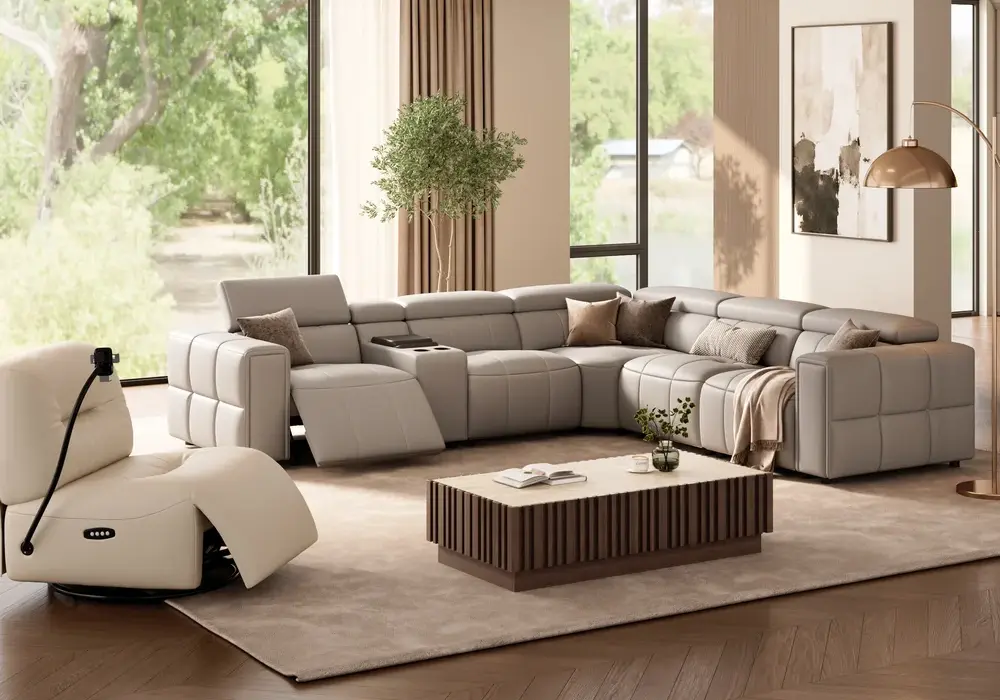
Genuine Leather Built-In Cooler Power Reclining Sofa
Table of Contents
Are Reclining Sofa Backs Removable?
Many reclining sofas have backs that are installed separately from the main seat frame. A removable back can make assembly easier and reduce the size of the sofa during delivery or relocation.
But there is no universal removal method. Some models use a simple bracket connection, while others use clips, levers, bolts, or other fixed hardware. Power reclining sofas may also have electrical connectors that need to be disconnected before an authorized separation.
It is helpful to distinguish three different features:
Feature | What it means | Does it prove the back is removable? |
Reclining backrest | Moves backward and forward during use | No |
Adjustable backrest | Can be positioned at different angles | No |
Removable back | Structural back section is designed to separate from the frame | Yes, when confirmed by the manufacturer |
The safest approach is to find the exact model or SKU and check its assembly or service instructions. Look for terms such as “back installation,” “back removal,” “locking bracket,” or “release lever.”
Why Reclining Sofa Backs Are Often Designed to Come Off
A removable back is particularly useful when a reclining sofa needs to be transported through a difficult route.
Narrow doorways
The back can add significant height to an assembled sofa. Removing it may reduce the overall bulk of the section and provide additional clearance through a doorway.
Tight hallway turns
Even when a sofa is narrow enough to enter a hallway, its depth and height can make a sharp turn difficult. A smaller transport configuration can give movers more room to rotate the furniture.
Stairs and elevators
Large reclining furniture can be difficult to maneuver on stairs or inside elevators. Separating documented removable components can make each piece easier to handle.
Shipping and assembly
Some manufacturers design backs to be attached after the main sofa frame has been positioned. This is useful for both packaging and in-home delivery.
A removable back does not necessarily solve every access problem. The arms, seat frame, reclining mechanism, or sofa depth may still be too large for the route.
For a sectional, also remember that removing a back is different from separating the sectional modules. A sofa may have removable backs while its individual sections still need to be disconnected for transport.
How to Tell If Your Reclining Sofa Back Is Removable
Before trying to lift, pull, pry, or unbolt anything, identify the exact sofa and find its documentation.
Find the model number
Look for a product label underneath the sofa, behind the seating area, or in your original purchase documents.
Do not rely only on the sofa's appearance. Two similar reclining sofas can use completely different attachment systems.
Check the assembly manual
The manufacturer's manual is the most reliable source for determining whether the back is designed to come off.
Search the documentation for:
- Back installation
- Back removal
- Locking bracket
- Release lever
- Assembly hardware
- Electrical connection
If the manual does not describe back removal, do not assume that visible hardware is intended to be removed.
Inspect where the back meets the frame
On many removable-back designs, the connection is located near the bottom of the backrest where it meets the seat frame.
You may see a metal bracket, clip, lever, or another locking mechanism. In some models, upholstery can partially cover the attachment point.
A visible seam is not proof of a removable back. Upholstery seams and structural joints can look similar.
Identify the attachment system
Once you know what the manufacturer's instructions call for, compare that description with the sofa in front of you.
Attachment type | General appearance | Important consideration |
Hook-and-bracket | Back slides or hooks onto a metal bracket | Usually requires the specified lifting or sliding motion |
Locking clip | Clip or catch holds the back to the frame | Should be released according to the instructions |
Locking lever | Lever or locking arm secures the back | Release direction and sequence can vary |
Bolted or fixed connection | Hardware permanently secures the structure | Do not assume removing bolts is manufacturer-approved |
These are common construction approaches, not a universal guide for every reclining sofa.
Check for power connections
Power reclining sofas require additional care. A sofa can have a removable structural back while still having electrical cables or connectors that must remain connected until the manufacturer-authorized separation procedure is followed.
Unplug the sofa before any approved disassembly. Never pull two sofa sections apart against connected wiring.
During reassembly, route cables as directed so they cannot be pinched by the reclining mechanism.
Stop when the mechanism is unclear
If you cannot identify the release point, do not force the back.
Pulling on the upholstery, twisting the frame, or prying against a bracket can damage the sofa. A generic online video may help you recognize a type of mechanism, but it should not replace instructions for the exact model.
Common Recliner Back Attachment Types
Understanding the basic types of connections can help you recognize what you are looking at without assuming that every sofa uses the same system.
Hook-and-bracket systems
A hook-and-bracket system allows the back to slide onto a bracket attached to the seat frame. Once correctly seated, the back is held in place by the bracket and locking mechanism.
This type of construction is common enough that it is worth checking the rear connection when the manufacturer's instructions indicate a removable back.
Locking clips
Some models use clips or catches to secure the back. These may be located behind upholstery or near the lower edge of the back.
The clip should be released in the manner specified for that model. Do not force a clip open with a tool simply because it appears accessible.
Locking levers
A locking lever or arm may hold the back securely against the frame. The sofa's instructions should show how the lever is positioned for removal and how it must be reset during installation.
Bolted or fixed backs
Some reclining sofas use bolts or other permanent structural connections. A back that appears removable because you can see hardware is not necessarily designed for routine disassembly.
When moving a sofa, use only documented removal points.
How to Measure a Reclining Sofa for Moving
Even when a reclining sofa has a removable back, measure the route before moving day.
Start with the sofa's assembled dimensions:
- Width
- Depth
- Height
Then measure the route from the delivery entrance to the final room.
What to measure | Why it matters |
Doorway opening | Determines the usable entrance clearance |
Hallway width | Determines whether the sofa can move straight or at an angle |
Corner or turn | Often limits the furniture's effective depth |
Stair landing | Can determine whether the sofa can be rotated |
Elevator door and interior | Both entry clearance and maneuvering space matter |
Measure the narrowest usable point, not simply the advertised door size. Door trim, handles, railings, and other obstacles can reduce the actual clearance.
Removing the back may reduce only one dimension
A removable back can lower the transport height or reduce bulk, but it does not necessarily make the sofa narrower.
For example, a reclining sofa may fit through a doorway in terms of width but be too tall to maneuver upright. Removing the back could address that height limitation. If the problem is a tight hallway corner, however, the sofa's depth or arm width may still be the limiting measurement.
Measure sectional modules separately
For a reclining sectional, measure both the assembled configuration and each individual module that can be separated according to the manufacturer's instructions.
This matters for products such as the Homary two-piece reclining sectional, where the sectional configuration itself is a separate consideration from whether an individual reclining back can be removed.
Think about the entire route
A sofa that fits through the front door may still fail at:
- A 90-degree hallway turn
- A narrow stair landing
- A low ceiling
- An elevator entrance
- An interior doorway
If clearance is close, send the delivery or moving team photographs and measurements before moving day. Ask whether the sofa should be carried in separate modules and whether professional assembly or disassembly is recommended.
Questions to Ask Before Buying a Reclining Sofa
If you are buying a new reclining sofa, access should be part of the decision before delivery.
Ask the seller or manufacturer for the:
- Assembled dimensions
- Carton dimensions
- Dimensions of individual modules
- Model or SKU number
- Assembly manual
- Recommended disassembly procedure
- Weight of each transportable section
Do not assume that “some assembly required” means the sofa can later be taken apart for moving.
The distinction matters for different types of sofas. For example, a Homary convertible sleeper sofa may have a mechanism that converts the seating area into a bed, but that movement does not tell you whether its structural back is removable.
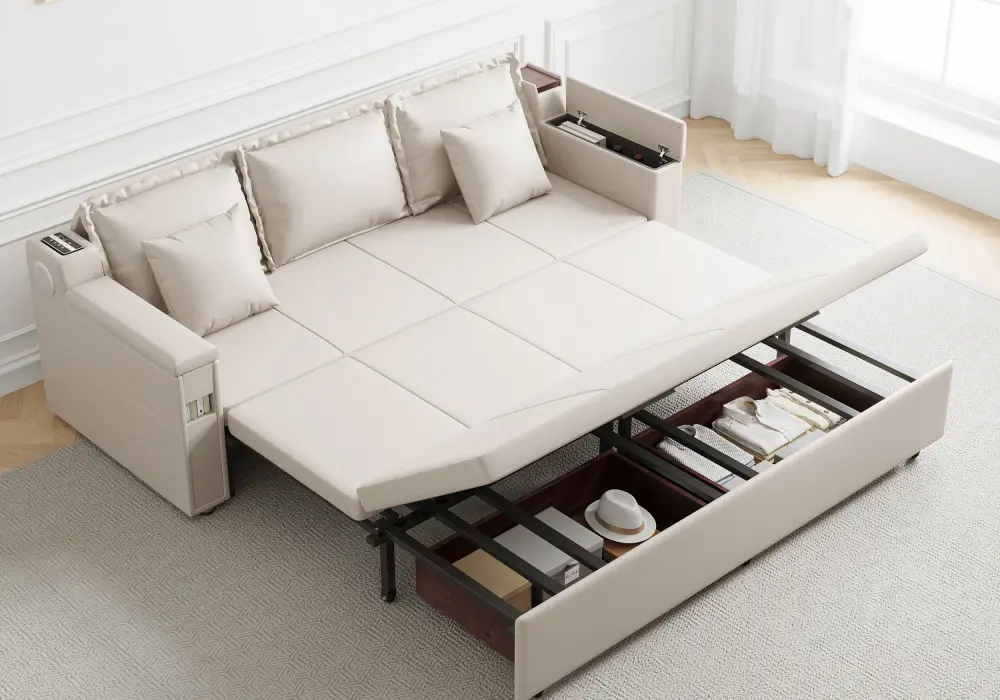
Likewise, an adjustable Homary three-seater sofa may allow the backrest to change position without being designed for structural removal. Always treat adjustability, reclining, and removability as separate features.
Think beyond the first delivery. A sofa may eventually need to be moved for cleaning, flooring work, remodeling, or a future relocation. A little extra attention to transport dimensions and documented disassembly options can make those situations easier.

Frequently Asked Questions
Can I take the back off any reclining sofa?
No. Some models have removable backs, while others use fixed construction. Check the exact model's assembly or service instructions before attempting removal.
Does an adjustable backrest mean the back is removable?
No. An adjustable backrest changes position during use. A removable back is a structural component designed to separate from the frame.
Will removing the back make a reclining sofa fit through a doorway?
It may. Removing a back can reduce the height or bulk of a sofa section, but the arms, seat frame, depth, and hallway turns can still limit access.
How do I know whether my sofa uses a bracket or clip?
Check the manufacturer's documentation first, then inspect the connection where the back meets the frame. Do not force or pry a mechanism that you cannot identify.
What should I do before moving a power reclining sofa?
Unplug the sofa before any manufacturer-authorized disassembly. Check the instructions for electrical connectors and avoid pulling sections apart while cables may still be attached.
Can I remove the back myself?
Only when the manufacturer provides a removal procedure for that model and you can follow it safely. Avoid relying solely on a generic video or a similar-looking sofa.
How do I secure the back after reassembly?
Follow the original installation procedure and verify every specified bracket, locking mechanism, and connector. Before normal use, check for unexpected movement. If the back does not seat or lock as described, do not use the sofa until the problem is resolved.