

Choosing dining room tables for small spaces is less about finding the smallest table and more about finding the right balance between seating, comfort, circulation, and style. A table that looks compact online can quickly make an apartment dining nook feel crowded once chairs are pulled out.
The right combination of measurements, table shape, flexible features, and compact seating can make a small dining area feel intentional rather than cramped. Whether you need a table for two every day or occasionally host four to six people, the key is choosing a design that matches the way your room is actually used.
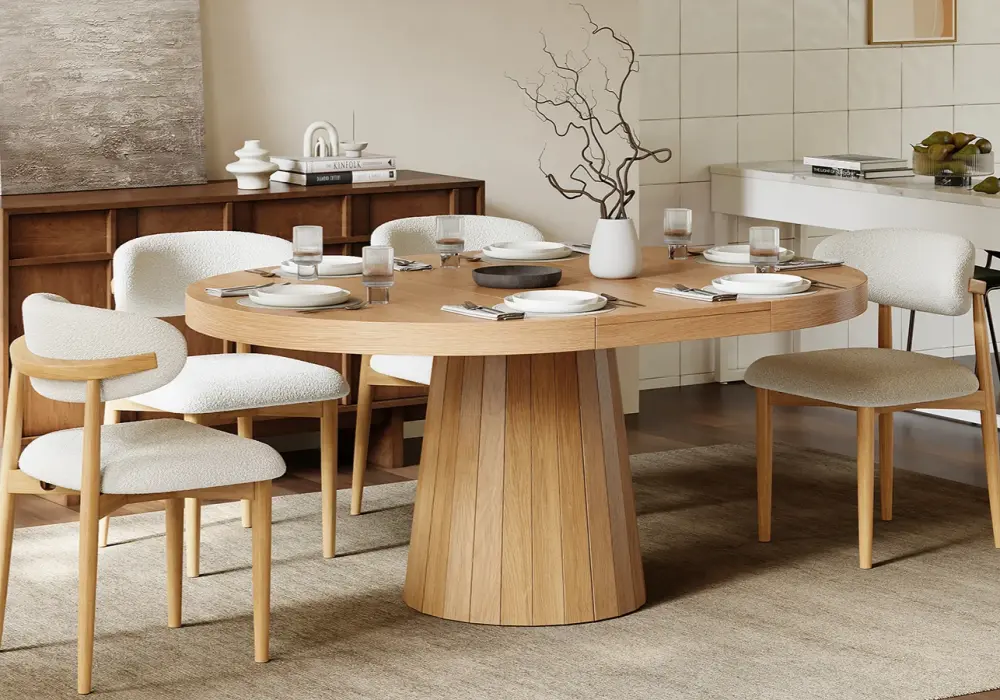
Source Homary
Table of Contents
How to Measure a Small Dining Room: Clearance, Seat Counts, and Layout Rules
Before choosing a table, measure the usable dining area, rather than simply looking at the overall room dimensions. Include walls, kitchen cabinets, door swings, windows, curtains, radiators, and other fixed features that may affect movement.
As a practical planning guideline, aim for about 914 mm of clearance between the table edge and a wall, cabinet, or major walkway whenever possible. This gives diners room to pull out chairs and move through the space without constantly bumping into furniture.
A simple way to estimate your maximum table size is:
Available table width = room width − clearance on both sides
For example, in a 10-foot-wide dining area, allowing about 914 mm of circulation on each side leaves roughly 1219 mm for the table. In a particularly narrow room, a table around 610 mm to 762 mm deep may be a better fit.
What Table Size Works for Two or Four People?
Table size | Typical shape | Approx. seating | Best use |
762–914 mm | Round | 2 | Tiny breakfast nook |
914–1067 mm | Round | 2–4 | Small apartment dining area |
610–762 mm W × 1219–1524 mm L | Rectangular | 2–4 | Narrow dining room |
914–1067 mm W × 1219–1524 mm L | Oval | 4 | Compact family dining |
610–762 mm W × 1219–1829 mm L | Counter-height | 2–4 | Open-plan kitchen |
Keep in mind that seating capacity depends on more than tabletop dimensions. Chair width, leg placement, apron depth, and the amount of room available behind each seat all affect comfort.
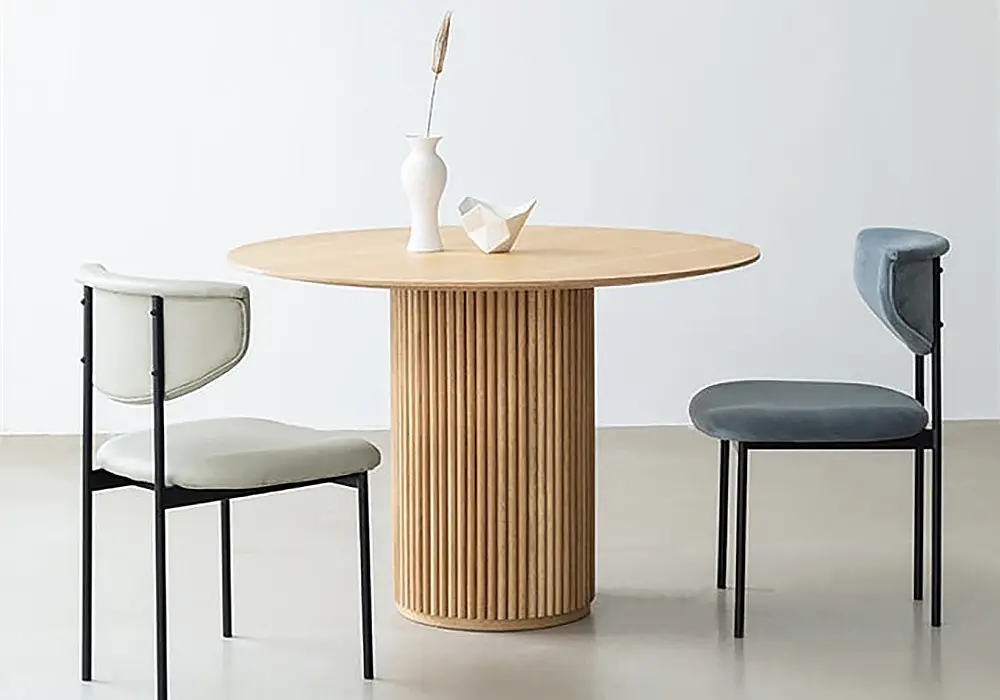
For instance, a 991 mm round pedestal table can be a practical benchmark for a small dining area because the circular shape avoids corners and a pedestal base leaves more flexibility for chair placement. A good real-world example is Homary's 991 mm Round Natural Wood Dining Table, which is designed for two to four diners and uses a pedestal base to reduce leg interference.
Source Homary
If one side of the table must sit close to a wall, also consider how diners will actually enter and leave their seats. A bench can be easier to use in this situation because it does not need to be pulled straight backward like a conventional chair.
Which Space-Saving Dining Table Shapes Make a Small Room Feel Bigger?
Table shape has a major influence on how crowded a small room feels. Sharp corners and bulky bases can interrupt walkways, while rounded edges and slimmer profiles often make circulation feel easier.
Are Round Dining Tables Good for Small Spaces?
A 914 mm to 1067 mm round dining table is one of the most versatile choices for a compact dining area. Without corners, it is easier to walk around, and a round tabletop can create a more flexible arrangement for two to four people.
A central pedestal base can make the layout even more efficient because chairs do not have to work around four separate legs. This is particularly useful when the table is also positioned close to a kitchen or living-room walkway.
Narrow Rectangular and Oval Dining Tables for Tight Rooms
For a long, narrow room, a 610 mm to 762 mm wide rectangular table can be more efficient than a traditional broad dining table. A 1219 mm to 1524 mm length can provide seating for two to four people while preserving a useful walkway.
Oval tables can provide a similar footprint while eliminating sharp corners. This can be useful when the dining table sits between a kitchen and living area, where people frequently walk around both ends.
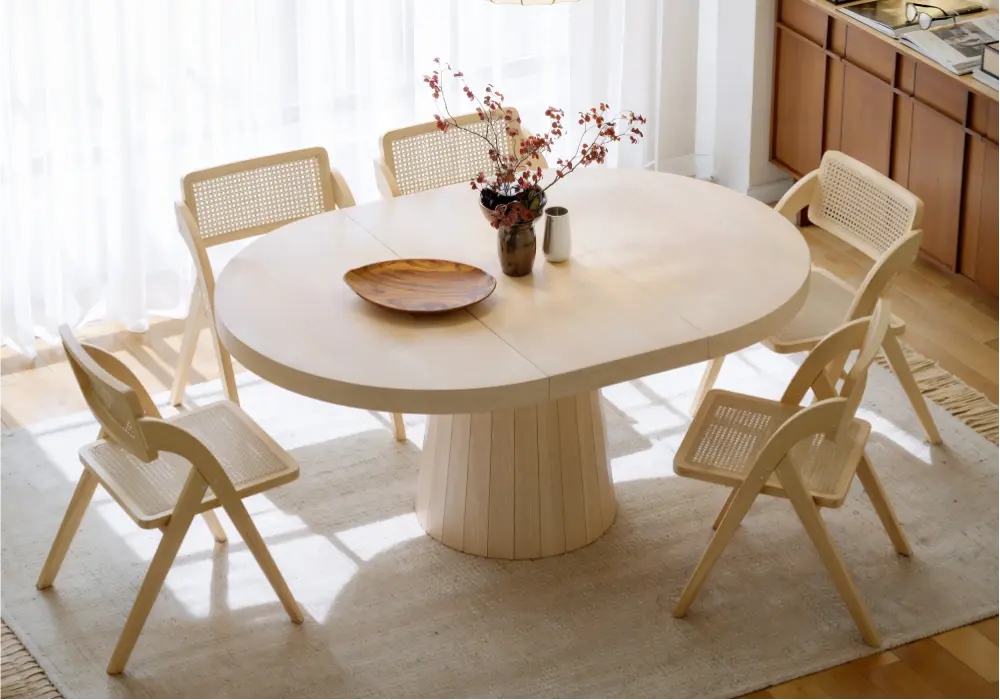
For example, an extendable round-to-oval design such as Homary's 991 mm–1397 mm Extendable Round-to-Oval Dining Table illustrates how a table can remain relatively compact for everyday use and then expand when additional seating is needed. The design is listed as seating four to six, uses a pedestal base, and is made from solid wood.
Source Homary
Can Glass, Acrylic, or Light-Colored Tables Make a Room Look Larger?
Yes. Transparent materials and pale finishes can reduce the visual weight of furniture. Because more of the floor and surrounding space remains visible, the room may feel more open even when the actual floor area has not changed.
Glass can be particularly effective in modern apartments, but households with young children should look for tempered safety glass, rounded edges, and a stable base. Glass also shows fingerprints, crumbs, and water marks more easily than many wood finishes, so cleaning may be more frequent.
Should You Choose a Drop-Leaf, Fold-Down, Extendable, or Storage Combo Table?
When floor space is limited, a table that changes size can provide more flexibility than a permanently compact design. The right mechanism depends on whether you need maximum floor space every day or extra dining capacity only occasionally.
Drop-Leaf Dining Tables for Everyday Flexibility
A drop-leaf table has hinged sections that fold down when they are not needed. Depending on the design, a compact table may be only 457 mm to 610 mm deep when folded and become substantially wider when one or both leaves are raised.
This makes drop-leaf furniture useful for one or two people on ordinary days while allowing extra seating during meals with guests.
Wall-Mounted Fold-Down Tables for Tiny Apartments
Wall-mounted tables can provide an extremely small footprint. When folded up, the surface occupies very little floor space; when lowered, it becomes a usable dining or work surface.
The biggest consideration is installation. Renters should check whether drilling is allowed and whether the mounting system needs to connect to wall studs or another suitable structural support. Adhesive mounting solutions should not automatically be treated as substitutes for structural hardware on a heavy dining table.
Extendable Dining Tables for Occasional Guests
Extendable tables are especially useful when you normally need seating for two or four but occasionally host larger meals.
One compact strategy is a round-to-oval table: the smaller round configuration keeps the everyday footprint efficient, while the extended oval shape provides more seating without introducing a completely different piece of furniture.
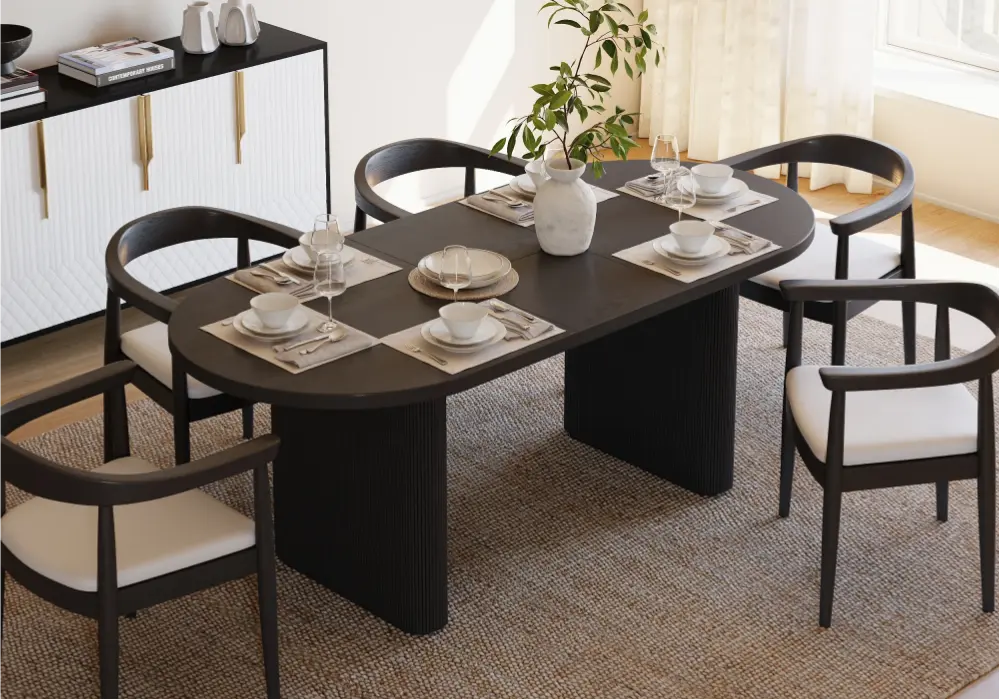
Another approach is a conventional long oval table that expands from a compact everyday size to a larger entertaining surface. For example, the Homary 1600 mm–2007 mm Extendable Oval Black Dining Table is listed for four to six people and uses a double-pedestal design intended to improve legroom. Its Japandi-inspired black finish can also work well when a small dining area needs a stronger visual anchor.
Source Homary
The important point is to measure the table both closed and fully extended. A common mistake is confirming that the compact configuration fits, only to discover that the extended version blocks a doorway or walkway.
Storage Combo and Multi-Function Dining Tables
Tables with drawers, shelving, or built-in storage can replace some of the functions of a sideboard or cabinet, which is useful when floor space is limited.
A narrow console that converts into a dining table can also serve multiple purposes in a small apartment. Likewise, a folding outdoor table can make a balcony usable for meals without creating a permanent furniture footprint.
Table mechanism | Everyday footprint | Expanded footprint | Best for |
Drop-leaf | Very compact | Medium | 1–4 people |
Wall-mounted | Minimal | Medium | Tiny apartments |
Extendable | Small/medium | Large | 2–6+ guests |
Storage combo | Medium | Medium | Dining + storage |
Folding outdoor table | Minimal | Small/medium | Balconies |
When shopping for a folding or extendable table, inspect the hinges, runners, support arms, locking hardware, and base construction. These components receive more stress than a fixed tabletop.
Which Materials, Budgets, and Assembly Options Hold Up for Small-Space Dining Tables?
A small dining table still needs to withstand spills, chair movement, daily meals, and repeated adjustments if it has a folding or extension mechanism.
Comparing Dining Table Materials for Small Spaces
Material | Durability | Water resistance | Weight | Best feature |
Solid wood | High | Good with finish | Heavy | Long-term durability |
Engineered wood | Moderate–high | Finish dependent | Medium | Value and lighter weight |
Glass | Moderate | High | Medium–heavy | Visual lightness |
Metal | High | High | Medium–heavy | Strength and modern style |
Engineered stone | Very high | High | Very heavy | Excellent surface durability |
Solid wood is an attractive choice if stability and longevity are priorities. However, heavier construction can make moving the furniture more difficult in a rental.
Engineered wood may offer better value and easier handling, although very inexpensive boards can be more vulnerable around screws, hinges, and frequently used extension mechanisms.
Glass creates visual openness but can be heavy despite its appearance.
Metal can be durable and relatively visually slim, making it useful in modern or industrial interiors.
Stone or engineered-stone tops offer excellent durability but can be difficult to move and may not be ideal for renters who rearrange frequently.
Does Assembly Matter When Buying a Small Dining Table Online?
Yes. A low-priced table may not be a good deal if its assembly is unusually difficult or its hardware becomes loose after repeated use.
For a busy household or first-time furniture buyer, look for:
- Clearly labeled components
- Easy-to-follow assembly instructions
- Pre-installed hinges where appropriate
- Tool-free or minimal-tool setup
- Adjustable feet
- Secure extension locks
- A package size and weight that can be handled in your building
For renters or people who move frequently, choosing a lighter table can be more practical than selecting a very heavy design simply because the tabletop looks premium.
How Do You Arrange a Small Dining Area with Benches, Banquettes, and Compact Tables?
The table is only half the solution. Seating can determine whether a compact dining area feels comfortable or congested.
Pair a 610 mm Wide Table With a Bench
A 610 mm wide dining table can work especially well against a wall when paired with a bench. Instead of pulling a chair backward on the wall side, diners can slide onto the bench.
A table around 610 mm to 762 mm deep combined with a bench approximately 406 mm to 508 mm deep can create a compact two- to four-person dining arrangement.
Turn an Unused Corner Into a Banquette
A corner banquette can transform a dead corner into a defined dining area. It can seat several people while using less pull-back space than individual chairs.
The trade-off is flexibility. A fixed banquette is efficient when the corner will always be used for dining, but less practical if you regularly rearrange the room.
Use a Narrow Table Behind a Sofa
In an open-plan apartment, a narrow dining table can double as a spatial divider between the living and dining areas. A surface around 610 mm to 762 mm deep may be enough for comfortable dining without consuming too much floor area.
Keep enough distance between the table, sofa, and main walkway so people can move through the room without squeezing between furniture.
Create a Small Dining Zone Without Building a Wall
A studio does not need a permanent partition to have a defined dining space. A compact table, rug, pendant light, open shelf, or slim cabinet can visually separate the dining zone from the living area.
This is particularly useful for renters. Instead of drilling into walls, use freestanding furniture combinations that can be moved when the room layout changes.
Use Scandinavian and Farmhouse Style Without Adding Visual Bulk
Scandinavian-inspired dining furniture often works well in small spaces because slim legs, pale finishes, and uncluttered shapes reduce visual weight.
Farmhouse style can also work, but a large chunky tabletop can dominate a compact room. A smaller pedestal table can preserve the warmth of farmhouse-inspired design without the visual bulk.
A Simple Buying Checklist for Small-Space Dining Tables
Before ordering a dining table, check these four areas:
- Space: Measure the room, doors, walkways, and chair clearance. Aim for around 914 mm of circulation where practical.
- Table mechanism: Decide whether a fixed, drop-leaf, fold-down, or extendable design matches your lifestyle.
- Material and budget: Consider durability, cleaning, weight, and long-term use rather than choosing by appearance alone.
- Seating: Measure chairs, benches, or banquettes together with the table.
The most suitable dining room table for a small space is not necessarily the smallest one. It is the table that works comfortably when the room is actually being used.
For everyday dining, a compact 991 mm round pedestal table can be enough for two to four. When you occasionally host more people, an extendable round-to-oval design can provide additional capacity without requiring a permanently large tabletop. And in a longer, more contemporary dining zone, an extendable black oval design can combine a flexible footprint with a stronger visual style.
Before purchasing, compare the table's closed dimensions, extended dimensions, seating capacity, base design, and required chair clearance. That simple checklist can prevent most small-space dining mistakes.
FAQ: Dining Room Tables for Small Spaces
What is the best dining table shape for a small space?
Round tables are often one of the best options because they eliminate corners and allow easier movement around the table. A 914 mm to 1067 mm round table can work well for two to four people, depending on chair size and available clearance.
How much clearance do I need around a dining table in a small room?
Aim for approximately 914 mm between the table edge and walls, cabinets, or important walkways. Areas around frequently used doors may benefit from additional space.
What size table can seat two or four people without overwhelming a small dining area?
For two people, a 762 mm to 914 mm round table can be sufficient. For four people, a 914 mm to 1067 mm round table or a 610 mm to 762 mm wide rectangular or oval table around 1219 mm to 1524 mm long can work well.
Are drop-leaf or wall-mounted fold-down tables better for tiny apartments than regular tables?
They can be, especially when floor space is needed for other activities. Drop-leaf models are more flexible for renters because they remain freestanding, while wall-mounted models can have a smaller footprint but may require permanent installation.
How can I make a small dining area look bigger with glass, round, or light-colored tables?
Choose transparent surfaces, pale wood, light finishes, slim bases, and rounded silhouettes. These features can reduce visual bulk and allow more of the surrounding floor to remain visible.
Should I use benches, chairs, or a corner banquette in a small dining nook?
Benches and banquettes are often space-efficient because they can sit closer to a wall. Chairs are more flexible and easier to move, while a corner banquette can maximize seating in a dedicated dining nook.
What materials and budget should I choose for a durable small-space dining table?
Solid wood is a strong long-term choice, while engineered wood can provide better value and easier handling. Glass and metal are useful when visual lightness or modern styling is important. For extendable furniture, always consider hardware quality as well as the tabletop material.