

Clever dining tables for small spaces solve a specific problem: they fit everyday meals, keep the route through the room open, or stretch when guests arrive. Start by comparing dining tables on closed footprint and comfortable seating, and look at maximum capacity last. In a narrow room, a slim fixed table often beats a larger extendable one. In a square nook, a round top that grows into an oval can do both jobs.
The best features change how you live in the room. A self-storing leaf removes the need to hide a spare panel in a closet. A round-to-oval top gives a square nook its everyday circle and its weekend length. A slim oval follows a narrow room instead of fighting it. None of these adds floor area, but each one makes the area you have work harder.
Table of Contents
Identify the space problem you want to solve
Start by writing down what bothers you about the current setup. Maybe chairs block the kitchen route, the table is too deep for the room, or guests end up eating from their laps. A precise problem gives you a much stronger shortlist than a search for a "compact" or "space-saving" table.
Measure the room the way you use it. Include doors, sideboards, radiators, and anything that stays put. Then set a real chair where you plan to sit, pull it out, and stand up. The gap between a tucked chair and an occupied one is part of the table's true footprint. A good target is at least 36 inches (914 mm) between the table edge and the nearest wall or furniture, which lets people sit down and move around without a squeeze. The National Kitchen & Bath Association's planning guidelines set the minimum at 32 inches (813 mm) where nobody walks behind the chairs (36 inches (914 mm) for accessible layouts) and at least 44 inches (1118 mm) where people do, and Room & Board also recommends at least 36 inches (914 mm) behind chairs.
Next, decide how often you host. If guests come twice a year, a fixed table plus a couple of folding chairs may be all you need. If they come every week, choose a table whose extension is quick and built in. Match the feature to the routine you actually have, and the table will feel easy from the first week.
Compare clever features by the work they save
Feature or format | Problem it solves | Best for |
Round-to-oval extension | Gives you a compact everyday circle and a longer oval for guests | Square nooks and open-plan corners |
Narrow oval top | Fits a tight depth in a long dining area | Galley kitchens and narrow rooms |
Self-storing leaves | Removes the need to store a separate panel | Homes that host now and then |
Pedestal or double pedestal | Clears corner legs so chairs can go anywhere | Households that seat guests at both ends |
Fixed footprint | Needs no setup for daily meals | Everyday dining with steady numbers |
Each of these answers one question well. A pedestal base opens up the corners and leaves a clean edge for chairs. A self-storing leaf takes one storage chore off your list. A fixed oval gives you a table that is always ready. Pick the feature that matches your biggest daily frustration, and the table will feel clever every time you use it.
Use round-to-oval extension in a balanced nook
The 47–79-inch (1194–2007 mm) black extendable dining table with a fluted base is made for the dining corner that is close to square. Closed, it is a round table of about 47.2 inches (1199 mm), just under 29.9 inches (759 mm) high. That is a comfortable fit for a window nook or the end of an open-plan living room. On a weeknight it gives two or three people plenty of room for plates and a shared dish in the middle, and with no corners to squeeze past, everyone can slide in and out easily.
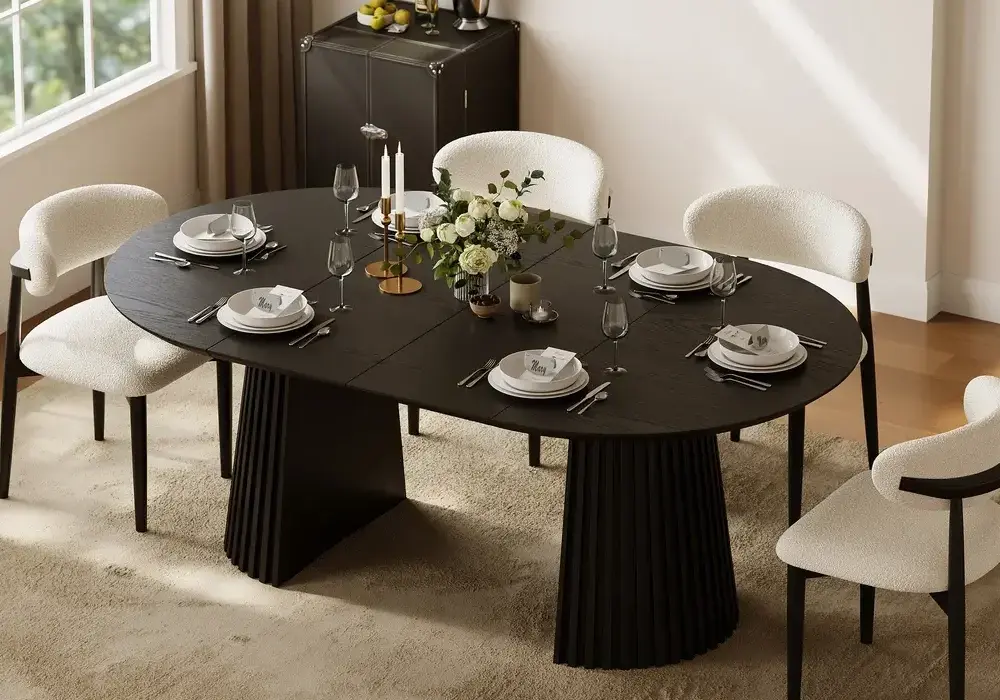
When family or friends come for the weekend, the top opens from a circle into an oval of up to 79 inches (2007 mm). The extra length goes to the two ends, so the table stretches along the room instead of pushing outward on every side. Listed for four to six people, it covers a birthday dinner or a long Sunday lunch without borrowing a second table.
The fluted pedestal base keeps the edge free of corner legs, so chairs can go wherever the conversation needs them. The listing describes solid wood construction with an oak veneer, a sturdy build for everyday meals, homework, and hosting alike. If your dining zone is roughly square and you want one table for both the quiet week and the busy weekend, this is the one to start with.
Choose a slim oval for long, narrow dining areas
The 55.1-inch (1400 mm) white sintered stone dining table with a three-leg base measures 55.1 inches (1400 mm) by 29.5 inches (749 mm). That slim oval suits a dining area that runs long and narrow, such as the far end of a galley kitchen or a strip of floor beside the living room. The shallow depth leaves a clear walkway along one side, and the listing says it seats up to six for family meals.
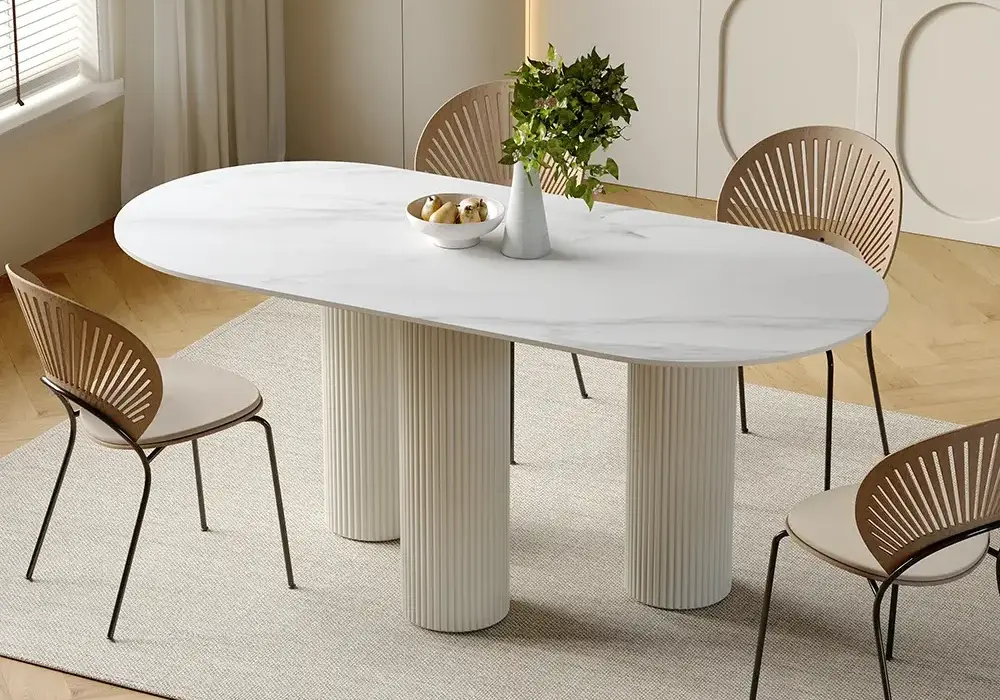
The surface is where it earns its place in a busy household. The sintered stone top is waterproof, scratch-resistant, and easy to clean, so breakfast spills, school projects, and hot mugs can all be wiped away at the end of the day. The rounded corners of the oval are also kinder to children running past, a small reassurance in a room that doubles as a play route.
Because the size is fixed, there is nothing to set up. The table looks the same on a Tuesday as at a family dinner, which suits a household that eats at the table every day. The ribbed three-leg base adds a sculptural touch, so the table works as a design feature as well as a place to eat.
Use self-storing extension to simplify occasional hosting
The 55–87-inch (1397–2210 mm) extendable whitewash dining table with a double pedestal is a rectangular table with a 32-inch (813 mm) depth, designed for homes that eat quietly most days and entertain now and then. At 55 inches (1397 mm) it fits a family of four for everyday dinners. Its straight lines sit neatly along a wall or run lengthwise down a narrow room, so the layout stays tidy.
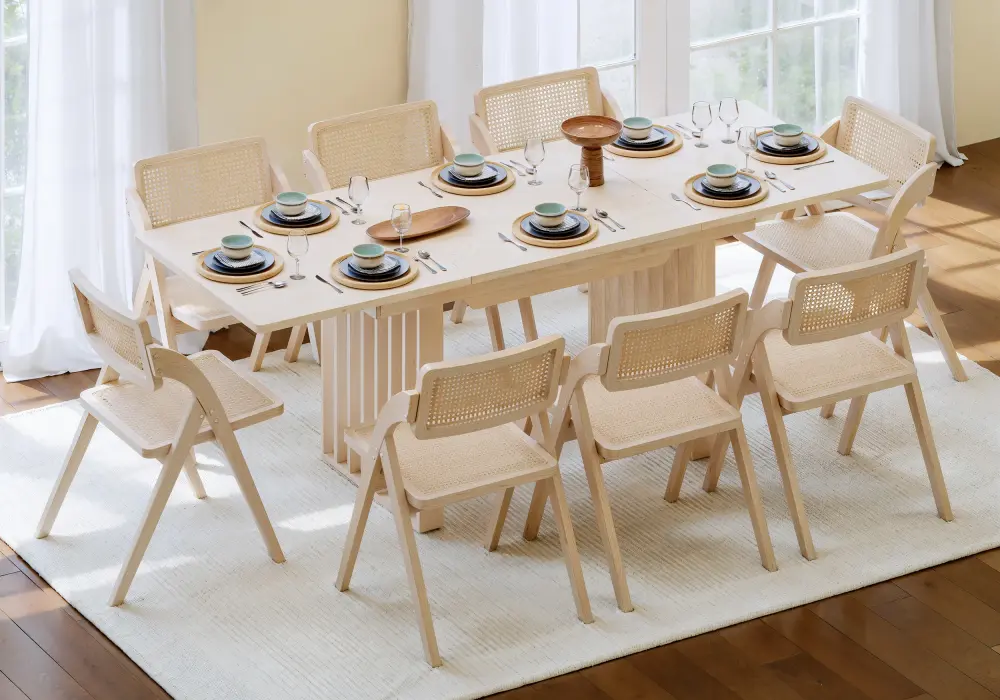
When guests arrive, the top extends to 87 inches (2210 mm), enough for a holiday meal or a dinner party of up to eight. The leaf is self-storing, so there is no separate panel to find room for in a closet. You open the table when you need it and close it afterwards, and the dining area goes back to its everyday size.
The double pedestal base places the supports toward the ends, which leaves legroom along the sides. Guests can sit comfortably down the length of the table without working around corner legs. The engineered wood with oak veneer gives a stable, durable top, and the Japandi styling, with clean lines and natural texture, keeps the room calm whether the table is set for two or for eight.
How to choose among the three
Choose the black round-to-oval table if your dining zone is close to square and you want one table for weeknights and weekends. Choose the white stone oval if your room is long and narrow and you eat at the table every day. Choose the whitewash double-pedestal table if you host regularly and want the extra length built in. Whichever you pick, the closed footprint is the number you will live with most, so let it lead the decision.
Make chairs part of the clever solution
Chairs shape how well a table works. Allow about 24 inches (610 mm) of table edge for each diner, the width the NKBA guidelines use for seating, and pick chairs whose width and depth suit that spacing. A slim armless chair tucks in neatly and frees floor space, while a broad upholstered seat feels generous and suits a roomier nook. Both are good choices when they match the table and the room.
Check that your chairs slide fully beneath the top without catching an apron or a pedestal. With a pedestal base, the clear edge lets chairs tuck in from any side, and that is one of the quiet advantages of these designs. Sit in the end seats as well as the side seats so you know every position is comfortable before guests arrive.
Plan where spare chairs live. Folding chairs can stand in a hallway closet, and stackable chairs can wait in a corner. When the extra seating has a home and the path to the table is short, hosting takes minutes rather than a rearrangement of the whole room.
Test two layouts with the same measurement method
Cut out full-size paper or tape outlines for the two tables you like best, then place chairs around each one with people seated in them. Use the same method for both so the comparison is fair. Mark the main route through the room and walk it while someone sits at the table. The layout that leaves the easier walk is usually the winner.
Include the table's second jobs. Laptop work, homework, and crafts all need real surface area and a comfortable edge. A good dining table handles these tasks between meals, so check that the top gives you room for a laptop and a mug without crowding the place settings.
Keep chairs out of the kitchen work aisle. A table that seats your regular household comfortably and stretches for guests will serve you better than a larger one that makes every trip to the stove a detour.
Care, delivery, and final checks
Care is simple once you know your finish. A sintered stone top wipes clean with a damp cloth. Wood and veneer surfaces like a soft cloth and a coaster under hot dishes. Follow the care notes that come with your table, and it will look good for years.
Before you order, measure the delivery path. Check doorways, stair turns, and hallway corners against the packaged dimensions on the product page. Plan for two people to carry the tabletop and base, and follow the assembly sheet for each step, especially for extension mechanisms. A little preparation on delivery day makes setup quick and keeps your floors and walls safe.
Finally, compare the closed footprint, the chairs you own, and your walking route one more time. When all three line up, you have found a table that earns its place.
Frequently Asked Questions
What makes a dining table clever for a small space?
A clever table solves your room's actual constraint. That could be a narrow fixed top that leaves a walkway, a compact everyday size that grows for guests, or leaves that store inside the table. The best designs save effort every day, which is why the feature should match how you live.
Is an extendable table always the best choice?
Not always. A fixed table is the simplest option when your household stays the same size and guests are rare. An extendable table shines when you host regularly and both sizes fit the room. Choose based on how often you need the extra length.
Are round tables better in narrow rooms?
Round tables work best in nooks and near-square spaces, where they remove corners and make seating flexible. In a long, narrow room, a slim oval or a rectangle follows the shape of the space and keeps the walkway open. Match the table's shape to the shape of the room.
Does a self-storing leaf remove all storage needs?
It removes the biggest one: you no longer need a spot for a separate panel. Extra chairs and serving pieces still need a home, so plan a closet or corner for them. With that sorted, hosting becomes a quick open-and-set routine.
How should I compare seating capacities?
Start with the listed capacity, then check it against your chairs and the roughly 24 inches (610 mm) of edge each diner needs. Plan everyday meals around the closed size and guest meals around the extended size. A table that seats your regular household comfortably will always serve you better than one with a bigger number on the label.