

Choose a Christmas table centerpiece by checking the table shape, place settings, sightlines, and serving space before selecting decorative objects. Start with dining tables that suit your room, then build a centerpiece that occupies only the surface you can comfortably spare. Low, removable arrangements are useful for many meals because they can adapt as dishes arrive. A successful focal point should help the table feel considered while leaving guests free to eat, talk, and pass food.
Table of Contents
Measure the useful space at the center
Lay out the table for the number of people you expect. Include plates, utensils, glasses, and the serving pieces that will remain on the table. The space left afterward is a better guide than the empty tabletop. A centerpiece that fills a beautiful empty surface may be impractical once dinner starts.
Look at the center from the seats, not only from above. Check whether guests can see one another and reach shared dishes. Keep the arrangement inside a footprint that does not compete with neighboring place settings. If the table is small, a single low group may provide all the decoration it needs.
Decide whether the centerpiece will stay during the meal. A display intended for the whole evening needs to work with food service. A fuller arrangement intended for arrival can be moved, but it needs a designated landing place. Planning that transition prevents a last-minute search for another surface.
Match the arrangement to the table shape
Rectangular tables
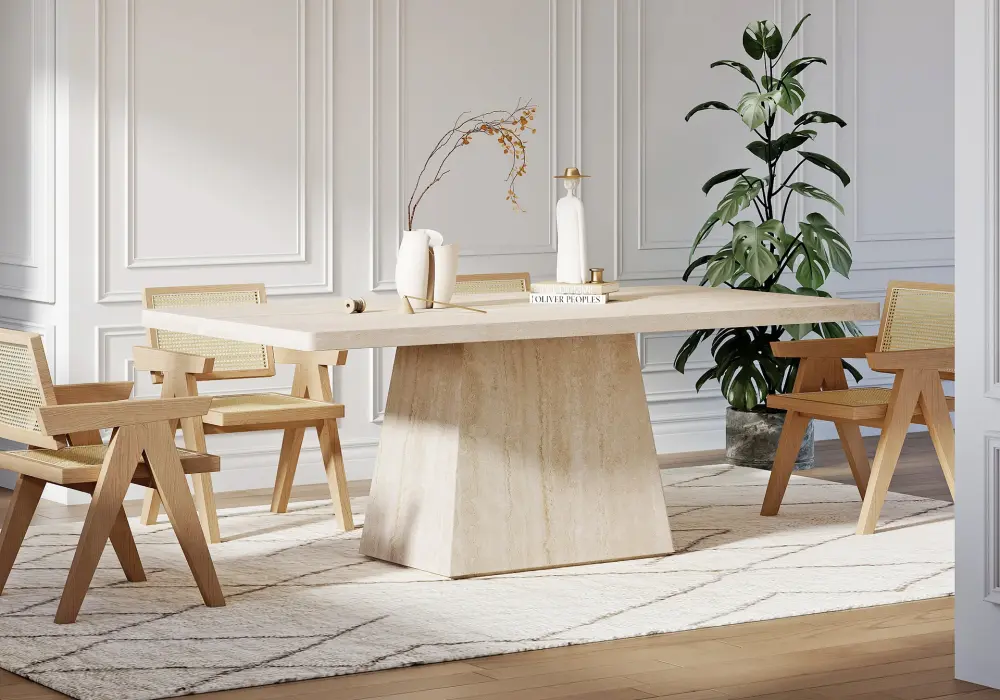
The 79" Rectangular Sintered Stone 6-Seater Dining Table is a good fit for a long, low centerpiece. A narrow band of greenery or a row of small groups can follow the table's length, and a stone top suits dry materials such as pinecones, ornaments, and flameless candles. If you plan to use water or fresh fruit, check the manufacturer's care instructions and use a tray or plate underneath. Leave breaks between groups for serving dishes, and check the end seats as well as the side seats.
Extendable tables
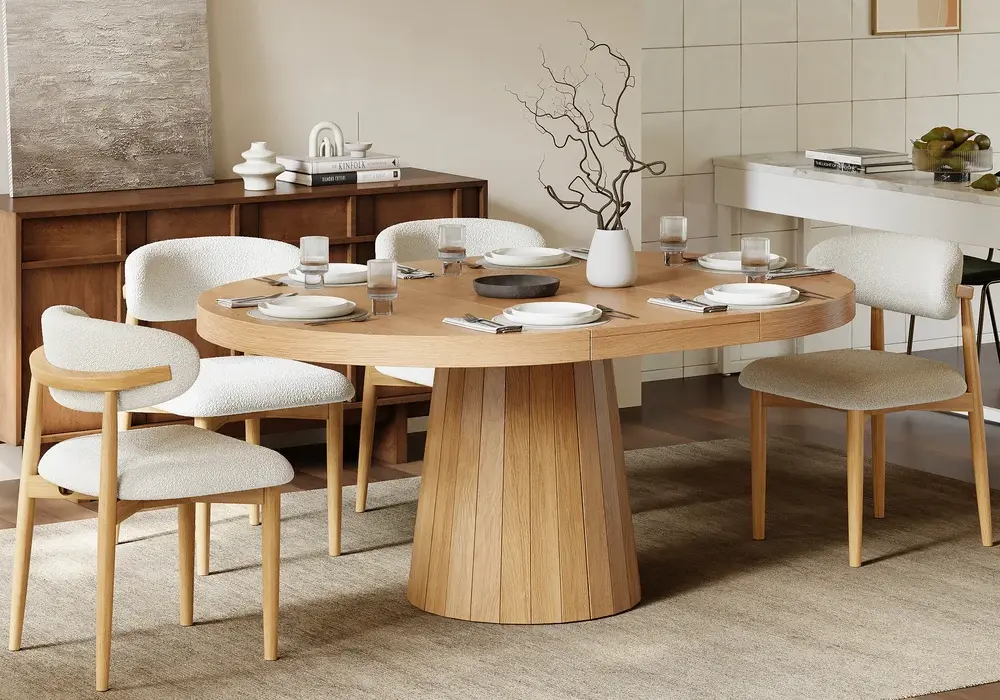
The Oakard Extendable Solid Wood Dining Table suits an arrangement made of separate small groups, because the groups can be moved apart when the table opens. Set the table to its dining size first, then place the groups. With a compact table, use one or two groups. With the leaf in, add a third or space them wider rather than stretching one large piece across the new surface. A wood top benefits from a tray, plate, or mat under anything that could scratch or leave moisture.
Round and oval tables
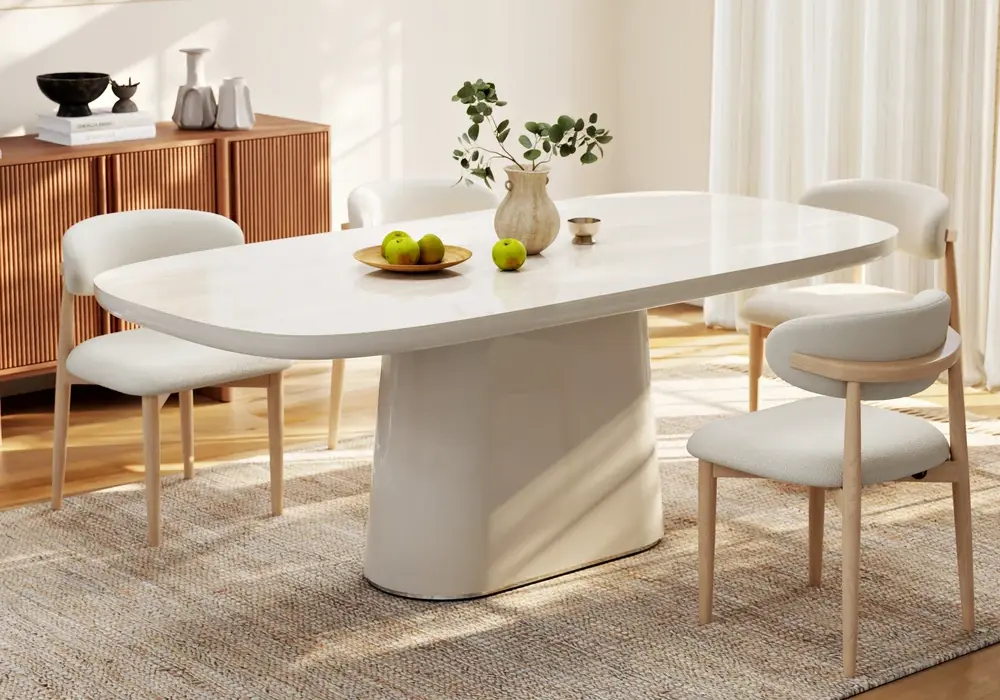
For a round table, begin with a compact central shape and avoid placing the display too close to one seat. The 79" Oval Sintered Stone 6-Seater Dining Table is a good fit for a short line of two or three small groups down the center, since an oval has no corners to crowd. Make the groups slightly smaller toward the curved ends so the end seats keep their space. The faux travertine texture adds warmth on its own, so one low greenery sprig with a flameless candle, or a single-color ornament bowl, is enough, and the sintered stone top stands up to daily use.
Set height and footprint limits for vases
A vase can establish a focal point, but its contents matter as much as the container. Stems that spread widely can undo a narrow opening, so check the complete outline from seated eye level. Choose a stable container that suits its contents. A decorative vessel is not automatically watertight, so protect the table as its manufacturer recommends, or go with a dry arrangement when water management is inconvenient. Keep the composition readable: one larger form with a few supporting details is enough, and repeating a finish from the dining room or a color from the place settings connects the centerpiece with its surroundings.
Add a candle-like glow with flameless candles
Flameless candles give a candle-like appearance without an open flame. Follow their instructions, choose a stable position, and keep loose batteries away from children and pets. Two lower groups are more comfortable than one tall cluster, since a tall center can interrupt conversation even if it looks elegant from the doorway. If you use a tray, choose it for a practical purpose: it moves several pieces together, but its handles and edges also take up space. Each piece should stay upright on its own rather than being balanced against another.
5 Christmas table centerpiece ideas that still leave room for dinner
The five ideas below put the vase and candle guidelines above into practice. Each can be scaled up or down. As a rule of thumb, keep the tallest element at or below roughly 12 inches so guests can see across the table, and adjust once you have sat at the table yourself.
- A low greenery strip. Lay short sprigs of pine, fir, or cedar in a narrow band along the center of a rectangular table. Tuck in a few pinecones, berries, or small ornaments, and keep the band slim enough that dishes can still sit on either side. Break it into two or three sections so a platter can fit between them.
- A tray trio. On a small tray, group a bud vase holding a few evergreen stems, a flameless candle, and one ornament or pinecone. The tray lets you lift the whole arrangement away when the main dish arrives. This works well on round and small tables where one compact group is enough.
- A single-color ornament bowl. Fill a low, wide bowl with ornaments in one color, such as red, gold, or white, and add a sprig of greenery. A dry arrangement avoids water spills and needs no maintenance during the meal. A matte finish keeps reflections down under evening light.
- Fruit and rosemary. Arrange oranges, apples, or pomegranates on a shallow dish with a few rosemary or fir sprigs. The colors look seasonal, the materials are inexpensive, and the dish can move to the sideboard when space is needed. Place a plate or liner under the fruit to protect the tabletop from juice.
- Separated mini groups for long tables. Repeat the same small vessel, such as a bud vase or candle holder, three to five times along the center with a sprig of greenery in each. Repeating one shape and color looks cohesive without a continuous runner. Keep gaps wide enough for a serving dish to fit between groups.
Adapt the idea to a budget and a smaller table
Review your existing containers and decorative pieces first. Choose a combination that shares a palette or material rather than purchasing a new collection. A centerpiece can feel intentional because of its proportions and placement even when its components were collected over time.
For a small table, edit the arrangement to one main detail. Use the napkins or dishes to carry additional seasonal color instead of adding another object. The centerpiece does not have to do all the visual work by itself.
For a large gathering, consider distributing decoration between the table and a sideboard. The table can remain quieter while the serving area carries a fuller display. Keep those roles separate enough that guests can understand where food, drinks, and decorative objects belong.
Set a spending limit before buying an accessory. Identify what is missing: a lower container, a coordinated textile, or perhaps no new item at all. Buying for a defined need is more useful than collecting small decorations until the table has no remaining service space.
Test the arrangement before guests arrive
Complete one place setting and one section of the centerpiece early, using the actual dishes if possible. Sit down, talk across the table, and pass a serving piece. This rehearsal shows whether the display's height and footprint suit the way you plan to eat.
Review the table under the evening lighting, since reflective objects and dark materials can look different after daylight fades. Finally, have a simple clearing plan. A low container on a removable base is easy to relocate, while several loose objects need more handling. Keep a space ready so the table can change naturally from an arrival display to a working dining table.
Frequently Asked Questions
How tall should a Christmas centerpiece be?
Choose a height that preserves comfortable views between the actual seats. Test the complete arrangement, including stems or other projecting details. A low display is often easier to keep during dinner, but the room and table should guide the decision.
What works on a round dining table?
Begin with a compact central group and leave a clear place setting for every guest. Avoid a broad arrangement that pushes dining items toward the edge. The complete meal layout matters more than the empty tabletop shape alone.
Can I combine vases and flameless candles?
Yes, if each piece is stable and the combined footprint leaves enough room. Repeat a color or finish to connect them. Follow the lighting product's instructions and confirm that any container is appropriate for its contents.
How do I decorate a long table?
Try separated low groups along the center with useful gaps for service. Repeat a limited palette to connect them. Check the end seats and adjust the arrangement when the table is extended or the guest count changes.
How can I create a centerpiece inexpensively?
Start with suitable containers and objects you already own. Limit the palette and focus on proportion. Let place settings carry some seasonal color so that the centerpiece can stay compact instead of requiring more purchases.