

A small-space round dining table works best when its diameter, base, and chairs fit the room’s daily circulation. Start with the number of people who eat there regularly, then compare dining tables using the full occupied footprint rather than the tabletop alone. A circle can soften a compact dining area, but it is not automatically more space-efficient than an oval or rectangle in every room.
The useful choice is the table you can leave in place without making ordinary movement awkward. Measure the doorways, kitchen route, and chair positions before choosing a finish. This guide centers on a compact fixed round table, then uses two larger tables to show where a round shape stops being a small-space solution and what to consider instead.
Table of Contents
Decide whether the room favors a circle
A round table has the same dimension in every direction. That can suit a roughly square nook or an open corner, where chairs can be arranged around the perimeter without creating a long axis. In a narrow room, however, that same diameter may project too far into the route.
Compare the open floor area with a circle and a narrow oval drawn at full size. A circle eliminates tabletop corners, while an oval may provide length with less depth. The best choice depends on which dimension is constrained and where people need to walk, rather than a general promise that round tables save space.
Think about the surrounding furniture too. A sideboard, radiator, window treatment, or projecting kitchen handle can reduce usable clearance. Measure the room as it is used, including anything that stays in place. Moving an essential item elsewhere is part of the plan, not a detail to postpone until delivery.
Measure the occupied footprint
Put a chair where you expect it to sit, then test sitting down, rising, and passing behind it. Repeat at the seats nearest a wall or doorway. A chair tucked neatly beneath the tabletop takes up less room than a person eating, and a product photograph often shows only the tidy position.
As an editorial mock-up starting point, you can test roughly 914 mm from the tabletop edge to a nearby obstruction for chair movement, then adjust for the actual chair, route, and household. That is not an accessibility certification or a guarantee that people can pass behind occupied seating. Busy routes and mobility needs require their own assessment.
Use the same measurement method for every candidate. If one table is evaluated with chairs occupied and another with chairs tucked in, the comparison will be misleading. Mark the tabletop first, then add chair use and circulation as separate layers so you can see what actually consumes the floor area.
Start with a fixed round table for a dedicated nook
For a genuinely small dining area, a fixed round table is the most straightforward place to start. You know where the surface ends every day, there are no leaves to manage, and the room can be arranged around one footprint. This suits households that usually eat together in small numbers and do their larger entertaining elsewhere.
The Modern 991 mm round gray wood dining table is the compact round option in this guide. It has a listed 991×991 mm footprint and a 762 mm height, and its pedestal-style base makes it a sensible candidate for a tight nook. Check where your chair legs and feet meet the base, and use your actual chairs and intended place settings to decide how many positions work comfortably.
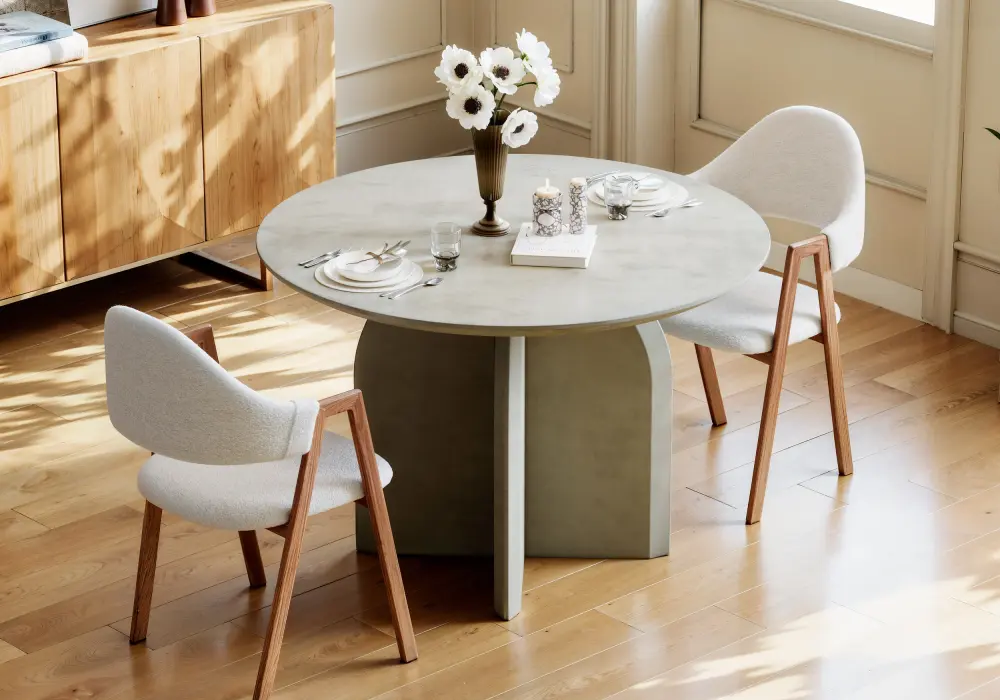
A pedestal can remove corner legs from the tabletop perimeter, yet its floor-level support can still occupy foot space. Check the base from above and from the seated position. Also measure whether chair arms can tuck beneath the top if that matters to your everyday arrangement.
Know where a round table stops being compact
Round tables do not stay small when they are made to seat more people. A useful way to judge your room is to look at a larger round-to-oval table and ask how much more floor it demands every day, not only on hosting nights.
The Modern 1194–2007 mm extendable whitewash dining table with a fluted base changes from round to oval according to its listing, and its detailed unextended dimensions are approximately 1200 mm across. That is substantially larger than a compact 991 mm round table, so treat it as a size reference rather than a small-space pick.
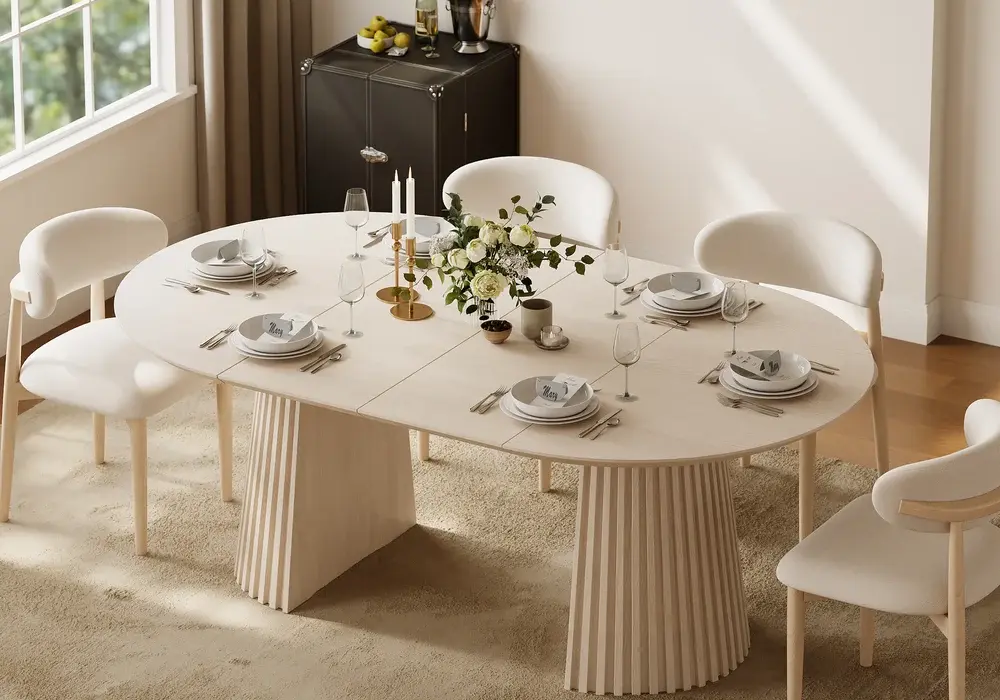
The two diameters differ by just over 203 mm, but the extra space is required across the room, not only along a wall. A pale finish may change the table’s visual presence while leaving the actual circulation requirement unchanged. If you regularly host five or six people and your room can handle this closed footprint plus the extended position, a table in this class may be worth testing. If the closed table already fills the nook, you have probably passed the point where a small-space round table is the right tool.
Keep an oval on the shortlist as a fallback
If the room is long and narrow, or a circle simply will not clear your route, the right alternative may be an oval rather than a smaller circle. You can gain length for place settings without using the same amount of depth as a broad round top. The base and chair arrangement still need an individual check.
The 1400 mm white sintered stone dining table with a three-leg base is listed with a 1400×749 mm footprint and an oval shape in its specifications. It is not a round option, but it shows what a narrow alternative looks like when depth is the limiting dimension. Mark its full length and each base position before deciding how chairs will sit around it.
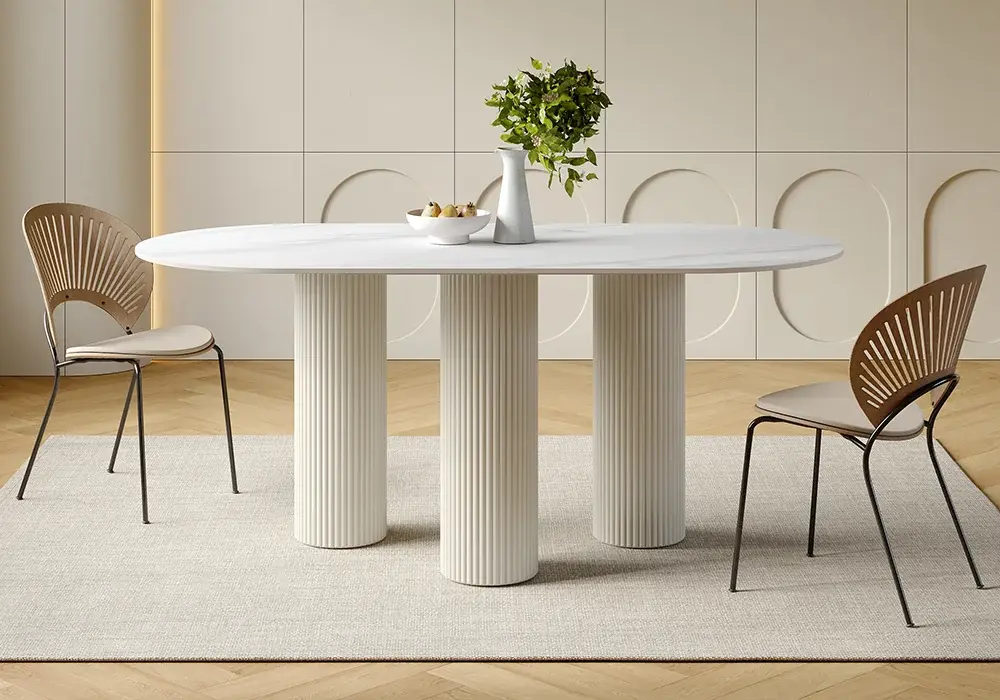
A narrower tabletop is not automatically better for every meal. Put down your usual plates and shared dishes within the proposed depth. If you regularly serve large platters in the center, a narrow surface may change the way you serve. The room plan and the meal routine need to work together.
Choose chairs that support the space plan
Compare overall chair width, depth, back angle, and arm height. A broad upholstered chair can occupy more of the perimeter and floor than a slim armless design. That does not make one better universally; it means the table’s advertised capacity cannot replace checking the chairs you intend to use.
Avoid treating benches or backless stools as automatic space savers. Think about comfort, how people enter the seat, and where the furniture sits when occupied. A chair that tucks in fully may be useful between meals, but its normal seated position still needs room.
If the table is used for work as well as meals, try a laptop and any materials you need. Check whether the surface is deep enough for that activity without leaving equipment near the edge. A small dining table can serve several purposes, but the dimensions should support those uses rather than merely accommodate them in a photograph.
Check delivery and care before choosing the finish
Measure the route into the home, including turns and stairs, and compare it with the packaged or separately carried components. A round tabletop can be awkward through a narrow route even when the finished dining area has enough space. Confirm the assembly requirements and arrange the help specified by the manufacturer.
Read the care instructions for the exact finish. Wood grain, veneer, painted finishes, and stone surfaces need different handling. Use protective accessories as directed and clean spills promptly according to the manufacturer’s guidance. Choose a surface you are comfortable maintaining during ordinary meals, not only one that looks right when unused.
Frequently Asked Questions
Is a round table always best for a small dining room?
No. A round table can suit a square nook, while an oval or narrow rectangle may fit a longer space more efficiently. Draw more than one shape at full size and add occupied chairs. The route through the room should decide the shortlist before style determines the final choice.
Is a 991 mm round table compact enough for an apartment?
It depends on the available floor area, chair dimensions, and circulation. The 991 mm tabletop is only the central footprint. Mark the seats and the space needed to rise and pass, then check nearby doors and furniture. Apartment size alone does not establish whether it fits.
Does a pedestal table give more legroom?
It may reduce interference from corner legs, but the pedestal and its floor support can still affect feet and chair placement. Inspect the base dimensions and position. Test every intended seat rather than assuming that the absence of four corner legs guarantees unrestricted space.
Should I choose a larger round-to-oval table for guests?
Only if the room can handle both configurations, and only if you accept that a table of this size is no longer a compact round table. Prioritize the closed position you use most days, then confirm the extension process, extra chairs, and occupied routes. If the closed footprint already crowds the room, a smaller fixed round table or a narrow oval is usually the more realistic choice.
How can I make a small dining area feel less crowded?
Start with a suitable footprint and chairs that fit the arrangement. Keep essential routes clear and decoration easy to move. A light finish, simple centerpiece, or visually open chair can affect the room’s appearance, but those choices cannot replace the physical space people need.