

Reclining sofas are designed around a simple promise: lean back, put your feet up, and let your body relax. For many people, that comfort is real. But recurring lower back pain can make you wonder whether spending hours in a recliner is quietly making the problem worse.
The answer is more nuanced than simply calling recliners “good” or “bad” for your back. Your posture, recline angle, lumbar support, body size, and how long you remain in one position can all affect comfort and spinal loading.
This guide explains how reclining sofas affect the spine, who may benefit from them, how reclined sitting compares with other resting positions, and how to create a more back-friendly setup. Persistent or worsening pain needs medical evaluation, not just a furniture change.
Table of Contents
How Reclining Sofas Affect Back Pain and Spinal Health
Reclining can reduce pressure on the lower back
When you recline, the backrest takes more of your upper-body weight. This can reduce the load carried directly through the pelvis and lumbar spine compared with unsupported upright sitting.
Classic biomechanical research found substantially lower lumbar disc pressure in a reclined posture. Later research has shown that spinal loading varies with posture, backrest support, and movement, so there is no single position that is ideal for everyone.
Your lumbar curve changes as you recline
Reclining changes the natural shape of the spine. MRI research has found differences in lumbar and cervical curvature between upright and reclined sitting, with individual variation between people.
A good reclining sofa should support the natural curve of the lower back rather than forcing it into excessive rounding or arching. This is why lumbar support matters as much as the reclining mechanism itself.
Lumbar support can reduce muscular effort
A supportive backrest can provide passive support while reducing the amount of effort required from the trunk muscles. Research suggests that backrests combined with moderate recline can reduce spinal muscle activity and disc pressure.
However, lower muscle activity does not automatically mean that using a recliner causes a weak core. Evidence is stronger for short-term biomechanical changes than for the claim that reclining directly causes long-term muscle weakness.
Prolonged sitting is the bigger concern
The more established issue is prolonged sedentary behavior. Research connects extended sedentary time with musculoskeletal discomfort, while breaking up long periods of sitting with movement may be beneficial.
The practical takeaway: reclining may ease discomfort for some people, especially during short periods of acute pain, but it should support—not replace—regular movement.
Who Benefits From Reclining Sofas?
People who need supported rest
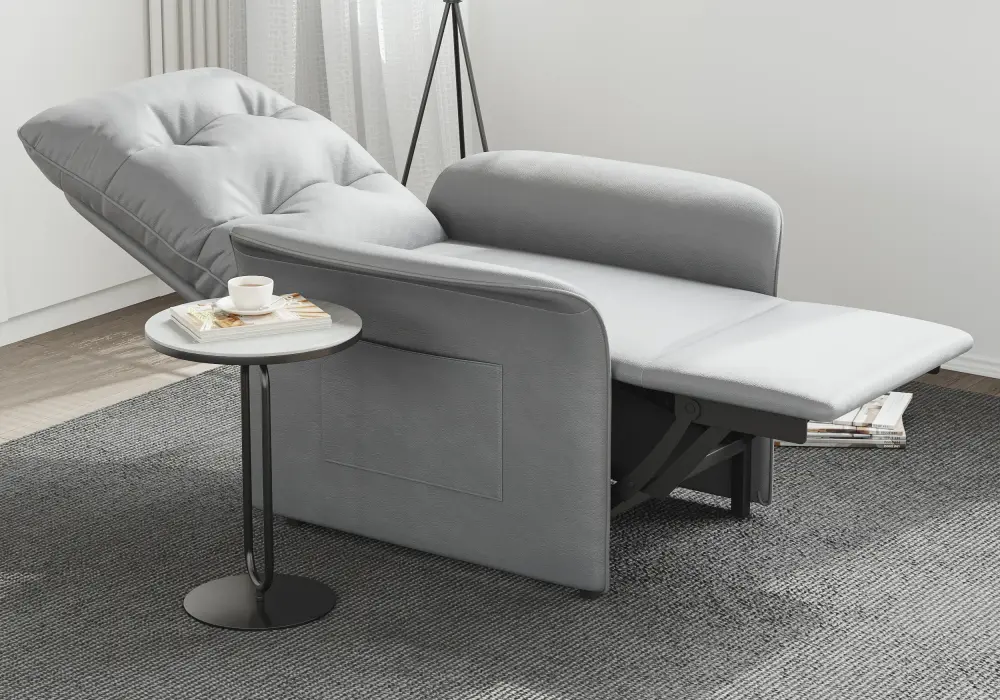
A semi-reclined position can make resting more comfortable when upright sitting feels unpleasant. The backrest and leg support can distribute body weight across a larger area instead of requiring the trunk to remain upright.
Older adults and people recovering from procedures
Some older adults value a recliner because it makes changing position and elevating the legs easier. People recovering from certain procedures may also be instructed to use supported resting positions. Any post-surgical positioning should follow the recommendations of the treating clinician.
People with temporary back pain
During an acute flare-up, finding a comfortable position can help you rest without constantly bracing your back. A recliner may be useful when a fully upright posture increases discomfort.
Who May Be More Sensitive to Recliner-Related Back Pain?
Existing back or disc problems
People with persistent low back pain or a history of disc-related symptoms may be more sensitive to certain seated positions. This does not automatically make reclining unsuitable, but it makes individual fit and symptom response more important.
Poor baseline posture and sedentary habits
A recliner can become less helpful when it encourages hours of uninterrupted sitting. A supportive chair cannot completely offset a lack of movement.
Furniture that does not fit your body
A seat that is too deep may encourage you to slide forward. A cushion that is excessively soft can let the pelvis sink. A backrest that is too short may leave the head unsupported when you recline.
Ergonomic guidance emphasizes selecting seating based on individual body dimensions rather than relying on one universal chair size.

Recliners vs. Other Resting Positions
Reclined sitting vs. upright sitting
Unsupported upright sitting can require more trunk stabilization and may produce greater lumbar disc pressure than supported reclining in some conditions. However, upright sitting also allows easy movement and changes of position.
Reclined sitting vs. lying flat
Lying flat changes the mechanical demands on the spine substantially and can feel better during some pain episodes. But it is not automatically the most comfortable option for every person.
Reclined sitting vs. standing
Standing generally avoids prolonged seated hip flexion and can reduce the time spent sedentary. However, standing for long periods is not a replacement for varied movement either.
Comfort depends on the individual
There is no universally “best” position for spinal health. A recliner can be a useful middle ground between sitting and lying because it combines back support with adjustable positioning.
Recliner Ergonomics for Better Back Support
Choose the right recline angle
Biomechanical research has examined reclined trunk positions around 110–130 degrees, with lower disc pressure and spinal muscle activity reported when adequate lumbar support is present. A practical starting point for everyday supported sitting is around 105–115 degrees.
For deeper relaxation, you can recline farther as long as your back and neck remain comfortable and supported.
Set the lumbar support correctly
The strongest part of the lumbar support should sit against the natural small of your back. As a starting point, many ergonomic systems place adjustable lumbar support roughly 15–25 cm (5.9–9.8 in) above the seat.
The exact height depends on your torso length, so adjust by feel rather than following a rigid measurement.
Check seat depth before buying
You should be able to sit fully against the backrest while leaving roughly 25–51 mm (1–2 in) between the seat edge and the back of your knees.
If the seat is too deep, you may slide forward to support your feet, leaving your lumbar area unsupported.
Match backrest height to your body
The backrest should support your lower back through at least the shoulder-blade area. If you prefer a deeper recline, a supportive headrest becomes increasingly important.
Fit factor | Practical starting point | Why it matters |
Recline angle | About 105–115° for everyday sitting | Provides support without forcing a rigid upright posture |
Lumbar support | Approx. 15–25 cm (5.9–9.8 in) above seat | Supports the natural lower-back curve |
Seat depth | About 25–51 mm (1–2 in) clearance behind knees | Helps maintain full back contact |
Backrest height | Lower back through shoulder-blade region | Supports the trunk and upper back |
Leg support | Feet and lower legs fully supported | Improves stability and relaxation |
Choose supportive cushioning, not excessive softness
There is no reliable medical formula that assigns one cushion firmness to a specific body-weight range. In general, lighter users may prefer softer cushioning, while heavier users often need more substantial support.
The key is whether the cushion lets you maintain a stable, comfortable position without excessive sinking.
Best Practices for Safe Recliner Use
Keep your hips, knees, and feet supported
Sit fully back instead of perching on the front edge. Keep your hips and knees in a relaxed position and support both feet or the leg rest.
When you recline farther, use the headrest so your neck does not have to hold your head forward.
Change position regularly
There is no universal evidence-based maximum sitting time. A practical habit is to change position or stand up about every 30–60 minutes when possible, and sooner if stiffness or discomfort develops.
Research continues to support the general principle of interrupting prolonged sitting, although the optimal frequency and duration of movement breaks are not fully established.
Pay attention to symptom changes
A position that feels comfortable at first but gradually produces more back or leg symptoms may not be suitable for long periods.
For people with sciatica or nerve-related pain, increasing leg pain, numbness, or weakness deserves particular attention.
Simple Exercises to Support Back Strength
Reclining can provide comfort, but your overall routine should also include regular movement and, when appropriate, strengthening exercises.
Level | Exercise | Starting point |
Beginner | Walking + gentle pelvic tilts | 5–10 minutes walking most days; 8–10 reps |
Intermediate | Glute bridges + bird-dog | 2 sets of 8–12 reps, 3–4 days/week |
Advanced | Squat-to-chair + hip hinge or loaded carry | 2–3 sets of 6–12 reps, 2–3 days/week |
These are general examples rather than individualized rehabilitation programs. Exercise-based approaches can improve pain and function for many people with chronic low back pain. (pubmed.ncbi.nlm.nih.gov)
Stop an exercise that causes a sharp increase in symptoms and seek professional advice when appropriate.
When Sciatica or Nerve Pain Needs Extra Attention
A comfortable reclined position may reduce symptoms for some people, but there is no single recline angle that treats sciatica.
Avoid forcing yourself into a position that increases radiating leg pain. More importantly, seek medical advice for persistent or worsening neurological symptoms.
Red-flag symptoms to take seriously
Urgent medical attention is appropriate for symptoms such as severe or worsening weakness or numbness in both legs, numbness around the genitals or anus, or new problems controlling or passing urine or stool. These symptoms can indicate serious neurological conditions.
How to Make a Reclining Sofa More Back-Friendly
A reclining sofa does not have to be bad for your back. Its adjustable position, back support, and leg elevation can make it a valuable part of a comfortable living space.
The goal is not to find one perfect posture and stay there. Instead, choose a sofa that fits your body, provides reliable lumbar and head support, and makes it easy to change positions throughout the day.
For your next sofa purchase, use a spine-health and recliner ergonomics checklist to evaluate seat depth, lumbar position, recline angle, backrest height, cushioning, and leg support. You can also sign up for practical exercise and posture tips to build a more movement-friendly routine.
When red-flag symptoms appear, medical evaluation should always come before a furniture change.
Frequently Asked Questions About Reclining Sofas and Back Pain
Can reclining sofas make lower back pain worse?
They can improve comfort for some people but aggravate symptoms in others. Poor fit, inadequate lumbar support, and prolonged inactivity are more important concerns than the simple fact that a sofa reclines.
What is the best recline angle for back support?
Around 105–115 degrees is a practical starting point for everyday supported sitting. Research has also examined wider ranges, including approximately 110–130 degrees, when suitable lumbar support is provided.
How high should lumbar support be?
The lumbar support should contact the natural curve of your lower back. A general starting range is about 15–25 cm (5.9–9.8 in) above the seat, but adjustment based on your body shape is more useful than a fixed measurement.
Who is most likely to experience back pain in a recliner?
People with existing back problems, poor posture, highly sedentary routines, or furniture that does not fit their body may be more likely to develop discomfort.
Is reclining better than sitting upright?
Reclining can reduce some spinal loading compared with unsupported upright sitting, but there is no universally superior position. Changing positions regularly is generally more useful than staying fixed in either posture.
How long can you sit in a recliner?
There is no universal safe time limit. A practical strategy is to move or change position about every 30–60 minutes and adjust sooner when stiffness or pain appears.
Can a recliner help sciatica?
A supported position may feel relieving for some people, but reclining is not a treatment for sciatica itself. Increasing leg pain, numbness, or weakness should be evaluated rather than managed solely by changing the chair position.
When should you stop using a recliner and see a doctor?
Seek prompt medical evaluation for progressive weakness, significant worsening numbness, numbness around the groin or anal area, or new bladder or bowel problems. Severe symptoms affecting both legs also require urgent attention.