

The best apartment size outdoor furniture fits the usable floor area while leaving the door, drainage, and main walking route clear. Start by choosing one primary activity, then compare outdoor furniture against a measured plan. A compact looking product is not necessarily small, and a modular set is not automatically suitable for a narrow balcony. Overall depth and the space needed to use each seat matter as much as width.
For an apartment, the buying decision begins before the furniture reaches the balcony. You also need an accessible delivery route, permission for the intended setup, and somewhere to keep cushions during prolonged bad weather. This guide focuses on those apartment specific constraints so the outdoor area becomes usable rather than crowded.
Table of Contents
Measure the usable balcony rather than the advertised area
Measure the length and depth at floor level, then repeat at the height where furniture backs and tabletops will sit. A railing, wall ledge, downpipe, or uneven corner can reduce usable space. Draw those features on a simple plan rather than treating the area as a perfect rectangle.
Mark the door swing, threshold, drainage outlets, and any access panel. If you have a sliding door, reserve the opening and the approach to it. If a hinged door opens outward, its full arc belongs in your plan before you position a chair.
Next, measure your preferred walking route from inside to the furthest usable seat. Around 30–36 inches can be a useful starting allowance for ordinary circulation, with more space where you carry trays or pass another person. This is a furniture planning suggestion, not an accessibility or emergency egress standard; building requirements take precedence.
Do not use a furniture layout to calculate whether a balcony is structurally suitable. If weight limits are uncertain, ask building management for the approved information. Furniture, occupants, planters, and stored items all contribute to the load, and the product photograph cannot answer that question.
Choose the activity that deserves the space
A balcony can support breakfast, reading, conversation, or outdoor meals, but a small one may not support all four comfortably. Write down what happens most often. Two people having coffee each morning need a different layout from four friends eating dinner twice a month.
For quiet lounging, prioritize a comfortable seat and a small reachable surface. For conversation, orient seats toward each other without closing the exit. For regular dining, start with the occupied chair positions around the table rather than its unoccupied footprint.
Avoid choosing a nominal seat count before choosing the activity. A four person set may be useful on a broad terrace, while a pair of genuinely comfortable seats may make better use of a balcony. Occasional visitors can sometimes be accommodated inside instead of determining the entire outdoor purchase.
Use an occupied footprint calculation
A furniture footprint shows where the frame touches the plan. An occupied footprint includes your legs, chair movement, table access, and circulation. The second measurement is the one that predicts daily comfort.
For a sofa facing a coffee table, add sofa depth, the reach gap, table depth, and the passage beyond the table if that is your only route. A starting gap of about 14–18 inches can work for reaching a low table, but test it with your height and furniture. It is not a through walkway.
For dining, allow chairs to move back and people to sit down. If the route passes behind occupied chairs, reserve more space than the distance needed simply to tuck them under. A table that fits against the railing when empty may be unusable once everyone sits.
Balcony condition | Layout worth testing | Main dimension to verify |
Long and narrow | Seating along one long edge | Depth left for passage |
Short and wide | Two seats angled inward | Door approach and legroom |
Broad corner terrace | Corner seating with an open side | Both sectional legs and table access |
Dining focused terrace | Table with chairs in use | Full occupied dining envelope |
Three featured products and the space they really need
The Tevara Outdoor Extendable Teak and Aluminum Dining Table is a dining option for a larger apartment terrace, rather than a default choice for a small balcony. Its listed overall dimensions reach 106 inches long by 39 inches wide at 30 inches high. Check both the closed and extended drawings before ordering; the maximum footprint alone does not establish the closed size.
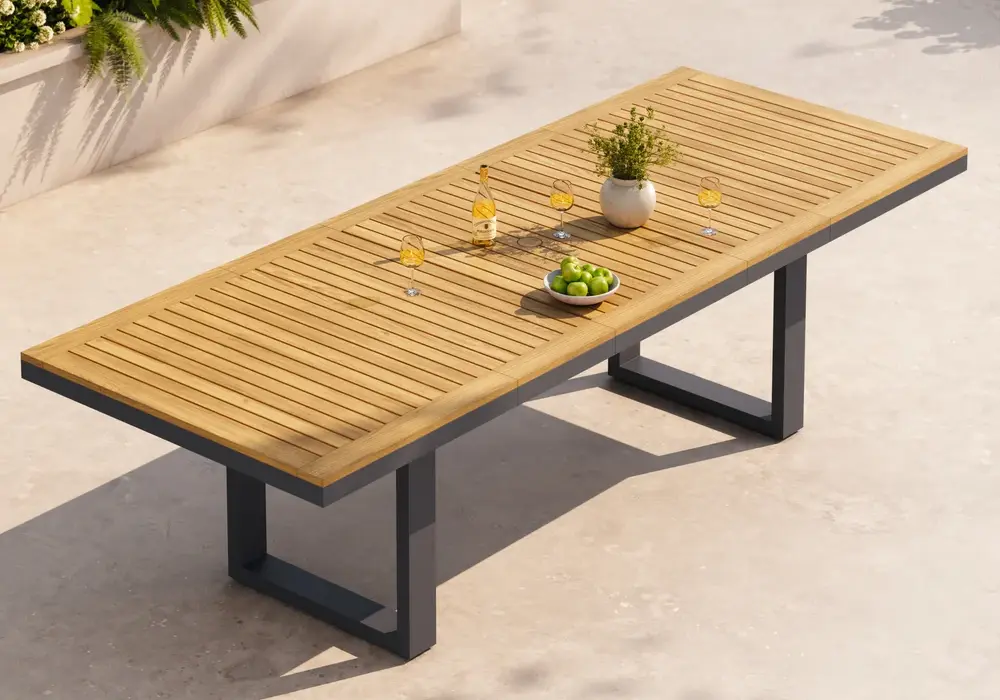
Its extension feature is useful only if the larger arrangement can actually be used. Tape the extended outline on the floor and place chairs around it. Confirm that opening the table does not turn the route to the door into a narrow gap behind seated guests.
The Costra Outdoor Handwoven Rope Sofa Set with Coffee Table has a listed sectional footprint of approximately 103.9 by 103.9 inches. That is a substantial corner arrangement. It may suit a generous apartment terrace, but it should not be described as balcony sized simply because it replaces several separate chairs.
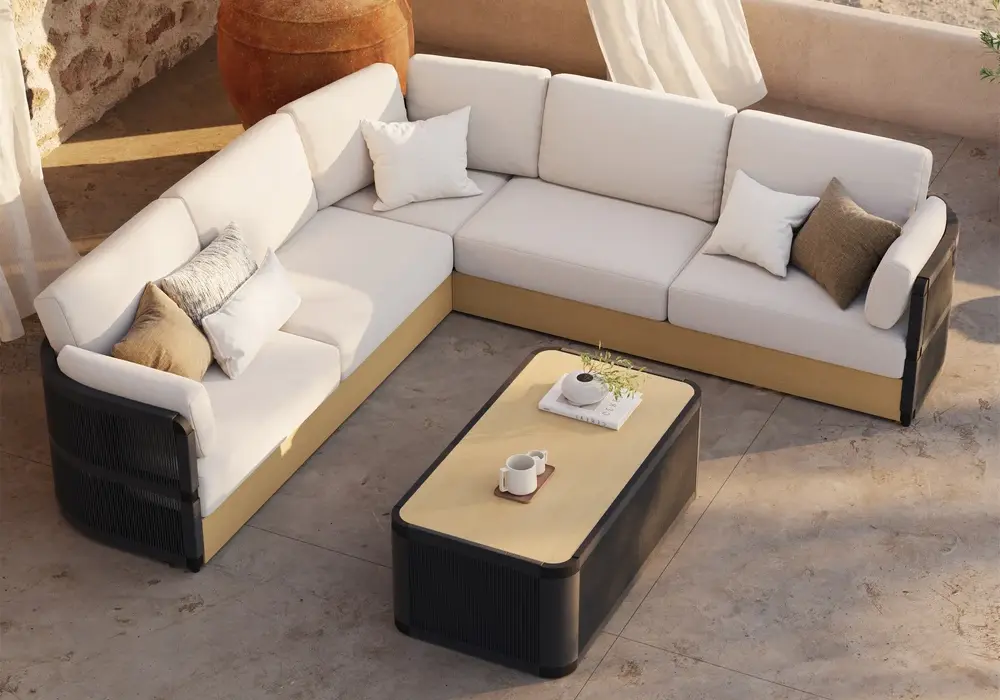
The accompanying table is listed at 47.2 by 25.6 inches. Include it in the plan rather than judging the sectional alone. Check which side remains open for arrival and whether every seated person can leave without stepping over someone else's legs.
The Martic Four Piece Outdoor Sofa Set offers a different planning approach: a sofa, separate chairs, and a coffee table. The listed sofa is 53.1 inches wide and 27.6 inches deep, while the chairs are approximately 27.6 inches square. Those individual dimensions make it easier to test an arrangement along the perimeter.
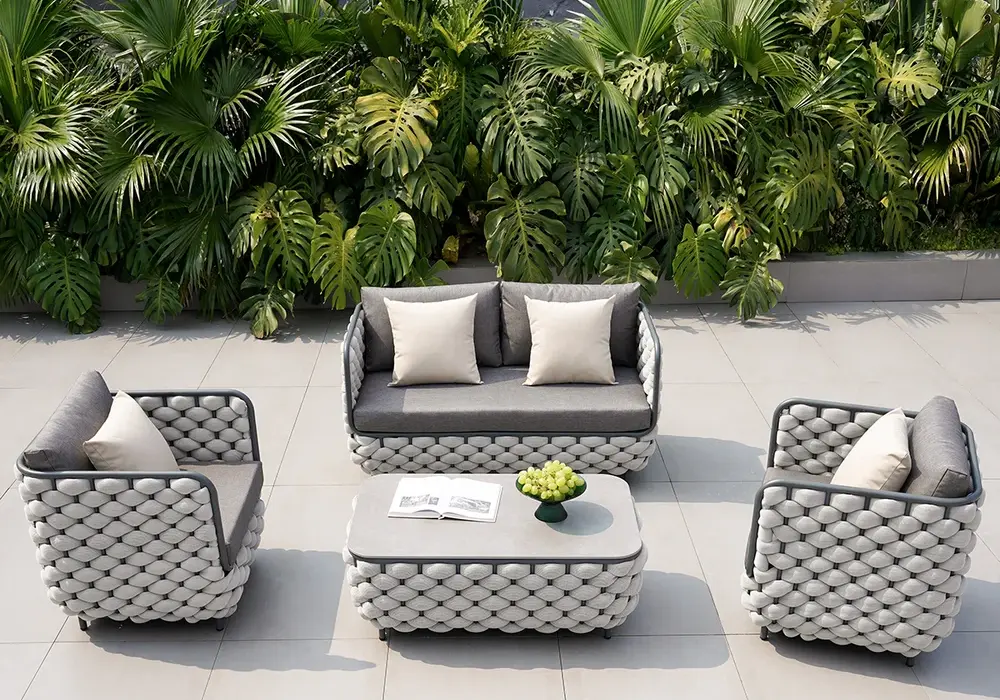
Separate pieces can be useful, but the whole set still needs an occupied plan. You may find that one chair belongs beside the sofa rather than directly opposite it. Keep the table reachable and the entry side open; do not squeeze every piece into a symmetrical display if it weakens circulation.
Check the journey from the street to the balcony
Measure the building entrance, elevator opening, elevator interior, apartment door, hallway turns, and balcony doorway. Compare them with the package dimensions, not just the assembled furniture dimensions. A narrow frame may arrive in a much larger carton.
Ask which components are assembled on site and which arrive as fixed sections. A modular label does not guarantee that the largest piece will turn through a short hallway. If the route is tight, provide the seller with the measurements and request written clarification before delivery.
Also plan the assembly location. Large components may need to be assembled outside because the finished frame cannot pass back through the door. Protect the floor without blocking drainage, keep fasteners contained, and arrange help according to the instructions and package weights.
Match materials to your apartment exposure
A sheltered balcony and an exposed upper floor terrace experience different conditions. Note direct sun, wind driven rain, nearby sea air, and the length of time cushions remain damp after a shower. Choose care requirements you can realistically maintain in that setting.
Aluminum frames are often convenient where furniture must be repositioned, but use the actual product weight rather than assuming every aluminum piece is light. Coatings, fasteners, and joints still need inspection and cleaning. Rope details also need a care routine that removes dirt without harsh scrubbing.
Wood brings warmth, but weather exposure can change its appearance. Follow the product's guidance for cleaning and any optional finish maintenance. Do not promise permanent color or maintenance free performance from the word teak alone.
For cushions, verify whether covers are removable and whether they can be machine washed. Those are separate features. Water resistance also does not mean that foam or seams can remain saturated indefinitely. Plan a dry storage location before buying deep cushions that have nowhere to go indoors.
Make a small area easier to live with
Choose one useful table rather than several surfaces that interrupt movement. Use a restrained palette if you want visual calm, but prioritize dimensions over color tricks. An airy frame can make furniture look lighter without reducing its actual depth.
Keep plants and accessories out of the path, and avoid placing climbable furniture against a railing. Secure lightweight accessories appropriately for your exposure and building rules. Do not attach or alter anything on the balcony without permission where that permission is required.
Before purchasing, simulate an ordinary evening. Open the door, carry out a drink, sit down, move past the occupied seat, and bring the cushions inside. A layout that passes that test is more useful than one that only fits neatly in a drawing.
Frequently Asked Questions
What counts as apartment size outdoor furniture?
There is no universal product size. It means furniture that suits your measured apartment outdoor area, access route, and intended activity. Compare exact dimensions and occupied space instead of relying on the label.
Can I fit a sectional on an apartment balcony?
Possibly, if both sectional legs, the table, and circulation fit. Large corner sets can require a broad terrace. Tape the complete arrangement before assuming a sectional saves space.
Is an extendable table suitable for a small balcony?
Only if both its normal and extended positions remain usable. Verify the closed dimensions, chair clearance, and access to the door. Extension flexibility cannot compensate for insufficient occupied space.
Should I buy all the matching pieces?
Buy the pieces you can use comfortably. A coordinated set can work well, but forcing an additional chair into the entrance can make the balcony less practical. Confirm what the selected package includes.
Where should apartment outdoor cushions be stored?
Use a clean, dry location that does not obstruct circulation. Let cushions dry before enclosing them. Check care labels before washing and avoid assuming removable covers are machine washable.
What should I measure first?
Start with the door opening and usable balcony depth. Then map the route through the apartment and the furniture's occupied footprint. Compare candidates only after those constraints are clear.